This year, my sister-in-law expressed an interest in riding in the Seattle-to-Portland (STP), a one- or two-day, 206 mile bicycle ride between (obviously) Seattle, Washington and Portland, Oregon. I've done the ride twice now, and last year my wife and my in-laws met me in Portland and we spent the next week vacationing on the Oregon coast.
I didn't want to push her into it, because I know how hard this ride can be, especially as one gets older. The first year I rode it, back in 2004, I hadn't trained at all and decided a couple of days before Why not? Let me tell you; 'why not' is one of those phrases that you pay for later, in spades. It was very tough, physically and especially mentally. There's nothing worse than being totally exhausted with 30 more miles to go, up hills and into headwinds. Last year I did train moderately and had several 50+ mile rides under my belt, and it was still hard. My Polar heart rate monitor showed that I burned over 14,000 calories in the two days; I believe it, because I was down over 2 lbs after a couple of days of recovery and full hydration. You simply can't eat enough to replace the calories you burn on such a ride.
Nevertheless, my sister-in-law was determined to do it, and so we went bike shopping for her in February, got her outfitted by early March (she picked up a Specialized Roubaix Elite), and we've been going on training rides since mid-March. All of this bicycling piqued my wife's interest in bikes again; we used to ride years ago before we got married but both quit for a while due to computer industry-related health issues (carpal tunnel syndrome) that made cycling too uncomfortable.
My solution to the discomfort problems was to go 'bent. I purchased my first recumbent, a Vision R32, back in 2003, and a year later bought my current bike, a Rans V-Rex. These short-wheelbase (SWB) bikes are very agile and fast, but also are different enough from a regular diamond-frame "wedgie" bike that there is a learning curve. Plus, unlike a regular bike, you cannot stand while climbing, meaning you have to spin, spin, spin! up hills.
To make a long story short(er), my wife saw how much fun we were having and wanted in on it. No problem I thought, and I went out and bought her some 1.5" slick tires for her mountain bike. They worked great, but the comfort issue was still there; she found cycling for more than 30 minutes uncomfortable and had the wrist and shoulder problems the next day that had caused her to quit years ago. What she needed was a new bike. So we went bike shopping.
She rode a SWB recumbent (a Bachetta Giro), and although she did well on it (she's very coordinated), it was different enough from a regular bike that she didn't want it. We looked at Rans' new line of crank-forward bikes next... and it was love at first ride. Although we both loved the Fusion, she realized that if she wanted to go for longer rides she needed the most efficient bike in the line, and chose the Zenetik. We've been going on rides for a couple of weeks now, whenever we can get someone to watch our son, and she's very happy with her choice.
Which leads me to the subject of this post: be careful what you ask for. My sister-in-law and I had made plans well in advance to get in a 50 mile ride early on Mother's Day so we could be back in time for the barbeque at their house. Then my wife threw a monkey wrench into our training schedule because she wanted to go on a ride, too, but not a long one. Okay I said, I'll ride on Sunday morning with your sister, and we'll get her to babysit while you and I ride Sunday afternoon.
Of course, things never go as scheduled. We got a late start on Sunday morning; I had to feed Las Tres Primas and fix my riding buddy's bike. A quick, and hard, 50 mile ride (with the last mile and a half being up a very steep hill) brought me home to one frowning spouse. Two granola bars and a bottle of Gatorade later, I threw our bikes in the back of the truck and off we headed for a local rail-trail (the Centennial Trail). A quick 10 miles up from Snohomish, yet another granola bar, and a quick 10 miles back.
By the time we got back I was pretty whupped, as they say where I was raised. Both sisters had no pity, and took great pleasure in teasing me about having to keep up with them. My reply: this isn't quite what I imagined when I fantasized about having two beautiful women arguing over who got to wear me out first.
I'm either going to be very fit, or very dead, in a very short while. As I said, be careful what you wish for....
Wednesday, May 17, 2006
Sunday, May 07, 2006
What If...
Whenever I have a problem that could be solved by more than one choice, I use the "What If..." method, as in, "What if I did this?" or "What if I did that?" I then look at the outcome, and use that outcome to rank my strategies, eliminate the losers, and then determine whether or not the solution fixes the problem at an acceptable price.
So, in an attempt to chase my blue funk away (a blue funk caused by the idiots running things), let's play "What If..." for a bit.
What if... Democrats regained control of the House of Representatives? Well, according to the Washington Post, Democrat leaders, joyfully anticipating just such a return to power through the combination of energized Democratic and disaffected Republican rank-and-file voters, are planning to use their regained authority to bring down the Bush Administration. How? By endless investigations and the filing of articles of impeachment. If the Democrats regain control of the Senate, then a conviction is a certainty.
What would this do to the country? I believe it would result in a civil war. The Democrats aren't looking for justice, just power, and as we learned during Monica Gate an impeachable offense is in the eye of the beholder. If the Majority Party has the political support from their base to impeach and convict, they will and whether or not justice is being done is irrelevant.
What would this do to our efforts in Iraq and elsewhere? That's a no-brainer. We'd be out of Iraq, and out of the Middle East, quicker than Teddy Kennedy could pull a twist-off from a bottle of Budweiser. The Iranians would move in almost as quickly, brutally suppressing any opposition, and replacing one form of dictatorial hell (Saddam's) with another. Iran would shortly thereafter control a swath of the Middle East stretching from Lebanon to the Pakistani border. They'd establish hegemonic control of the Gulf states via the threat of invasion. Israel would soon thereafter find itself fighting for its life, with Hamas leading the charge from the Gaza Strip and Hezbollah leading the charge from Lebanon. With no support from the US to fall back on, Israel would go nuclear, most likely after a first strike by the mullahs. What's that, you say? Iran doesn't have nukes? You're right... but Pakistan does and how long will the present government under Musharef last once we pull out of the Middle East?
What would this do to the War on Terror? Hmmm... an emboldened Iran, controlling 25% or more of the world's oil reserves plus the strategic chokepoint of the Straits of Hormuz, no US to oppose them, no counterbalancing Gulf states, the EU (as usual) as useless as ever... anyone want to bet that we wouldn't get another attack from a resurgent al Qaeda within a few years? Not to mention the hit we'd get from an Iranian-imposed embargo, or over $100-per-barrel price hike on oil, with all the money going to fund more weapons that will be used against us.
Here's my final "What If"... What If the Democrats actually cared more about doing the right thing than trying to seize power by any means available?
Hey, I can dream, can't I?
So, in an attempt to chase my blue funk away (a blue funk caused by the idiots running things), let's play "What If..." for a bit.
What if... Democrats regained control of the House of Representatives? Well, according to the Washington Post, Democrat leaders, joyfully anticipating just such a return to power through the combination of energized Democratic and disaffected Republican rank-and-file voters, are planning to use their regained authority to bring down the Bush Administration. How? By endless investigations and the filing of articles of impeachment. If the Democrats regain control of the Senate, then a conviction is a certainty.
What would this do to the country? I believe it would result in a civil war. The Democrats aren't looking for justice, just power, and as we learned during Monica Gate an impeachable offense is in the eye of the beholder. If the Majority Party has the political support from their base to impeach and convict, they will and whether or not justice is being done is irrelevant.
What would this do to our efforts in Iraq and elsewhere? That's a no-brainer. We'd be out of Iraq, and out of the Middle East, quicker than Teddy Kennedy could pull a twist-off from a bottle of Budweiser. The Iranians would move in almost as quickly, brutally suppressing any opposition, and replacing one form of dictatorial hell (Saddam's) with another. Iran would shortly thereafter control a swath of the Middle East stretching from Lebanon to the Pakistani border. They'd establish hegemonic control of the Gulf states via the threat of invasion. Israel would soon thereafter find itself fighting for its life, with Hamas leading the charge from the Gaza Strip and Hezbollah leading the charge from Lebanon. With no support from the US to fall back on, Israel would go nuclear, most likely after a first strike by the mullahs. What's that, you say? Iran doesn't have nukes? You're right... but Pakistan does and how long will the present government under Musharef last once we pull out of the Middle East?
What would this do to the War on Terror? Hmmm... an emboldened Iran, controlling 25% or more of the world's oil reserves plus the strategic chokepoint of the Straits of Hormuz, no US to oppose them, no counterbalancing Gulf states, the EU (as usual) as useless as ever... anyone want to bet that we wouldn't get another attack from a resurgent al Qaeda within a few years? Not to mention the hit we'd get from an Iranian-imposed embargo, or over $100-per-barrel price hike on oil, with all the money going to fund more weapons that will be used against us.
Here's my final "What If"... What If the Democrats actually cared more about doing the right thing than trying to seize power by any means available?
Hey, I can dream, can't I?
Tuesday, May 02, 2006
Solving The Immigration Crisis
Yesterday, Hispanic immigrants (both legal and illegal) engaged in a multi-city organized effort (organized by leftist groups including International ANSWER and the Socialist Workers' Party, eager to support and exploit any cause that weakens America) to demand a relaxation of US immigration laws and for unconditional amnesty for illegal aliens.
The worst thing we can do at this point is to accede to their demands. However, this view is not universally held; news sites have been reporting the Senate is evidently considering another attempt at "revamping" our immigration laws (ht: Drudge Report). What is wrong with our leaders... of both parties??!!
This country doesn't need uneducated workers who are a drain on the social welfare system. This type of immigrant only benefits the exploitative employer, while the rest of us subsidize that employer due to higher social services costs. We may save on produce and landscaping, but we pay higher taxes.
What we need are, often times, the very workers who are disadvantaged by our immigration laws and policies. Here's one example: an Indian software engineer with a post-graduate education is severely restricted by our immigration policies. If she obtains a job in America's high-tech industry, she is locked into that one job and, if she wants a green card (permanent resident status) or US citizenship, the waiting period will be reset if her job title changes. That means she cannot switch jobs, and she cannot accept a promotion. She must work at least seven years at the same position, at the same company, before she can apply for a green card. Meanwhile, she must pay thousands of dollars each year in expenses to maintain her H1B visa, in fees to Indian companies to fill out paperwork and file forms, and in lost work time and travel expenses to return to India to visit the US Embassy in order to extend her visa.
Nearly all of the legal immigrants I know, especially the more-educated ones who want to become US citizens and who are following the rules, are incensed at the protesters, and the protests. They wonder why they should follow the law, especially when they think of the possibility of illegals getting a jump on the all-important green card, and they feel like fools. It's not a laughing matter; many of these people who are trying to obtain the American Dream the right way through hard work and education become clinically depressed when they realize that at least a decade of their lives must be spent 'on hold' in a stagnant career position if they wish to follow the path to citizenship.
My solution:
The worst thing we can do at this point is to accede to their demands. However, this view is not universally held; news sites have been reporting the Senate is evidently considering another attempt at "revamping" our immigration laws (ht: Drudge Report). What is wrong with our leaders... of both parties??!!
This country doesn't need uneducated workers who are a drain on the social welfare system. This type of immigrant only benefits the exploitative employer, while the rest of us subsidize that employer due to higher social services costs. We may save on produce and landscaping, but we pay higher taxes.
What we need are, often times, the very workers who are disadvantaged by our immigration laws and policies. Here's one example: an Indian software engineer with a post-graduate education is severely restricted by our immigration policies. If she obtains a job in America's high-tech industry, she is locked into that one job and, if she wants a green card (permanent resident status) or US citizenship, the waiting period will be reset if her job title changes. That means she cannot switch jobs, and she cannot accept a promotion. She must work at least seven years at the same position, at the same company, before she can apply for a green card. Meanwhile, she must pay thousands of dollars each year in expenses to maintain her H1B visa, in fees to Indian companies to fill out paperwork and file forms, and in lost work time and travel expenses to return to India to visit the US Embassy in order to extend her visa.
Nearly all of the legal immigrants I know, especially the more-educated ones who want to become US citizens and who are following the rules, are incensed at the protesters, and the protests. They wonder why they should follow the law, especially when they think of the possibility of illegals getting a jump on the all-important green card, and they feel like fools. It's not a laughing matter; many of these people who are trying to obtain the American Dream the right way through hard work and education become clinically depressed when they realize that at least a decade of their lives must be spent 'on hold' in a stagnant career position if they wish to follow the path to citizenship.
My solution:
- Build the damn fence, already!
- (here's the big one) Change the law so that only children born to parents who are legally in the US as permanent residents or US citizens are themselves granted US citizenship.
- Force state and local authorities to enforce existing immigration laws, or lose all federal funds. That means police must ascertain whether people are legal immigrants, must detain those who aren't, and must turn these people over to US Immigration for deportation. That also means that employers must be held civilly and criminally responsible for hiring illegal workers.
- Allow legally-employed H1B visa holders to switch positions or employers without having to restart the waiting period for a permanent visa. This encourages educated, professional immigrants to become stakeholders, and eventually citizens, in the US.
- Restrict permanent visas to those who have held gainful, legal employment for a period of seven consecutive years, and who have made high enough wages to be required to pay income tax, with an exemption for those who have served in the US military. Each day of unemployment adds a day to the waiting period, and unemployment for sixty days, or one hundred twenty days in two years, results in cancellation of your H1B visa and deportation. If you can't find a job, we don't want you.
- Only US citizens can draw Social Security, but all employees must pay Social Security taxes. Legal immigrants' contributions to Social Security are credited to them upon achieving citizenship.
- Once all of this is done, then we need to create a guest worker program so that foreign nationals can come for a limited duration to work in our country and then return to theirs.
We need to remove the incentives for illegal immigration and increase the penalties, and we need to make it harder to get away with.
The only question is, do we as a country have the decisiveness to pull it off? Or, have we lost the national will to insist that foreigners obey our laws, or leave?
Friday, April 14, 2006
Famous Last Words...
“I’m the only one in this room, that I know of, professional enough to carry this Glock .40.”
Those are the words of DEA agent Lee Paige immediately before shooting himself in the foot in front of a classroom full of at-risk youth during a drug education presentation. The video is here.
Those are the words of DEA agent Lee Paige immediately before shooting himself in the foot in front of a classroom full of at-risk youth during a drug education presentation. The video is here.
Mr. Paine is suing his employer, the DEA, and by extension the U.S. government, for “emotional and mental pain and suffering, mental anguish, loss of enjoyment of life, loss of reputation, loss of opportunity, loss of money, embarrassment, humiliation and anxiety.” From the video, it seems apparent that the only person to blame for Mr. Paine’s humiliation, embarrassment, etc., is himself.
My first question, after watching the video, was “What in the Hell was a trained law enforcement agent doing handling a loaded firearm in a classroom full of children??!!” My second question was “Why on Earth was this clown ever tasked with talking to children about drugs and guns?”
I watched Mr. Paige clear his gun. He walks off stage after he racks the slide, but I never see him withdraw the magazine. Obviously, all racking the slide is going to do is eject the chambered round, and when Mr. Paige closes the slide in front of the class he chambers the next round from the still-loaded magazine. Mr. Paige doesn’t visually or tactilely verify that the chamber is empty and the magazine is removed, nor does he bother to check the chamber again before pulling the trigger on his ‘assumed-to-be-unloaded’ Glock. Thank God he had enough sense to point it away from the children before he pulled the trigger, but I guess he didn’t care enough about his own personal safety to refrain from pointing the gun at his body.
Pride goeth before a fall; we’ve all done things that we wish we hadn’t. However, Mr. Paige did many things that he definitely shouldn’t, most likely because he was feeling a little too full of himself. We all know people like this, but when it comes to gun safety don’t be “that guy.”
Remember the Four Rules of Gun Safety:
• All guns are always loaded.
No one ever got shot with an unloaded gun, but many people have been shot with a gun that was assumed to be unloaded... including Mr. Paige. Treat every gun as if it’s loaded regardless of whether you just cleared it and you know there’s no way on Earth it could be loaded. The life, or foot, or embarrassment you save may be your own.
• Never point a gun at anything you aren’t willing to see destroyed.
If you value your TV set, or your friend, or your foot, then don’t point a gun at them. You can’t call a bullet back, and while you can replace a TV set and, perhaps, heal from a bullet wound, you can’t bring back life either, or recover from a crippling wound. Especially when dry-firing, or decocking an unloaded gun, remember Mr. Paige, and point that gun at something that doesn’t matter if it gets hit by a bullet, and that will capture that bullet.
• Keep your finger off the trigger until your sights are on the target.
Guns are like computers, in that they do what we tell them to do instead of what we want them to do. Pulling the trigger tells a gun to fire; touching the trigger is confusing to a gun... do you want it to fire, or not? Don’t confuse the gun, or yourself. Don’t touch the trigger unless you are sure that activating the firing mechanism is okay and the gun is pointed at an appropriate target (backstop, target, bad guy) so if it discharges no harm is done.
• Be sure of your target, and what is behind and beyond your target.
Is that a bad guy you’re getting ready to shoot, or your teenage son who stayed out a little late and had a few beers? Is your hunting partner on the other side of that bush the pheasant is flying past? Where will that bullet end up if you miss your target, or if you hit your target and the bullet penetrates? Know where your bullet will end up before pulling the trigger... or don’t pull the trigger.
All of these rules are simple, the simple distillation of six centuries of bitter experience. Break any one of them and you’re likely to inadvertently discharge your firearm. Break more than one and you’re likely to kill someone, or yourself, when you inadvertently discharge your firearm.
Accidents are the result of a chain of events that end at the incident. Break the chain and you prevent the incident. Mr. Paige broke two of these rules and ended up with a battered ego and a painful injury. He was lucky. Don’t count on luck.
If I were Mr. Paine, I’d quietly abandon my lawsuit, and work within the Law Enforcement community as an evangelist for gun safety. I’d use my misfortune as a learning experience so others wouldn’t make the same mistake. Mr. Paine was a high school and college football player, deputy sheriff and DEA agent, a physically big man... and he needs to be a bigger man and accept the responsibility for his problems.
Friday, March 10, 2006
The Thousandth Woman: Dana Reeve 1961-2006
I saw the news report about the death of Dana Reeve earlier this week, and was shocked and saddened. Fate never went halfway with the Reeve family, nor did it give them a break.
They were two people who had everything: fame, wealth, athletic good health, career success, a happy marriage and a healthy child. And then, one day, you go out to ride on your horse the way you've done it for years, and you don't ride back home because you've fallen and broken your neck. You'll never ride, or walk, again. You're stuck in a wheelchair, a prisoner of your useless, paralyzed body; what was once finely-tuned muscle and bone is transformed into so much useless meat. You don't even have the ability to take your own life. You are totally at the mercy of others.
I understand that, sometime after the realities of the situation sank in (he was doomed to live a few years at best, as a quadraplegic with many health problems, any one of which would most likely kill him sooner rather than later), Christopher told his wife Dana that she should end their marriage, take their child and the vast majority of their assets, and try to start her life again with someone else. She reminded him of their wedding vows of "for better or for worse," turned down his offer, and stuck with him to the end.
Kipling's "The Thousandth Man" begins, "One man in a thousand... will stick more close than a brother." Finding someone you can truly count on in life is that rare, but by all indications Dana Reeve was that "Thousandth Woman." Rest in Peace.
They were two people who had everything: fame, wealth, athletic good health, career success, a happy marriage and a healthy child. And then, one day, you go out to ride on your horse the way you've done it for years, and you don't ride back home because you've fallen and broken your neck. You'll never ride, or walk, again. You're stuck in a wheelchair, a prisoner of your useless, paralyzed body; what was once finely-tuned muscle and bone is transformed into so much useless meat. You don't even have the ability to take your own life. You are totally at the mercy of others.
I understand that, sometime after the realities of the situation sank in (he was doomed to live a few years at best, as a quadraplegic with many health problems, any one of which would most likely kill him sooner rather than later), Christopher told his wife Dana that she should end their marriage, take their child and the vast majority of their assets, and try to start her life again with someone else. She reminded him of their wedding vows of "for better or for worse," turned down his offer, and stuck with him to the end.
Kipling's "The Thousandth Man" begins, "One man in a thousand... will stick more close than a brother." Finding someone you can truly count on in life is that rare, but by all indications Dana Reeve was that "Thousandth Woman." Rest in Peace.
Friday, February 10, 2006
Mental Gumbo
I haven't blogged as much as I should be, so here's some ponderings that have occupied thirty seconds here or there recently, all thrown together.
What on Earth is up with those Muslim idiots who are rioting all over Europe and the Middle East because of a few cartoons lampooning Mohammed? Don't they realize how ironic it is for people who protest the depiction of their Prophet as a man who encouraged violence to go around rioting and threatening violence? I guess if the shoe fits.... And what is up with the Iranian government lauding a newspaper contest that lampoons the Holocaust? Do they think the Jews are going to start burning down embassies in Tel Aviv, or have large protests in Miami Beach or Westchester? I know a few Muslims and, to a person they're appalled at this behavior. When will the rest of the Muslim world grow up? (When the rest of the civilized world stops indulging them and instead tells them this behavior will not be tolerated. What's up with Britain allowing Muslims to march with signs that incite violence? Why weren't all those Muslims arrested?)
I really felt for President Bush and his wife Laura, having to sit there quietly at Coretta Scott King's funeral while Jimmy Carter, the man who is really trying to ensure that Bill Clinton is not the most ridiculous living ex-president, a man whose performance as president was so woefully lacking, and so widely recognized, that he carried only one state in his contest for re-election, a man whose bumbling put the Ayatollahs in power in Iran and allowed North Korea to develop nuclear weapons unimpeded, impugned his judgement and character. Of course, you have to consider the source: Jimmy Carter loved Yassir Arafat, praises Hugo Chavez, and respects Fidel Castro. On second thought, maybe having Jimmy Carter insult you is a sign that you're doing something right. Question: how do you know if something is a good idea? Answer: If Jimmy Carter is vehemently opposed to it.
I haven't commented on the sordid Senate performance during the Alito confirmation, and this week's hearings on the NSA terrorist surveillance program is equally distasteful. Two months ago the Democrats were giddy with expectations of taking control of at least one house of Congress; today all of that joy has turned to ashes. They haven't got a snowball's chance in Hell of regaining political power at the federal level, and they realize it, and so do their large donor supporters (that's why the DNC has $5 million in the bank as opposed to $35 million for the GOP). But they don't understand why. Sure, they realize that America doesn't trust the Democrats when it comes to national security, but they just think it's a perception problem... that if people really knew in their hearts how the Democratic Party leaders really cared about national security then everything would be okay. They just don't get it, and I believe they're psychologically incapable of 'getting it.' That's why the Republicans, despite their screwups, will most likely win even more seats in both the Senate and House. Remember, you read it here first. What about the Abramoff scandal, you ask? That's going to die down, because the Republicans have Kryptonite in the form of two simple words: "Harry Reid." Glass houses and all that....
How about New Orleans? Mayor Nagin's on a roll... first declaring that the city must remain "chocolate" and then threatening to get aid from other nations, among them France. Someone needs to get the recall petition drive in high gear before the Mayor makes even more of an ass of himself... if that's possible. The Democrat-controlled city and state governments deliberately held back food and water to increase the suffering of those trapped at the Superdome immediately after Katrina in the belief that it would motivate them to want to leave New Orleans as quickly as possible without resistance... and they got what they wanted in spades. Here's what Nagin doesn't seem to understand: you have a lot of "chocolate" ex-New Orleaneans who don't want to go back because what they left wasn't all that great in terms of quality of life, opportunities, or respect. They've lost everything, and this seems like as good a chance as any to start over somewhere, perhaps in a city where they're not stereotyped as "chocolate" and can aspire to something besides low-level service jobs in the tourist industry. It will be decades before New Orleans recovers, if ever. And, by the way, if Nagin is waiting for France to bail him out... well, just ask Saddam what happens when you place all your hopes in the French.
And finally, Iran. What can I write about Iran that I already haven't (here and here)? A showdown's coming, because Iran wants a showdown. The ayatollahs really think we'll fold when the pot gets too big; in fact, they're counting on it. They don't understand America, and Americans, and George W. Bush. The Chinese thought we'd fold, too... and lost a million men including Mao's son in a year's combat in Korea (that's why they didn't get involved in Vietnam). Saddam thought we'd fold, twice. I can understand the first bluff, but after we totally kicked his butt in 100 hours one would think he'd learn not to underestimate the Americans. Didn't he also realize that, while the French and Germans could be bought, George W really didn't give a fig what they thought? And, the jury's still out on WMDs, by the way. I think he had 'em, and either they're still buried (likely) or that the Syrians got 'em (likely). Saddam didn't have tens of thousands of chemical weapons suits and nerve gas antidotes stockpiled for nothing.
Back to the subject at hand. Iraq is going to do their durndest to get a nuke as quickly as possible. The lesson they learned from the two wars in the Gulf and watching North Korea was that the only way to keep the Americans out of your country was to have a nuke to threaten us with. But, they don't get it either. The very thing they're trying to stop (us attacking them) is what they're provoking. They don't seem to understand that the US, now joined by the EU, realizes that if Iran is allowed to develop a nuke without serious consequences, then every dirtbag country with a two-bit dictator is going to want one. The West has drawn a line in the sand, and we have to stand up now and back up our words with actions or accept the fact that backing down means we will suffer a nuclear attack in the near term.
In my opinion, things are going to get worse before they get better, but sufficient unto the day is the evil thereof. Thank God I was born in America!
What on Earth is up with those Muslim idiots who are rioting all over Europe and the Middle East because of a few cartoons lampooning Mohammed? Don't they realize how ironic it is for people who protest the depiction of their Prophet as a man who encouraged violence to go around rioting and threatening violence? I guess if the shoe fits.... And what is up with the Iranian government lauding a newspaper contest that lampoons the Holocaust? Do they think the Jews are going to start burning down embassies in Tel Aviv, or have large protests in Miami Beach or Westchester? I know a few Muslims and, to a person they're appalled at this behavior. When will the rest of the Muslim world grow up? (When the rest of the civilized world stops indulging them and instead tells them this behavior will not be tolerated. What's up with Britain allowing Muslims to march with signs that incite violence? Why weren't all those Muslims arrested?)
I really felt for President Bush and his wife Laura, having to sit there quietly at Coretta Scott King's funeral while Jimmy Carter, the man who is really trying to ensure that Bill Clinton is not the most ridiculous living ex-president, a man whose performance as president was so woefully lacking, and so widely recognized, that he carried only one state in his contest for re-election, a man whose bumbling put the Ayatollahs in power in Iran and allowed North Korea to develop nuclear weapons unimpeded, impugned his judgement and character. Of course, you have to consider the source: Jimmy Carter loved Yassir Arafat, praises Hugo Chavez, and respects Fidel Castro. On second thought, maybe having Jimmy Carter insult you is a sign that you're doing something right. Question: how do you know if something is a good idea? Answer: If Jimmy Carter is vehemently opposed to it.
I haven't commented on the sordid Senate performance during the Alito confirmation, and this week's hearings on the NSA terrorist surveillance program is equally distasteful. Two months ago the Democrats were giddy with expectations of taking control of at least one house of Congress; today all of that joy has turned to ashes. They haven't got a snowball's chance in Hell of regaining political power at the federal level, and they realize it, and so do their large donor supporters (that's why the DNC has $5 million in the bank as opposed to $35 million for the GOP). But they don't understand why. Sure, they realize that America doesn't trust the Democrats when it comes to national security, but they just think it's a perception problem... that if people really knew in their hearts how the Democratic Party leaders really cared about national security then everything would be okay. They just don't get it, and I believe they're psychologically incapable of 'getting it.' That's why the Republicans, despite their screwups, will most likely win even more seats in both the Senate and House. Remember, you read it here first. What about the Abramoff scandal, you ask? That's going to die down, because the Republicans have Kryptonite in the form of two simple words: "Harry Reid." Glass houses and all that....
How about New Orleans? Mayor Nagin's on a roll... first declaring that the city must remain "chocolate" and then threatening to get aid from other nations, among them France. Someone needs to get the recall petition drive in high gear before the Mayor makes even more of an ass of himself... if that's possible. The Democrat-controlled city and state governments deliberately held back food and water to increase the suffering of those trapped at the Superdome immediately after Katrina in the belief that it would motivate them to want to leave New Orleans as quickly as possible without resistance... and they got what they wanted in spades. Here's what Nagin doesn't seem to understand: you have a lot of "chocolate" ex-New Orleaneans who don't want to go back because what they left wasn't all that great in terms of quality of life, opportunities, or respect. They've lost everything, and this seems like as good a chance as any to start over somewhere, perhaps in a city where they're not stereotyped as "chocolate" and can aspire to something besides low-level service jobs in the tourist industry. It will be decades before New Orleans recovers, if ever. And, by the way, if Nagin is waiting for France to bail him out... well, just ask Saddam what happens when you place all your hopes in the French.
And finally, Iran. What can I write about Iran that I already haven't (here and here)? A showdown's coming, because Iran wants a showdown. The ayatollahs really think we'll fold when the pot gets too big; in fact, they're counting on it. They don't understand America, and Americans, and George W. Bush. The Chinese thought we'd fold, too... and lost a million men including Mao's son in a year's combat in Korea (that's why they didn't get involved in Vietnam). Saddam thought we'd fold, twice. I can understand the first bluff, but after we totally kicked his butt in 100 hours one would think he'd learn not to underestimate the Americans. Didn't he also realize that, while the French and Germans could be bought, George W really didn't give a fig what they thought? And, the jury's still out on WMDs, by the way. I think he had 'em, and either they're still buried (likely) or that the Syrians got 'em (likely). Saddam didn't have tens of thousands of chemical weapons suits and nerve gas antidotes stockpiled for nothing.
Back to the subject at hand. Iraq is going to do their durndest to get a nuke as quickly as possible. The lesson they learned from the two wars in the Gulf and watching North Korea was that the only way to keep the Americans out of your country was to have a nuke to threaten us with. But, they don't get it either. The very thing they're trying to stop (us attacking them) is what they're provoking. They don't seem to understand that the US, now joined by the EU, realizes that if Iran is allowed to develop a nuke without serious consequences, then every dirtbag country with a two-bit dictator is going to want one. The West has drawn a line in the sand, and we have to stand up now and back up our words with actions or accept the fact that backing down means we will suffer a nuclear attack in the near term.
In my opinion, things are going to get worse before they get better, but sufficient unto the day is the evil thereof. Thank God I was born in America!
Friday, February 03, 2006
How Important is the Lens?
If you're into photography, like I am, you will notice that photographers have a tendency to get tempted into believing that the quality of one's equipment has a direct correlation to the quality of one's photographs. Like golfers who are sure that breaking 90 is just a matter of picking up the latest and greatest set of clubs, or who marvel at Tiger Woods and then run down to buy the titanium driver he used to eagle at the Masters, many photographers invest several thousand dollars in expensive cameras and glass in the belief that only equipment separates them from making photographs that will have "National Geographic" beating at their door.
I think this is mostly a male phenomenon, and it is seen widely at sporting good stores, at the Snap-On Tool truck, and at gun shops. Men, as opposed to Man, seem to have a lust for tools that you just don't see in women. I plead guilty as charged; I like fine mechanical objects, and have a variety of expensive gadgets from custom bicycles to beautiful shotguns to expensive fly fishing reels. None of these make me a better cyclist, shooter, or fisherman (none of them make me worse, either). All of them give me extra enjoyment of the activity. It's just nicer to ride along listening to the sound of a well-made derailleur clicking away, or to shoot a round of sporting clays while looking at a beautiful crotch walnut stock, or to pull line from a silky smooth reel.
I've never known a woman who really cared one way or another about her tools. As long as they were functional, they were good enough. The women I've known also don't seem to take care of tools, whether it's being careful to use wooden or plastic utensils with non-stick cookware, knocking the dirt off of gardening tools so they don't rust, or even maintaining a car. I fully expect my fine tools and toys to outlast me, and to look as good decades from now as they do today; any sort of tool or utensil that my wife also uses inevitably ends up dying a premature death from neglect or abuse. It's not a matter of ignorance, either; how many times do you have to replace a skillet before you figure out that using a metallic spoon to stir sauce is suboptimal? Or that screwdrivers and chisels, while superficially similar, are not to be used interchangeably and that neither is a substitute for a hammer. Even a disposable razor displays the difference; the man's lives on for a week or two, being rinsed out carefully with hot water so it dries without rusting, while a woman's is left inside a damp shower and corrodes to dullness in a day or two.
But I digress... back to the subject at hand.
When it comes to photography, 90% of a photograph is the subject and composition. If your images are crummy, then it's probably not your equipment. As the saying goes, "a poor craftsman blames his tools."
However, that remaining 10% is the image quality, and if it isn't there, the 90% is worthless. For example, there are a lot of moon shots on the Internet, taken with a variety of different cameras and lenses. Some are obviously much better than others, and since the subject is a glowing object surrounded by black, composition isn't much of an issue. What is the difference? Image quality.
As we all know, image quality is affected by several things, including the film/sensor size and resolution, the resolving capability of the lens, and the photographer's technique as applied to steadiness, proper exposure, and proper focus. I have found that the secret to obtaining 'good' images is a tripod, a quality lens stopped down a couple of stops, and careful attention to composition, focus, and exposure. Given that everything else is the same, better lenses make better pictures.
How much better is 'better'? Well, I for one can see the difference between my Sigma 18-50 DC 'kit' lens @ f/8, and my Sigma 50/2.8 EX pro-level lens (or my Pentax SMC Takumar 50/1.4) at f/8. The prime lenses are noticeably sharper. The same was true when I compared pictures from my 55-200 DC 'kit' lens @ f/8 and my 70-200/2.8 EX pro-level lens at f/8. You can see the difference that better optics make, even though it's a small difference. (As an aside, I've looked at a couple of full-sized images from Sigma's new 18-125 DC lens, and while the focal length range is compelling, the lens just isn't as sharp as the EX series. It would be great for snapshots... if you're into snapshots... which I'm not.)
Now, I will further qualify 'better' as being a noticeable improvement. Even though the images from the better lenses look better on the computer monitor when viewed full-size, when I make 5x7 prints it's darned hard, if not impossible, to tell the difference. However... I didn't buy my SD10 dSLR to make 5x7 and smaller prints. My personal standard of a 'good' image is one that looks good when sized and printed to at least an 8x10.
Post-processing is important, and it is surprising how much a marginal image can be improved, but nothing beats an image that was 'good' at the moment the shutter closed.
I am also a competitive marksman, and shooting and photography have one thing in common; average shooters occasionally make a good shot, good shooters can shoot up to the capabilities of their equipment, and great shooters are limited only by their equipment. If you aspire to be great, don't let your equipment be the limiting factor when it comes to the quality of your performance. Buy good (not necessarily expensive) lenses!
And, for Pete's sake, take care of your equipment!
I think this is mostly a male phenomenon, and it is seen widely at sporting good stores, at the Snap-On Tool truck, and at gun shops. Men, as opposed to Man, seem to have a lust for tools that you just don't see in women. I plead guilty as charged; I like fine mechanical objects, and have a variety of expensive gadgets from custom bicycles to beautiful shotguns to expensive fly fishing reels. None of these make me a better cyclist, shooter, or fisherman (none of them make me worse, either). All of them give me extra enjoyment of the activity. It's just nicer to ride along listening to the sound of a well-made derailleur clicking away, or to shoot a round of sporting clays while looking at a beautiful crotch walnut stock, or to pull line from a silky smooth reel.
I've never known a woman who really cared one way or another about her tools. As long as they were functional, they were good enough. The women I've known also don't seem to take care of tools, whether it's being careful to use wooden or plastic utensils with non-stick cookware, knocking the dirt off of gardening tools so they don't rust, or even maintaining a car. I fully expect my fine tools and toys to outlast me, and to look as good decades from now as they do today; any sort of tool or utensil that my wife also uses inevitably ends up dying a premature death from neglect or abuse. It's not a matter of ignorance, either; how many times do you have to replace a skillet before you figure out that using a metallic spoon to stir sauce is suboptimal? Or that screwdrivers and chisels, while superficially similar, are not to be used interchangeably and that neither is a substitute for a hammer. Even a disposable razor displays the difference; the man's lives on for a week or two, being rinsed out carefully with hot water so it dries without rusting, while a woman's is left inside a damp shower and corrodes to dullness in a day or two.
But I digress... back to the subject at hand.
When it comes to photography, 90% of a photograph is the subject and composition. If your images are crummy, then it's probably not your equipment. As the saying goes, "a poor craftsman blames his tools."
However, that remaining 10% is the image quality, and if it isn't there, the 90% is worthless. For example, there are a lot of moon shots on the Internet, taken with a variety of different cameras and lenses. Some are obviously much better than others, and since the subject is a glowing object surrounded by black, composition isn't much of an issue. What is the difference? Image quality.
As we all know, image quality is affected by several things, including the film/sensor size and resolution, the resolving capability of the lens, and the photographer's technique as applied to steadiness, proper exposure, and proper focus. I have found that the secret to obtaining 'good' images is a tripod, a quality lens stopped down a couple of stops, and careful attention to composition, focus, and exposure. Given that everything else is the same, better lenses make better pictures.
How much better is 'better'? Well, I for one can see the difference between my Sigma 18-50 DC 'kit' lens @ f/8, and my Sigma 50/2.8 EX pro-level lens (or my Pentax SMC Takumar 50/1.4) at f/8. The prime lenses are noticeably sharper. The same was true when I compared pictures from my 55-200 DC 'kit' lens @ f/8 and my 70-200/2.8 EX pro-level lens at f/8. You can see the difference that better optics make, even though it's a small difference. (As an aside, I've looked at a couple of full-sized images from Sigma's new 18-125 DC lens, and while the focal length range is compelling, the lens just isn't as sharp as the EX series. It would be great for snapshots... if you're into snapshots... which I'm not.)
Now, I will further qualify 'better' as being a noticeable improvement. Even though the images from the better lenses look better on the computer monitor when viewed full-size, when I make 5x7 prints it's darned hard, if not impossible, to tell the difference. However... I didn't buy my SD10 dSLR to make 5x7 and smaller prints. My personal standard of a 'good' image is one that looks good when sized and printed to at least an 8x10.
Post-processing is important, and it is surprising how much a marginal image can be improved, but nothing beats an image that was 'good' at the moment the shutter closed.
I am also a competitive marksman, and shooting and photography have one thing in common; average shooters occasionally make a good shot, good shooters can shoot up to the capabilities of their equipment, and great shooters are limited only by their equipment. If you aspire to be great, don't let your equipment be the limiting factor when it comes to the quality of your performance. Buy good (not necessarily expensive) lenses!
And, for Pete's sake, take care of your equipment!
Thursday, December 29, 2005
AIDS in Africa: Does Throwing Money at a Problem Fix It?

The Gardian (UK)'s Christmas appeal for 2005 has a very poignant story about AIDS in Nigeria. One in ten people in that country are HIV positive, and AIDS is prevalent throughout sub-Saharan Africa. We are likely to see a severe medical disaster in the next decade as those afflicted with the disease develop full-blown AIDS and suffer from all of the diseases and infections that plague the continent due to their compromised immune systems and woefully inadequate health care system. Some experts estimate that Africa will lose over half the population in the next half century due to AIDS and related diseases. That is a significant portion of the world's population.
Stories like this make me very thankful that I was fortunate enough to be born in America. We think we have poor people here, but our poor are generally poor due to their mindset, their attitudes. In America, poor people have working cars and color TVs, and they have access to a free education and basic health care. Poor in the Third World is poor. We're talking living in cardboard shanties-poor, drinking out of the same water source that is used for a sewer poor, living on less than $100 a year poor.
How do we fix Africa? My former boss has spent, and has committed to spend, millions of dollars in Africa. His heart's in the right place... but unless that money is directed by people who are both knowledgeable and trustworthy enough to spend it wisely, then I'm afraid it will only end up making more African bureaucrats rich. I don't think money in and of itself is going to fix Africa. Instead, the two biggest problems facing Africa are ignorance and corruption (we could say the same thing about New Orleans, or Seattle for that matter), and these must be addressed before money will make a difference.
I list ignorance first, because I am amazed that the people in Lagos don't do the simplest things... like clean up their immediate surroundings... that don't take much money or effort and that would make a difference in their health situation. The place is a freakin' mess... abandoned cars, rotting organic material, etc. Of course, this ignorance is compounded by the well-intentioned and the evil. Most NGOs that work at AIDS prevention do not, and will not, preach abstinence, preferring to pass out condoms that are invariably discarded instead. And then there's the rise of the "super-evangelist" hustler-preacher, who builds the big church and promises the desperate that he is uniquely gifted and can cure their ills... of course, the good man needs donations to do the Lord's work.
Second, corruption must be a big problem here. Nigeria has considerable oil resources; why doesn't the government use some of that money to make life better for its citizens? Compare Nigeria to Alaska; both have considerable oil resources (Nigeria has more), yet every Alaskan gets money from the oil. Does every Nigerian get money from the oil revenues? I doubt it, although I'm sure the leaders are extremely wealthy.
There's a reason that some countries and cultures are better off than others: every culture is not equal. Cultures that are bound by traditions tend to be backwards and resistant to improvement. African culture is an example of this, and Middle Eastern culture is another example. What might have been optimal for Iron Age existence just doesn't work in a post-Industrial Age world.
Whatever your goal, if you look to those who have accomplished it and imitate them, you will also accomplish it. Want to look like Arnold Schwartzenegger? Work out like him. Want to be wealthy? Then embrace the habits of wealthy people (living within your means, investing, owning your own business, etc.). Want to transform your country from a Third World disaster to a thriving, prosperous, nation? Then look at other countries, from America to Japan to South Korea to Singapore, determine what they did that worked, and do it!
A century ago, many parts of America and Europe were like present-day Lagos. We figured out what to do and how to do it. Why is it that the Chinese have figured this out in the last decade but Africa hasn't? Why doesn't Africa look to the West to see what works, and then imitate us? The answer is attitude. Of course, this attitude is only reinforced by the pseudo-intelligentsia in the West who can only find fault with Western society, culture, and government.
I don't think that the rest of the world can save Africa unless we conquer it and administer it -- and that's not going to happen. The West has thrown hundreds of billions of dollars at Africa over the past half-century, to very little effect. We can (and we do) help a little, but Africa is going to have to save itself... or not.
I'm not saying we shouldn't try. I hope The Gates Foundation can make a difference in Africa. I wonder, however, if it will, because we're talking about dealing with sovereign governments who can arbitrarily decide what rules to follow and what not to... and Bill's only option is to take what's left of his money and go somewhere else. I have faith in Bill Gates; I know he's smart enough to figure out what works and what doesn't. I don't have faith in most of the governments in Africa.
Perhaps some of that money, the part that is going to end up buying a retirement villa on the French Riviera for a Nigerian politician, might make a much bigger difference if, say, it was used to improve things in, say, Eastern Europe, or eastern New Orleans.
Tuesday, December 13, 2005
Image Quality Is More Than Megapixels: A Primer on Image Sensors

A Bunch of Old Coots © 2005 John Clifford
Sigma SD10, Sigma 70-200/2.8 EX @ 200mm, 1/200 @ f/6.3
Sigma SD10, Sigma 70-200/2.8 EX @ 200mm, 1/200 @ f/6.3
A digital camera's image resolution, as measured in megapixels (millions of pixels), is what most people view as the primary indication of image quality. Manufacturers play to this perception, releasing cameras with increasingly greater megapixel ratings. However, there's more to image quality than the sheer number of pixels comprising that image.
All megapixels are not created equal. Sensor size, photodetector size, and sensor technology all play a role in determining image quality, or how closely the image reflects the scene that we attempted to capture. I'll explain why in a moment.
First, lets get some terminology straight. A pixel is shorthand for picture element, and refers to one of perhaps millions of colored 'dots' that make up an image. A photosite is a more precise way of saying a particular location on an image sensor that can record a light value. Photosites may have one or more photodetectors, or light sensing areas. Pixels and photodetectors are used interchangeably, but they are not necessarily so because most image sensors create a pixel by calculating its value from several adjacent photodetectors, each occupying a photosite in a two-dimensional array, while some image sensors can record multiple colors at the same X-Y photosite location via a stack of photodetectors (the Foveon sensor is the most widely-know of this type). And finally, let's define image quality as a coefficient that relates the RGB value of a single pixel compared to the value that should have been captured if the sensor was perfect in terms of capturing the RGB value. In other words, the highest quality image would have the actual RGB value captured at each photosite match the resultant pixel on the image.
Next, let's discuss how image sensors work. There are three main digital imaging sensor technologies in use today. We'll ignore the scanner backs used on medium- and large-format cameras (interesting technology but for very limited use), and look at the two variations of 'one-shot' digital imaging sensors: the Color Filter Array (CFA) sensor and the Foveon® sensor.
The most widely-used sensor technology is the Color Filter Array (CFA) sensor comprised of a two-dimensional array of photosites with a color filter array on top. Since photosites are monochromatic in nature the CFA sensor puts a pattern of color filters on top of the sensor so each photosite is only sensitive to one of the primary colors (red, green, or blue). The most commonly used CFA is the Bayer pattern, of arranging the color filters in a repeating Red-Green-Blue-Green order, and most digital image sensors used in cameras today are Bayer CFA sensors. Bayer sensors have one obvious limitation; the CFA filter assures that 25% of the photosites will detect only shades of red, another 25% will detect only shades of blue, and the remaining 50% will detect only shades of green. Most CFA sensors have an anti-aliasing optical filter that slightly blurs fine detail in an attempt to minimize moire at the expense of fine detail. A Bayer sensor's resolution varies depending on the color composition of the scene: best for black and white, better for green hues, not so good if red and blue are the predominant colors. Figure on about 60% to 70% of the theoretical resolution based on pixels per mm of sensor, or about 45 line pairs per millimeter (45 lp/mm) on the Nikon D70 and other 6 MP Bayer sensor-equipped digital cameras.
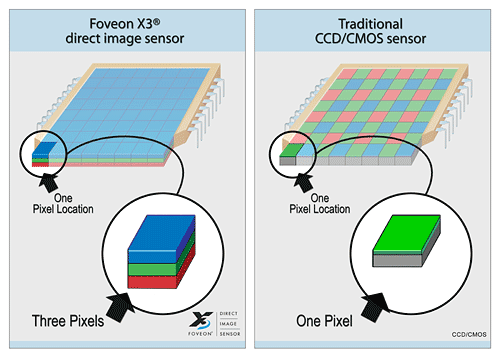
Comparison of Bayer CFA sensor and Foveon® sensor (from the Foveon website)
The second image sensor type used in dSLRs and digicams (point-and-shoot digital cameras) is the Foveon sensor. Unlike CFA sensors, the Foveon sensor has a three-dimensional photosite structure, with three photosensors stacked at each photosite (one for red, one for green, and one for blue). The founders of Foveon discovered how to to use silicon as a color filter of sorts, taking advantage of how deeply each primary color penetrates. What this means is that the image reconstruction process is as simple as taking the RGB value at each photosite and writing it out to an image file. No interpolation occurs; what you see is what you get until you are limited by either lens or sensor resolving ability. On the Foveon X3 second-generation sensor, that would equate to about 50 line pairs per millimeter (50 lp/mm).
Wait a minute! You're saying that a 3.4 MP camera has better resolution than a 6.1 MP camera? You're kidding!
No, I'm not kidding. That is exactly the point: more pixels in an image don't mean a higher-resolution image if the extra pixels do not contain valid image data but instead reflect interpolated, "guessed" data that may or may not accurately reflect what was in front of the camera. Here's a comparison of resolution test pictures from the Foveon-equipped Sigma SD10 and the Bayer-equipped Nikon D70:
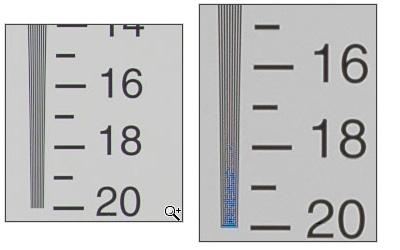
Sigma/Foveon (left) and Nikon/Bayer resolution test shots, from the dPreview website. Click on Sigma or Nikon to get a better view.
This black & white resolution chart is the best case test for a Bayer sensor because every photodetector either sees no light or some light and the color isn't important, yet the D70 and the SD10 have about equivalent resolution. The Bayer sensor's performance is dramatically diminished if resolution charts that are red, or blue, or green, on a white background are used. You can also notice the multicolor aliasing (moire) on the D70 image, a result of interpolation (guessing): certain photosites capture a boundary between black and white and because of the color filtering this is interpreted as different hues.
A better comparison of resolution between the Foveon 3.4 MP sensor (left) and Bayer 6 MP sensor (right). The Foveon's slightly higher resolution can be seen by how lines on the left side of the image extend slightly more towards the center.
(image courtesy of Digit Life)
(image courtesy of Digit Life)
Let's compare image quality from different-sized sensors with the same number of photosites. Obviously, smaller sensors with equivalent resolution will have physically smaller photosites. What does this mean in terms of picture quality? Generally speaking, sensors with larger photosites deliver images with less noise (a 'grainy' look), because while the electronic circuitry inside an image sensor will occasionally generate random photons that emulate light striking the photosites, the number of photons captured per photosite over a set time is greater when the photosite is larger and thus the signal-to-noise ratio (SNR) is higher. This is why high ISO images taken with digicams (compact point-and-shoot digital cameras) with smaller sensors display much more noise than their larger-sensored digital SLR (dSLR) brethren. It is also why a 6 MP image taken with a dSLR nearly always looks better than the same image taken with a digicam. And, it is why some digicams with 6 MP sensors actually provide better image quality than a nearly identical camera by the same manufacturer with a higher megapixel rating.
How do you get the most resolution out of your digital camera regardless of its megapixel rating or sensor design?
- Set your camera to save images in a lossless format (raw or TIFF) instead of JPEG
- Set your camera to its highest resolution rating
- Set your camera to the lowest ISO speed that will allow you to successfully capture pictures in your situation
- Finally, for the ultimate in image quality, do your post-exposure image processing (sharpening, etc.) in an image editor such as Photoshop or Picture Window Pro (my favorite) instead of the camera
Whacha Gonna Do Wid All Dat Junk?
Slate's Musicbox had an article on what was referred to as "a song so bad it veers towards evil." Give the writer his props: any article on that subject invites reading.
The song in question, "My Humps" by the Black-Eyed Peas, is a twist on the typical hip-hop view of the roles the different sexes play during courtship. It's not about love and respect, it's about access to those "lovely lady lumps" for "all that cash." Before I go further, let me state that I'm really not a Black-Eyed Peas fan, and I listened to the song initially because I wanted to understand how a man like Howard Dean could choose this band as one of his favorites (I think Howard was a poser who was trying to show how hip he was while hopefully getting some of the black vote).
I must be getting old. One of the elements of pop culture that ties a generation together is its music. By definition, I'm one of the last of the Boomers (people born between 1945 and 1961). I grew up with the music of the late '60s, listening to a lot of R & B and '70s rock and roll. Disco reared its generally-bland head during the mid-'70s and, I am ashamed to say, my senior-year high school yearbook features an abysmal drawing of a tiger (the school mascot) in the classic "Saturday Night Fever" pose. But the late '70s and early '80s had some great music. Punk, metal, alternative... it was all good. When I listen to today's music, I understand my father when he said, "You listen to that crap?"
All of these genres had one thing in common: they treated courtship respectfully. Male performers sang about the worship they had for a special woman; women sang about the positive aspects of men that invited respect. Yeah, there was the occasional "See Ya" song, like Journey's "Lovin', Touchin', Squeezin'" or Carly Simon's "You're So Vain" or Genesis' "There Must Be Some Misunderstanding." I look at these songs as warnings: guys, don't put up with cheating and getting blown off, girls, don't put up with a self-centered guy.
Which leads me to today's pop music and its misogynistic bent. I think much of this comes from black urban subculture, specifically hip-hop and gangsta rap. We don't want to know what love is anymore; we want that ho to call us Big Daddy when she backs that thang up. The hip-hop/rap subculture consciously rejects the social values of the mainstream. Why it does would make a fascinating essay in itself.
One of the recurring themes of Judao-Christian civilization is the union of sex with love in a monogamous heterosexual relationship that is the molecule, so to speak, of human civilization. The ideal is to find one person of the opposite sex that we can bond with for life, and then build a multi-generational family unit based upon that bond. There are a lot of good reasons for this ideal: monogamy builds stable societies without the problems of bastardy or jealousy.
This flies in the face of our genetic programming: men are designed to go forth and multiply. However, casual sexual relationships lead to violence between jealous lovers, unsupported children, and a fragmented society. People are programmed to require trust and security in a relationship in order to be happy. These problems have been with us from the beginning of time, and the ideal of monogamy is the result of millenia of experience.
Back to the song. I have to disagree with the author of the Slate column. I rather liked "My Humps" as a tongue-in-cheek commentary on the pathetic state of modern courtship, which evidently consists of winning a woman's affections temporarily by the simple expedient of throwing enough money at her. If you listen to the song, you realize that what the lyrics really say is that both sides play each other for fools. It's also a good dance track, and evidently a lot of people disagree with the column since this is one of the hottest singles on the charts.
You want a bad song? Just turn to any rap station and listen for a few minutes. How about "Shake That Laffy Taffy," a song so totally lacking in lyrical and musical merit that the person responsible for allowing it to be made should be barred from the music industry for life. The only rational explanation for why this song gets any airtime is that payola is alive and well in the music industry. No radio station would pay that song without getting paid big bucks. Hell, we should be getting paid to listen to it, but there isn't enough money in the music industry to make listening to this song bearable. Marvin Gaye would turn over in his grave.
I'll pick on my own generation because the new stuff is too easy. "Rock the Boat" by the Hughes Corporation? Yuck! Or "Afternoon Delight?" Every time I hear "thinkin' of you's working up a appetite" I wince. I want to slap the stupid songwriter who failed grade school grammar. How about "Ride the White Horse" by Laid Back? Or, pretty much the entire Beastie Boys collection, and the entire category of music referred to as 'Butt Rock.'
Whatever happened to great vocalists singing beautiful songs? Or great musicians? Earth, Wind, and Fire? Anita Baker? Jean-Luc Ponty, or Van Morrison, or Pat Methany, or any one of a great number of talented artists? Give me their music any day... and keep your Laffy Taffy.
The song in question, "My Humps" by the Black-Eyed Peas, is a twist on the typical hip-hop view of the roles the different sexes play during courtship. It's not about love and respect, it's about access to those "lovely lady lumps" for "all that cash." Before I go further, let me state that I'm really not a Black-Eyed Peas fan, and I listened to the song initially because I wanted to understand how a man like Howard Dean could choose this band as one of his favorites (I think Howard was a poser who was trying to show how hip he was while hopefully getting some of the black vote).
I must be getting old. One of the elements of pop culture that ties a generation together is its music. By definition, I'm one of the last of the Boomers (people born between 1945 and 1961). I grew up with the music of the late '60s, listening to a lot of R & B and '70s rock and roll. Disco reared its generally-bland head during the mid-'70s and, I am ashamed to say, my senior-year high school yearbook features an abysmal drawing of a tiger (the school mascot) in the classic "Saturday Night Fever" pose. But the late '70s and early '80s had some great music. Punk, metal, alternative... it was all good. When I listen to today's music, I understand my father when he said, "You listen to that crap?"
All of these genres had one thing in common: they treated courtship respectfully. Male performers sang about the worship they had for a special woman; women sang about the positive aspects of men that invited respect. Yeah, there was the occasional "See Ya" song, like Journey's "Lovin', Touchin', Squeezin'" or Carly Simon's "You're So Vain" or Genesis' "There Must Be Some Misunderstanding." I look at these songs as warnings: guys, don't put up with cheating and getting blown off, girls, don't put up with a self-centered guy.
Which leads me to today's pop music and its misogynistic bent. I think much of this comes from black urban subculture, specifically hip-hop and gangsta rap. We don't want to know what love is anymore; we want that ho to call us Big Daddy when she backs that thang up. The hip-hop/rap subculture consciously rejects the social values of the mainstream. Why it does would make a fascinating essay in itself.
One of the recurring themes of Judao-Christian civilization is the union of sex with love in a monogamous heterosexual relationship that is the molecule, so to speak, of human civilization. The ideal is to find one person of the opposite sex that we can bond with for life, and then build a multi-generational family unit based upon that bond. There are a lot of good reasons for this ideal: monogamy builds stable societies without the problems of bastardy or jealousy.
This flies in the face of our genetic programming: men are designed to go forth and multiply. However, casual sexual relationships lead to violence between jealous lovers, unsupported children, and a fragmented society. People are programmed to require trust and security in a relationship in order to be happy. These problems have been with us from the beginning of time, and the ideal of monogamy is the result of millenia of experience.
Back to the song. I have to disagree with the author of the Slate column. I rather liked "My Humps" as a tongue-in-cheek commentary on the pathetic state of modern courtship, which evidently consists of winning a woman's affections temporarily by the simple expedient of throwing enough money at her. If you listen to the song, you realize that what the lyrics really say is that both sides play each other for fools. It's also a good dance track, and evidently a lot of people disagree with the column since this is one of the hottest singles on the charts.
You want a bad song? Just turn to any rap station and listen for a few minutes. How about "Shake That Laffy Taffy," a song so totally lacking in lyrical and musical merit that the person responsible for allowing it to be made should be barred from the music industry for life. The only rational explanation for why this song gets any airtime is that payola is alive and well in the music industry. No radio station would pay that song without getting paid big bucks. Hell, we should be getting paid to listen to it, but there isn't enough money in the music industry to make listening to this song bearable. Marvin Gaye would turn over in his grave.
I'll pick on my own generation because the new stuff is too easy. "Rock the Boat" by the Hughes Corporation? Yuck! Or "Afternoon Delight?" Every time I hear "thinkin' of you's working up a appetite" I wince. I want to slap the stupid songwriter who failed grade school grammar. How about "Ride the White Horse" by Laid Back? Or, pretty much the entire Beastie Boys collection, and the entire category of music referred to as 'Butt Rock.'
Whatever happened to great vocalists singing beautiful songs? Or great musicians? Earth, Wind, and Fire? Anita Baker? Jean-Luc Ponty, or Van Morrison, or Pat Methany, or any one of a great number of talented artists? Give me their music any day... and keep your Laffy Taffy.
Subscribe to:
Comments (Atom)


