Showing posts with label History. Show all posts

Friday, February 23, 2007

Anniversary of the Decisive Gulf War Tank Battles


Take a look at this image, from Google Earth. I found it while dinking around this afternoon. It's the location of the Gulf War Battle of 73 Easting, almost sixteen years ago to the day, on the night of February 25-26 1991, when the US VII Corps caught up with one of the three Iraqi Republican Guard armored divisions, the Tawakalna Division and literally kicked their butts in a few hours. Click on the image to see it larger, and use the coordinates to help you zoom in with Google Earth if you want to check out the battlefield. This particular image is, I believe, the graveyard of the Iraqi 12th Armored Division, left behind to guard the rear of the Tawakalna Division while the Republican Guard units tried to retreat back into Iraq. I believe this division was destroyed mostly by Apache helicopter, with some assists from M1A1 Abrams tanks and Bradley Fighting Vehicles.

I've looked further to the north, where the three Tawakalna battalions got theirs, but the density of destroyed vehicles is very low although there are hastily prepared fighting positions where they're suppsed to be. Perhaps the Iraqis salvaged the destroyed tanks after the war, starting at the north and working their way southward.

Despite the impression that we have of Iraqis being most militarily adept at surrendering, the Guards divisions were actually pretty tough customers who tried to slug it out with the American forces. Remember, these are the same tank units that defeated the Iranians for a decade. Their biggest handicap was lack of intelligence; looking at the most-southern fighting positions shows that they were expecting the attack from Saudi Arabia and Kuwait to the south and east, and were completely surprised by our forces to the left. Coalition forces also had the advantage of superior equipment, training, and communications. Our tanks could detect and destroy their tanks beyond the range that they could even see us through their gunsights. In these battles, the first indication the Iraqis had that US armored forces were nearby was having one of their tanks blow up spectacularly.

One of the tactics used by the Iraqis as the battle raged on was to not power up their tank, instead letting it remain at the ambient temperature and thus be mostly invisible to our thermal sights. One of the US units reported coming over a small ridge and seeing 'basketballs' appearing and disappearing... and realizing these were the heads of Iraqi tank commanders coming in and out of their turrets quickly spread the word to shoot below the basketballs... ouch!

The smarter Iraqis kept their tanks cold and their heads down. After US vehicles would roll past these dormant tanks in the night, the Iraqis would crank their turrets around by hand and shoot us from behind. It was an effective tactic, but once a shot was fired the tank's temperature changed enough to become clearly visible on our thermal sights and most of these tanks only got off one shot before they were destroyed. Unfortunately, US tanks adjacent to those hit turned their turrets around to engage the bypassed Iraqis, leading to several incidents of fratricide, or "friendly fire" deaths when their gun flashes firing westward were mistakenly identified as enemy fire and engaged by oncoming US tanks to the westward.

After the destruction of the Tawakalna Division, the next Guard unit encountered was the Medina, leading to the Battle of Medina Ridge, the largest tank-on-tank battle in the history of the US Army. I think that only the WWII Battle of Kursk between the Soviets and the Germans was larger.

I think a case can be made that the Soviet Union collapsed as a result of the Gulf War and the lopsided US victory. Why? Because the Soviets were in Iraq supporting their client state with technical advisors and the latest and greatest Warsaw Pact armament. The Soviets always outnumbered the US in Europe, just as the Iraqis outnumbered us in Iraq, however US military strategy was predicated on the fact that large conventional battles would always be against numerically superior enemies like the Soviets and the Chinese. And yet, we defeated the fourth largest army in the world in less than 100 hours, while suffering more casualties in traffic accidents at home than we did on the battlefield. I think the Soviet leadership saw that all of their military spending, the decades of deprivation of their people, the lack of progress in their country's standard of living... it was all a waste. They'd never be able to conquer us militarily, they lost 40,000 troops and wrecked their army in Afghanistan in the 1980s, and they were getting left further and further behind, while their earstwhile junior partner China was making great economic strides. Despite the Soviets' best efforts, the US was less than 100 kilometers from downtown Baghdad with nothing in the way but sand. And so we saw the coup attempt fail shortly thereafter, and the Soviet Union was no more.

One wonders about the lost opportunities of the 1990s, starting with our running from Somalia to our ineffective responses to Al Qaeda. What would the world have looked like with Bush had won instead of Clinton? Would 9/11 or something similar have happened?

Saturday, August 06, 2005

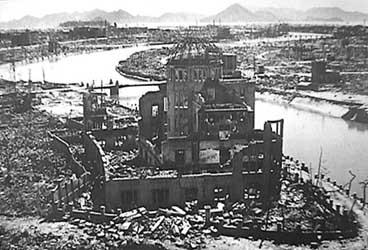
Was Hiroshima Necessary? Making the Case For Dropping the Bomb


Today, August 6, is the sixtieth anniversary of the first use of atomic weapons in warfare at Hiroshima, Japan.

The atomic bombings of Hiroshima and Nagasaki brought about the unconditional surrender of Japan and the end of World War II. The bombings also started the Atomic Era and kicked off the greatest arms race the world has ever known (and will probably ever know). With the development of thermonuclear weapons (hydrogen bombs) what was once inconceivable—the capability to destroy all life on the planet—now became possible.

Human technology has changed more since Hiroshima than in all of recorded history. For much of the last half of the Twentieth Century Americans, Europeans, and Russians went to bed every night knowing that, just possibly, they might not wake up tomorrow. Computer-controlled machine tools and open access to higher education education has empowered those who would do harm to us and our way of life; what was once the work of geniuses in government labs is now the province of technocrats using equipment available on eBay. The knowledge and skill needed to create atomic weapons is widespread, and the reason terrorists haven't detonated a nuclear bomb in an unsuspecting metropolis is more a matter of lacking the raw materials than the know-how. Many experts believe that within the next two decades we are almost certain to see terrorists use a nuclear weapon to destroy a large city in Europe or America.

This chain of events—the Atomic Era, the Cold War, nuclear proliferation—started sixty years ago today. Was it necessary? Did the US need to develop and deploy nuclear weapons? Did we need to bomb Hiroshima and Nagasaki? I believe an examination of history shows that we did.

How many of us know what was going on back in the 1940s just prior to and during World War II? Genocide was rampant in both theatres of war (Pacific and European); the Nazis were busy pitchforking millions of the undermenschen into crematoria and slit trenches, while in Asia the Japanese engaged in pleasurable activities like baby-bayonetting contests and rape-fests. Early in the War, Japanese maltreatment and brutality towards captured soldiers and innocent civilians became widely known thru events such as the Bataan Death March and the surrender of Wake Island.

The war in the Pacific was unbelievable in the viciousness and cruelty encountered by both sides. Early on, the average fighting American realized that their Japanese opponents would neither give nor accept quarter (mercy). Examples such as the Goettke patrol, where 19 men led by LtCol Goettke went to accept a purported surrender of starving and disease-ridden Japanese troops arranged by a Japanese prisoner only to be ambushed and annihlated—only three men escaped and the remains of the rest of the patrol were never located—hardened the Marines' and GIs' hearts. Once the Japanese tactic of faking surrender, death, or serious injury in order to kill responding Americans became widely known, our Marines and soldiers became understandably reluctant to risk their lives by taking prisoners. Eventually, the American forces developed a deep hatred of their opponents because of this lack of adherence to Western norms of civilized behavior.

As the war progressed and Japan suffered more defeats, its ability to defend itself shrunk accordingly. However, the deeply-ingrained warrior code that was widespread among the professional core of the Japanese military refused to consider surrender and instead resorted to more and more extreme methods and tactics. Despite Japan's military weakness in the face of growing US strength, each island campaign became more and more bloody as the Japanese improved their defensive tactics; no longer would they uselessly sacrifice themselves in repeated banzai charges in an attempt to drive the invading Americans off the beach. Instead, they would carefully prepare extensive defensive fortifications, carefully camouflaged and connected by underground tunnels, and seek to kill as many Americans as they could before they were destroyed by superior American numbers and firepower. The kamikaze was the result of the effective destruction of Japanese Naval air power and the deaths of experienced and trained Japanese aviators, yet despite the tremendous casualties inflicted on the American fleet surrounding Okinawa there was no chance that kamikaze attacks could influence the outcome of the war.

So, here we are, the Allied commanders in the Pacific in the summer of 1945. In the past year our troops have just experienced the carnage of Pelelieu, the Phillipines, Saipan, Guam, Iwo Jima, and Okinawa. We've witnessed the tragedy of Japanese troops forcing civilians to jump off cliffs rather than surrender to Americans. We've seen spectacular counterattacks that were as bloody and tragic as they were useless. We've seen young Japanese men who could barely control their rickety aircraft gladly dive into troop transports and aircraft carriers, killing thousands of our men and sinking dozens of ships. Our intelligence shows us the depths and the desperation of the Japanese preparations to counter an invasion of the Japanese home islands.

We also had evidence of a more sinister type. Japanese biological and germ warfare research was well-known; what was not so well-known was the Japanese atomic bomb project. Yes, they were trying to build a Bomb, too. And there is a report that the Japanese were on the way to attack America with a dirty bomb when the war ended; a German U-boat with U-235 aboard surrendered to US forces in the Pacific at the time the Japanese government capitulated; two Japanese on board the submarine committed suicide in order to avoid capture and interrogation.

By late July 1945 the Japanese government had rebuffed several surrender demands by the Allies. American military planners estimated that, based on previous experiences against Japanese forces, the invasion of the Japanese Home Islands would result in hundreds of thousands of American deaths and millions of Japanese military and civilian deaths—and that was something that a war-weary America that had suffered 300,000 deaths and millions of injuries on the battlefields of World War II didn't want to have to endure. So, facing an enemy who had fought fanatically, who neither accepted or offered surrender, whose words and deeds demonstrated the willingness to fight on and die rather than capitulate, who was not discouraged by the firebombing of Tokyo, the total embargo of the Home Islands, or the virtual destruction of the Japanese Air Force and Navy, who had no hope of victory yet no fear of death... what would you do?

Truman made the hard call when he gave the orders to proceed with the first attack against Hiroshima. Yet, even after the incredible devastation that literally left the Japanese government reeling in disbelief and astonishment, the Japanese government refused to surrender. America waited 5 more days, and then dropped a second bomb on Nagasaki that was even more devastating. There is evidence that this second bombing precipitated a military coup by officers who were adamant about not surrendering (the coup was fortunately aborted due to an American bombing raid that killed the coup's leaders). Upon delivering a second surrender ultimatum, the Allies also announced that cities would continue to be destroyed until the Japanese surrendered (a stone cold bluff on our part as there were no more atomic bombs available). The Soviets, seeing that the end was near and wanting to expand their Far Eastern territories, invaded Japanese-controlled Japan and China. Finally, the Japanese realized that the war was over; the only thing they could control was how many more Japanese died. Upon this realization the government admitted defeat and accepted the offered terms of surrender. The war was over.

Could we have won without dropping the Bomb? Almost certainly... but at what cost? For those who claim the Bombings were immoral, I would point out that a government owes one duty to its citizens; to protect their lives and to value them above those of an enemy nation-state. When there is no other alternative, it is far better for enemy civilians to die than for our troops to die. And, how many Japanese civilians would have died if we had invaded the Home Islands? The civilian casualties that occurred on Saipan and Okinawa—casualties that were largely the responsibility of the Japanese—equal those of Hiroshima and Nagasaki. A powerful and compelling argument can be made that dropping the Bombs actually saved lives.

The complications of the Atomic Era mentioned earlier... the Cold War, living under the fear of Mutually Assured Destruction, the rise of nuclear proliferation and the threat of nuclear terrorism... are historical events that would have happened in one manner or another regardless of our use of the Bomb. Time only flows in one direction; the nuclear genie was out of the bottle and it will never go back in.

Responding to a question about Woodrow Wilson's claim that World War I was the "war to end all wars" philosopher George Santayana replied "Only the dead have seen the end of war." What can we learn from Hiroshima and Nagasaki? War is hell. Innocent people die horribly in war. Therefore it behooves all nations to avoid war whenever possible, to only wage just war, and to wage war relentlessly so that the conflict is decided sooner rather than later.

The lessons have all been learned, and forgotten, before. Again, quoting Santayana, "Those who do not learn from history are doomed to repeat it." We dropped the Bomb because our enemy refused to face reality, to learn from history. Unfortunately, I think we will need to one day drop it again.

Thursday, January 27, 2005

What Really Happened in Vietnam: Learning the Lesson of History So We Don't Have to Repeat It

"Iraq is Bush's Vietnam!" claims Ted Kennedy, and he has claimed it on several occasions over the past couple of years as if his unique insight into world affairs, foreign policy, and American history is a courageous example of speaking truth to power. But what is the truth?

The "lesson of Vietnam" according to conventional wisdom goes something like this: the US is basically unable to successfully use its military to intervene overseas (and should not even try) because we will invariably pick the wrong side to support in any conflict due to our greedy and immoral national persona, use our military clumsily and ineffectively therefore strengthening our enemies and alienating our friends by the haphazard killing of innocents, and inevitably will be forced to retreat with our collective tails between our legs, leaving the other side victorious and ourselves even more impotent. And besides, violence never solves anything! This is the view of "what happened in Vietnam" that is shared by folks like Senator Kennedy, International ANSWER, and most of those who comprise the liberal base of the Democratic Party.

What really happened in Vietnam? Why did we go, how did we do, and how was it possible that the strongest nation in the history of the world (even at that time) was defeated by a Third World country with no economy to speak of, no industrial base to speak of, and no military to speak of? The long answer would make for a good book (or several). It would include background on the Cold War, US realpolitik strategy, the theory of containment, etc., and an understanding of these topics is important to understanding why the US decided to militarily intervene in Vietnam. However, I only have time and room for the short version.

The US first committed large-scale forces in South Vietnam after the Turner Joy incident, an inconclusive naval gun battle between two US destroyers and some North Vietnamese armed patrol boats. LBJ got the Tonkin Gulf Resolution thru Congress authorizing "all necessary measures" to repel attacks against US forces, and "all steps necessary" for the defense of US allies in Southeast Asia... a veritable "blank check" for presidential direction of military involvement in Vietnam. Shortly thereafter, US ground forces were committed in large numbers.

Originally the US military fought outside the major population areas and generally performed extremely well against NVA and VC forces. The Battle of Ia Drang, popularized in the movie "We Were Soldiers", was the first large-scale fight between US and North Vietnamese forces and although US casualties were heavy (almost 100 killed, more than a hundred wounded) the NVA lost almost 2,000 soldiers during the three-day battle... and who knows how many more due to the B-52 strike on their base camp area immediately following it.

One of the myths of Vietnam was that the US was fighting a largely-indegenous insurgency (the Viet Cong, or "Vietnamese Communists", AKA "VC" or "Charlie" from the radio-alphabetic "Victor Charlie") when in fact the Vietnam War was not an insurgency but instead a very-well propagandized attack by North Vietnam on its neighbor to the south. The US built up its ground forces over the next few years until 500,000 US military personnel were on the ground in Vietnam. Despite tough fighting the US military was successfully eradicating the enemy, at a higher cost in US casualties due to overly-restrictive rules of engagement. The North Vietnamese leadership recognized that it couldn't defeat the US in a stand-up fight and so guerrilla warfare became more prevalent. The use of ambushes, booby-traps (we call 'em IEDs or Improvised Explosive Devices today), hit-and-run tactics, and choosing to fight in populated areas in an attempt to neutralize superior American air and artillery firepower became the favored tactics.

Simultaneously with the US ground war in South Vietnam, the US Air Force and US Navy embarked on Operation Rolling Thunder, a limited strategic campaign designed to gradually escalate against the North Vietnamese until they "blinked" according to a US Air Force memorandum at the time. In that memo, US Air Force Undersecretary Townsend Hoopes, stated:
We believe the enemy can be forced to be 'reasonable', i.e. to compromise or even capitulate, because we assume he wants to avoid pain, death, and material destruction. We assume that if these are inflicted on him with increasing severity, then at some point in the process he will want to stop the suffering.

Therein lies the mistake of Vietnam in a nutshell: assuming that your enemy has the same values, goals, and motivations that you do. In formulating the strategy behind Operation Rolling Thunder, Secretary of Defense Robert McNamara relied on the concept of graduated pressure. Unfortunately for America, McNamara's preoccupation with the idea of treating war as a business situation despite evidence to the contrary doomed our efforts in Vietnam to failure. The North Vietnamese weren't intimidated by pain, death, and material destruction, and only cared about it as it affected their ability to pursue their strategic goal of conquering the South. What the North Vietnamese leadership truly cared about winning, something they had already devoted a decade to, and they were willing to pay any price in order to win if victory was possible.

Operation Rolling Thunder went on in fits and starts, with bombing halts called unilaterally by the Johnson administration as a way of signalling the North Vietnamese "Hey, that hurt didn't it? Come and talk to us now." Instead of productive talking, the North Vietnamese argued over the size of the negotiation table (literally!) and used the relative safety provided by the bombing halts to rearm, rebuild, and re-equip... while targeting restrictions prevented air strikes against North Vietnamese airfields, stockpiled SAMs on levees, and not-yet-complete SAM sites. Hundreds of US pilots were captured or killed due to restrictive rules of engagements, and who knows how many thousands of US casualties occurred in South Vietnam because our air power was arbitarily prevented from being used on logistics in the North by McNamara and his "Whiz Kids".

I can't emphasize strongly enough how the horrors of Vietnam and the tragedies of Southeast Asia that occurred after the war are largely the responsibility of LBJ's moral cowardice and McNamara's egotistical stubbornness that led to the fatally flawed strategy of graduated pressure.

Despite the abject mishandling of our military and the stubborn pursuit of a failing strategy that was criminal in its spending of American lives for no military purpose, the culmination of a couple of years' battle casualties and damage from millions of tons of bombs was having a deleterious effect on North Vietnam's ability to wage war to the point where the leadership became desperate, not unlike the Germans in the Fall of 1944; they were beaten but not defeated. Like the Germans the North Vietnamese decided to husband their resources and launch a devastating series of attacks throughout South Vietnam during the upcoming Tet (Vietnamese New Year) ceasefire. And, like the Germans, they bet all of their military chips on this one shot.

On January 30, 1968, the Tet Offensive started with a series of attacks against US and South Vietnamese forces. Due to poor planning the offensive was poorly coordinated, and the attacks were largely quashed. There were widely-publicized assault by NVA/VC forces including the siege at the US embassy in Saigon, but the NVA and VC forces were defeated and wiped out in almost every case. The North Vietnamese forces were able to conquer the city of Hue and hold it for almost a month, massacring thousands of civilians, until they were defeated and destroyed by the US Marine counterattack, losing 7,500 NVA and VC troops in this one battle. The largest battle of the Tet Offensive was fought at the US Marine base at Khe Sanh, where although US military casualties were in the hundreds, contemporary NVA losses were estimated at 8,000... and post-war information has indicated the NVA lost almost 25,000 soldiers at Khe Sanh.


US Marines in Hue, from Stars & Strips/John Olson via USMC/Combat Helicopter Association

The US and South Vietnam militarily won the Tet Offensive by any objective measure; 3,900 dead (1,000 American) to between 35,000 and 60,000 NVA and VC killed, another 60,000 NVA wounded, 6,000 prisoners taken, and complete control of the battlefield. The initial North Vietnam leadership response to the crushing defeat was to seriously consider a peace negotiation with the US and South Vietnamese. So what changed their minds? The news media and it's flawed reporting of the events.

Sensationalized reporting of the initial attacks by the media fueld the impression that the Tet Offensive was a victory for the North Vietnamese instead of a defeat. Ignoring, and in many cases, denying, the successes of the US and South Vietnamese military, the majority of the press corps reported their perceptions of the battles rather than the facts. The anti-war movement in the US seized upon the reports as proof that the US couldn't win in Vietnam, their rationale being that we couldn't be winning if the North Vietnamese were capable of launching something as widespread as the Tet Offensive. Then, as now, the anti-war movement claimed that the government was lying. More important, the mainstream American public was shocked by the size of the battles and the US casualty figures. LBJ had lied to the American public, not about whether or not we were winning (we were), but about the scope of the war and the extent of US involvement.

The US political fallout from the Tet Offensive ended LBJ's presidential career. With it, support for our presence in Vietnam also ended, and Richard Nixon campaigned and won election on the promise to get the US out of Vietnam. The North Vietnamese were also encouraged that victory was possible, not by militarily defeating the US (which they recognized was impossible) but by killing enough US troops to get the US to withdraw. Accordingly, their strategy changed from taking and holding territory to increasing US casualties regardless of the cost to North Vietnamese forces in order to increase the pressure on Nixon to withdraw. After four years of continued US military success and the drawdown of US troops, Nixon finally got the North Vietnamese to the table by the simple expedient of authorizing unrestricted strategic bombing of Hanoi and Haiphong during Operation Linebacker II in December of 1972. What if this had been done in March 1965?

The North Vietnamese attacked the South in the 1972 Easter Offensive, but underestimated the quality of the outnumbered South Vietnamese forces and their effectiveness when supplied and supported by US air power, resulting in yet another stunning defeat that set the North Vietnamese back for three years. In the interim, Democrats in the US Senate led by none other than our scholar Senator Ted Kennedy managed to gut the legislation that was part of our support for South Vietnam we agreed to at the Paris Peace Accords, and so when the North Vietnamese again invaded in 1975 there was no US airpower to oppose them, no US logistical support to resupply outnumbered South Vietnamese troops facing Soviet- and Chinese-equipped North Vietnamese troops, and no outcry from the United Nations about the violation of international law by the North Vietnamese. After a valiant fight, the ARVN was overwhelmed and defeated, leading to mass imprisonments in re-education camps, hundreds of thousands of executions, and indirectly to the horrific hell of the Cambodian killing fields as totalitarian forces overwhelmed democratic governments in Laos and Cambodia.

This has been a rather long post (more like a Thirty Minute Thought), so let me close with the true lesson of Vietnam and some important corollaries.

The Lesson of Vietnam: Don't fight a war unless you're going to fight to win... but if you do fight, then fight with overwhelming force to destroy your enemy's will to fight as quickly as possible.

First Corollary: A US president must have the moral courage to withstand the fierce personal and political attacks he will receive from his political adversaries, and fight any military action the US is involved in as if 100% of the population is behind him, otherwise he is doomed to military failure and political defeat.

Second Corollary: Wars are won by destroying the enemy's will to resist, so regardless of the disparity in military forces the winner is the one who is left standing on the battlefield.

Read Ted Kennedy's comments again, and also those of President Bush. Then ask yourself which one by his words and deeds demonstrates an understanding the Lesson of Vietnam, and which one is engaging in the same behavior that caused our defeat in Vietnam.