Monday, April 27, 2009

An Unfailingly Reliable Indicator

Then-President Jimmy Carter defending himself against a crazy rabbit (upper right)


I see former president Jimmy Carter has an op-ed in today's New York Times calling for the re-enactment of the 1994 'Assault Weapon' ban, a useless symbolic gesture and perhaps the single achievement of the Democrat House that allowed the GOP to take that chamber back after a half-century (certainly Bill Clinton believed so).

What I don't understand is why anyone is pushing for this law, a law that had absolutely no effect on crime, that was never successfully prosecuted, and that is almost certainly unconstitutional in this post-Heller world. One of Carter's claims is that American-made and legally purchased 'assault weapons' are being smuggled into Mexico and used by the cartels in their war against each other and the Mexican government... a claim which has been proven false as the cartels' main source of weapons is from other Central American countries like Panama, where real full-auto assault weapons (not the semi-auto lookalikes we can legally buy here), rocket launchers, grenades, etc., are available. Actually, I do understand. It's not about the problem in Mexico, it's about not trusting the American people.

Carter talks about his hunting guns, and then derides the NRA for "defending criminals' access to assault weapons and use of ammunition that can penetrate protective clothing worn by police officers." What he is either too stupid, or too dishonest to mention is that any centerfire deer rifle, including the ones he claims he owns and uses, will penetrate "protective clothing worn by police officers" (body armor). In fact, a criminal with a hunting rifle is far more dangerous than one with a semi-automatic AK-47. If Carter were really concerned enough about the danger to police he'd voluntarily turn in his own firearms before they can be stolen and put to criminal use. Again, the claim to be a 'hunter' is only a badly-disguised attempt to portray himself dishonestly as a 'sensible' gun owner instead of the elitist bigot that he really is. (If you're thinking I neither like or respect the man, you're thinking right.)

I for one am grateful Jimmy Carter occasionally makes a return to the world's stage. This man is the most reliable indicator of the intelligent side of a position the world has ever seen. You simply have only to determine where Jimmy Carter stands... and then you know unfailingly the opposite side is correct.

Don't The Police Have More Important Things To Do?

A perfect example of what is wrong with our country.

Santa Monica has hundreds of burglaries, robberies, dozens of rapes... and yet they have the manpower and money to go after this poor schlub?

Wednesday, April 15, 2009

The Seattle Tea Party

Seattle Tea Party Panorama - (c) 2009 John Clifford


I went down to Westlake Center in Seattle this evening to photograph the Seattle Tea Party, and to gauge the mood of the crowd.

Seattle Tea Party Audience - (c) 2009 John Clifford


I arrived just before the event kicked off, and watched the crowd from across the street, taking a few pictures before I decided to get into the audience for some crowd shots:

Vote 'Em All Out! - (c) 2009 John Clifford

The primary organizer and Master of Ceremonies was Keli Carendar, who spontaneously organized the first Tea Party in the country here in Seattle back in February.

Seattle Tea Party/Keli Carendar - (c) 2009 John Clifford

Ms. Carendar, dressed as 'Alice in Wonderland', did a great job of firing the crowd up, introducing the different speakers, and even offering a well-sung rendition of "Obama, Won't You Buy Me a Mercedes Benz" based on the Janis Joplin tune. It was pretty funny, and the crowd loved it.

The Crowd Listens - (c) 2009 John Clifford


There were perhaps a thousand Tea Party-ers with a wide variety of signs, mostly related to taxes and spending, but there was also a lot of anger about the TARP program, the Stimulus Bill, and the massive increase in the federal budget:

We The People... - (c) 2009 John Clifford

Speaking From The Arch - (c) 2009 John Clifford

No Longer Silent - (c) 2009 John Clifford


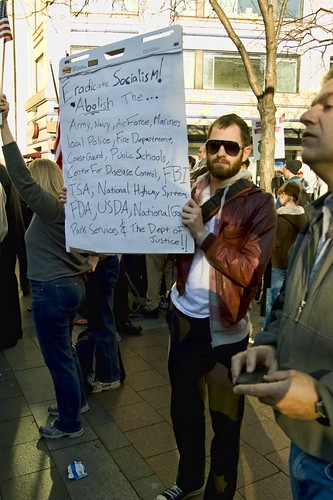
There wasn't much of a counter-protest, maybe a couple dozen disorganized folks who mostly came down to have some fun."Pro-Socialism - (c) 2009 John Clifford I talked to a few of them and really felt like the two sides are talking past each other; one teenager/twentysomething couldn't understand why the Tea Party folks were against "fairness" because "after all, that's what Obama is trying to do, ensure fairness. I tried to explain to him that maybe these folks believed that making them pay for other folks' mortgages, or for bailing out companies that took huge yet foreseeable risks was unfair, and that they thought putting a $200k bill on their children was especially unfair... but of course the young man isn't paying taxes because he doesn't make enough and believed that only the "rich" would end up paying for these programs. Another fellow evidently thought the Tea Party-ers were hypocritical in that they "supported socialism when it benefited them." His counter-protest sign illustrated his point, and since he was being very polite and well-mannered I didn't bother to explain the false premise he was making (that government services such as the military or law enforcement are a form of socialism).Don't Ask... - (c) 2009 John Clifford You can read his sign and make up your own mind. And then there was this last sign representing the motivations of most of the counter-protesters, who came down to shock the squares and get some laughs. I thought she was cute, so I sure hope that sign belongs to her boyfriend!


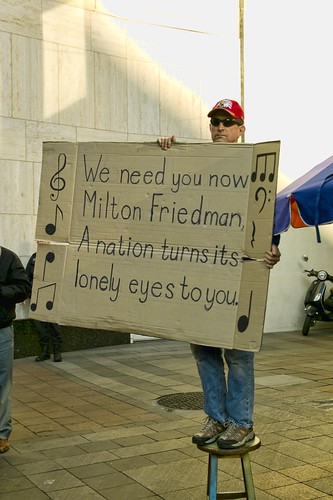
I especially liked this poignant sign from a capitalist wondering what the heck happened to his country. A witty way of capturing the change that has happened in America over the past quarter century; while the GOP was winning at the polls, the Democrats were winning the hearts and minds of Generations X and Y. The minority view of the 1980s is the conventional wisdom of today. A Great Sign - (c) 2009 John Clifford

Maybe it takes a Jimmy Carter, or a Barack Obama, for people to relearn the lesson of how There's No Such Thing As A Free Lunch every generation, and that someone has to pay for all of these programs. Maybe it's a good thing the Democrats won everything, so that America can realize just exactly how Democrats govern (unapologetic big spenders, as opposed to apologetic big spender Republicans). And maybe the GOP needs some time in the wilderness to think about the butt-kicking they've taken since 2006 and for the lesson of what happens when you don't govern the same way you campaign to sink in.

There was a considerable police presence, with a half-dozen mounted police (on horseback), perhaps another dozen bicycle police, and a couple of patrol cars with another half-dozen officers distributed through the square. The crowd was well-behaved, though, and the police mostly talked to each other and enjoyed the afternoon.

Just In Case - (c) 2009 John Clifford


The event ended around 7:30, with the last speaker getting the crowd fired up about throwing all of the incumbents out to send a message. I think the only way to solve the problem with our government is to get rid of the concept of career politicians by enforcing term limits on all federal elected offices. If eight years is good enough for the president, then surely twelve years is good enough for a Congressman or Senator.

The Silent Majority? - (c) 2009 John Clifford


It is unconscionable that a person who has never worked in the private sector can become a multi-millionnaire through public office, and this seems to be especially prevalent among Democrats, the prime examples being Bill Clinton and Barack Obama. Finally, Ms. Carendar announced that more Tea Parties were scheduled for upcoming holidays, and promising to run them until the 2010 elections.

In summary, a surprisingly strong crowd of folks who don't ordinarily come out and protest, reflecting considerable anger at their elected officials. I don't think the GOP understands how much of this anger is pointed their way, either. The true test of the Tea Party movement is its longevity; will these Parties be a flash in the pan, or will they grow over the next two years and culminate in a changing of the guard in Congress and the states? I think the answer lies in whether or not a leader emerges who can effectively speak to this anger and inspire a following, and so far I don't see that person.

Note: All photos taken with a Sigma SD14 dSlr, and either a Sigma 18-50/2.8 EX DC Macro lens, a Sigma 50-150/2.8 EX DG lens, or a Celestron 300/5.6 mirror lens.

The Nightmare Scenario: Are We Paying For The Rope That Will Be Used To Hang Us?

Let's say you were running a country with a huge population but a primitive infrastructure. For historical reasons, your population was not well-educated and your country was not industrialized; manual labor predominated. Your political-economic system provided security for the ruling elite and a docile populace, but the fundamentals of your economy could only change if you obtained money from other countries. More important to you as a leader, you believed your country was not treated with the respect it deserved given its historical accomplishments. How would you address these problems?

Let's say you realized that, although your economy was aligned with socialist principles, you were enough of a realist to realize that economic capitalism was the best way to bring prosperity and technical advancement to your country. So, you decide to utilize capitalism by exploiting your greatest resource; your people.

Fast forward a dozen years. Your country's factories produce durable goods for the world. Because you don't enforce intellectual property laws, much of what you value from other countries is used without compensation in your country... software, entertainment. You even turn a blind eye to the illegal copying of this, because it brings in hard currency. But all isn't rosy.

You realize that you need to not repeat the mistakes of countries like Japan, or England, Germany, or even the Unites States... manufacturing powerhouses who failed to control the natural resources that they depended on to keep their economies afloat. So, you bribe corrupt leaders of resource-rich but poor countries elsewhere in the Third World so you can develop and control their resources. You give guns and money to the Sudanese regardless of their deeds in Darfur, so you can get the oil you need. You do the same things in Nigeria and Angola. You go elsewhere in Africa, sending your people over to oversee the natives in places like South Africa and Zimbabwe. Like a drug pusher, you give poor nations cheap loans so they become beholden to you. You dump consumer goods in their markets, squeeze out the local competition for textiles, and you set up companies for these markets using mostly Chinese labor. In short, like the European powers you practice colonialism, but unlike your antecedents you have no religious or moral sentiments to make lives better for those you exploit, and you have no plans to leave. You don't stop in Africa, either. Iran and Venezuela need a friend who can sell them weapons, and you need oil. It's just business.

How do you handle your largest competitor, the Unites States? Well, you buy their debt so they can become beholden to you also. You give weapons technologies to proxies like Iran, Pakistan, and North Korea, so that America has to spend its time trying to do something about proliferation... and each time its efforts fail American prestige suffers another blow. The Islamists leave you alone, because unlike the Americans you really don't care about world opinion, and they know it. Not that you can project power... yet... but you've ensured that countries like Iran understand that it is in their interests to be aligned with you, to sell you oil and buy your technology, while they rail against the West. You don't care if the Islamists want to fight with the Americans. It only weakens both, and that benefits you. You don't care if the North Koreans or the Iranians get the Bomb. They won't use it against you, and it only weakens America.

So, here we are in 2009. China holds almost $2 trillion in US debt, in the form of treasury bonds. Foolishly, we have borrowed money from them to buy from them. And, we are counting on them to buy another couple trillion over the next few years. What happens when China calls in that debt? Or, even worse, what happens when China decides on a course of action that we find objectionable, and their response to our objection is to threaten to destroy our economy? Will we fight for Taiwan, for instance, if the cost of doing so makes our current economic woes seem like a bank holiday?

I don't think we've woken up to the fact that we are currently losing an economic war with China, and if we don't change course quickly we are going to be destroyed as a country. The evidence is there; all one has to do is to look at the contrast between Detroit and Shanghai, and to realize that the money that used to support America's industrial areas (the Rust Belt) has been sent overseas and has built China's shining cities and manufacturing facilities. It's not China's fault, of course. We gave them the opportunity by deliberately choosing to be non-competitive, and they have capitalized on our stupidity. And we're continuing down this road, further stifling our competitiveness because of shortsighted policy decisions. Americans were naive enough to believe that economic prosperity and political freedom had to go hand-in-hand, but that isn't necessarily true in a modern industrial society. Unlike us, the people who govern China don't have to worry about fractious political battles, and unlike us they have learned from their past policy mistakes.

Look ahead a few years. China is preparing a blue water navy, and there's only one reason a country needs a blue water navy: projection of power. China is working on a ballistic missile 'carrier killer' to deal with our blue water navy. China understands the latest GPS and computer technology, because they manufacture it for us, so there's no smart weapon in our arsenal they can't build. And China will have 32 million military-age men for whom there are no Chinese women, so these men will not be able to marry in their own society. All of these things will come to a head at the time we finally run out of money because China can choose when it will stop financing our debt... and then we are broke.

That is the nightmare scenario, the game of Risk in the real world: a China that has sewn up its natural resource needs, that has built a powerful military, and that has brought our economy to a halt. What if they go into Siberia? Only we could possibly stop them, and I don't think the American people will accept the risk of a nuclear strike against an American city to do so. The Russians don't have the population or the military to stand against them, even with nukes. Once China gets Siberia and has a few years of rest to rebuild what they lost in the Sino-Siberian War, who will be next?

Tuesday, March 24, 2009

The Second Rule of Gun Fighting

The First Rule of a Gun Fight is 'Have a gun.' What is the Second Rule?

There are four possible outcomes of any gun fight:
  • No one gets shot (showing a gun gets compliance).

    Now, this may be a 'win' and it may not be. If you point a gun at a bad guy and he goes face down on the ground until the police arrive to haul him away, score it a win. If the bad guy makes you comply, e.g., steals your wallet, rapes you, ties you up and throws you in the trunk of his car, you lose... and the scenario dictates how much you lose.


  • You shoot the bad guy.

    He loses. You may or may not win, depending on whether shooting him was the correct thing to do.


  • The bad guy shoots you.

    You lose.


  • You both get shot.

    You still lose, even if the bad guy loses worse.
  • So, the Second Rule of a Gun Fight is 'Don't get shot!' because winning a gun fight isn't strictly a matter of shooting the bad guy, it's surviving the encounter intact. It seems obvious, but a quick perusal through the 'Lessons Learned' archives of this site alone shows that most gun fights are lost because the good guys fail to faithfully follow the Second Rule.

    Let's look at the Miami Burger King shootout that happened today. The bad guy walks in complete with ski mask (thanks for the target identifier, buddy!) and holds up the place. A good guy, complete with concealed carry license, pulls his gun and confronts the bad guy. The bullets start flying, and when it's over the bad guy is dead and the good guy is seriously wounded. Ask yourself, did the good guy really win?

    Let's see... he won a trip to the emergency room, several hours of emergency surgery, months of painful convalescence, and perhaps some permanent disability... if he survives. Doesn't sound like much of a win to me.

    I'm not saying good guys should never fight back. Quite the contrary. What I want to emphasize here is to keep the goal in mind. The goal is not to protect Burger King's till. It is to protect your life, the lives of your loved ones, and the lives of innocents... in that order. Don't place one day's sales of a small business above your life and the well-being of a family that depends upon you.

    Before getting involved in a gun fight, ask yourself is this necessary? As Clint Smith is fond of saying, life will give you plenty of chances to show your heroism, so don't volunteer unnecessarily. Sometimes, however, there are no good choices. Sometimes you will have to get involved, because the cost of not engaging is too high. If you find yourself in such a situation, then remember the Second Rule of a Gun Fight: Don't Get Shot!

    Remember also that weapons are merely tools that we use to accomplish a task. Strategy and tactics are really what ensures success with the tool at hand. Have a plan, and develop the skills necessary to carry your plan out to a successful conclusion. In the case of the Miami Burger King shootout, the good guy had the initiative, and he had a gun. But did he have a sound strategy, a plan that would ensure success? No.

    From reading the news reports, it appears that the good guy pulled his gun and confronted the armed robber. At this point, the good guy has thrown away every advantage he has, and given the advantage to the bad guy! The lesson here: don't confront armed bad guys, shoot them... or don't get involved! If I was in a similar life-threatening situation where deadly force was warranted and felt I had to intervene in order to save my life or the life of others, rather than confront the bad guy I'd get behind cover if at all possible... something that would have a good chance to stop a bullet, like a counter or a booth partition. However, once I made the decision to shoot, I'd pull my gun out and aim it at the bad guy, and then I'd shoot him until I was absolutely positively sure he no longer posed a valid threat. No challenge, no "Drop your weapon!" or "Freeze!" I am not going to give any bad guy a chance to shoot me if I can help it.

    I understand that sometimes you can't seek cover, because there isn't time. Sometimes all the choices stink. Sometimes you have to resign yourself to the very real possibility that you will get shot, but the alternative of doing nothing and getting shot, raped, or killed is much worse. Your strategy doesn't change. Once you've made the decision that deadly force is warranted, then don't hesitate. Draw and shoot, and keep shooting until there is no longer a threat. Putting the bad guy down, now, is your best chance of minimizing harm to yourself and other innocents. It may be your only chance for survival. At the Burger King today, the first shot from the good guy could have ended it all. Make that first shot on your time, with all deliberate speed ("take your time, fast" as Bill Jordan wrote), and make it count because it may be the only shot you get.

    He who hesitates is lost. Don't hesitate. Make your decision, and then carry out your plan vigorously.

    Monday, March 23, 2009

    Is The Glass Half-Empty?

    Over at The Right Coast, Maimon Schwarzschild ponders on Things To Be Depressed About, asking who is right, optimists or pessimists and more pessimists? ht: Instapundit

    I gotta go with Scott and VDH on this one. It's not even close.

    You know, the really bad thing about reality is that it has a way of catching up to people who refuse to face it, and then smacking them in the chops until they do. As my dad said, "Life is hard, but it's a lot harder if you're stupid."

    America as a nation is stupid. We elected a charismatic, attractive, apparently-intelligent person to the President, ignoring the fact that the man had very little experience actually running things and making decisions... and the experience he did have wasn't illustrative of brilliance as a leader or manager (his management of the Chicago Annenberg Challenge oversaw the spending of almost $150 million! with no apparent quantitative results - no improvement in child or school performance). We could have elected a man with tremendous experience, and proven leadership and management abilities, but as I said, America as a nation is stupid.

    Now we have this resultant mess of the economy, which a strong, confident hand on the wheel could have prevented. We have trillion-dollar deficits stretching out as far as the eye can see. We have a Congress that is too lazy to actually read legislation before passing it... and then too stupidly arrogant to realize that passing unconstitutional bills of attainder are no substitute for due diligence. We have insulted our strongest allies, left important friends who trusted us at our word hanging by themselves, and kowtowed to our sworn enemies, earning not peace but a dangerous lack of respect that will foment more trouble around the world. But give the Obama Administration credit for one thing: we did all of this in 60 days! Yep... we made history alright, and let's pray that it's the history we wanted instead of the second coming of Jimmy Carter, or worse.

    We needed the best and brightest, but instead we elected the glib and facile, the popular kids in high school who got all the dates but ended up working where they could use their connections rather than innate ability to go farther... and we are going to pay for it.

    Tuesday, March 17, 2009

    The Difference Between Liberals and Conservatives: It's Not What You Think...

    So, I've been playing with watching streaming video over the Internet on my TV, through my XBox, and found a program called PlayOn. Playon lets you set up a PC to receive video streams from a variety of sources, including Amazon Video-On-Demand, Netflix, and YouTube. It's pretty easy to install, costs $35, and mostly works well (there are a few glitches but the PlayOn folks release updates often and the software has improved even in the past month or so that I've been using it).

    One of the YouTube channels I've subscribed to has been TEDtalksDirector, the video stream for the various TED presentations available. TED, which stands for 'Technology, Entertainment, Design' is a yearly conference series that brings together movers and shakers from a variety of different areas including high tech, education, politics, business, and entertainment. The conferences offer a multitude of presentations on a variety of subjects, from how the world began to the use of rock chords in progressive jazz... in other words, a very eclectic mix. Although some of the presentations are controversial, and others are just fluff, the occasional nugget of gold can be found.

    I'm embedding a TED Talk entitled "The Real Difference Between Liberals and Conservatives" by Jonathan Haidt. I just watched this, and at the beginning I was thinking yet another biased presentation, yet by the end my opinion switched to thinking that this was perhaps the best TED Talk I've seen yet.

    Here it is. Please watch it and then feel free to leave a comment on what you thought.


    As for me, it made me think about the various discussions I've had with my liberal friends... and the political combat that seems to be growing even harsher with every passing year regardless of who wins the White House or Congress.

    Tuesday, February 10, 2009

    The Economy Will Remain Broken Until Washington Is Fixed

    Glenn Reynolds, over at Instapundit, links to a Politico article on how the Democrat activist organizations are starting to attack the Republican Congressional leadership in an effort to turn around public perception on the Stimulus Bill. Fine... that's politics after all, but I don't understand Reynolds' comment that he's "tired of it." Tired of what? The GOP leadership? Or, attacking the GOP leadership? I think many Americans were hoping that Hope and Change meant hoping for true bipartisanship, for putting country above party, and for changing the way things were done... but despite all the hope nothing has changed. Certainly the Democrats haven't changed.

    The Democrats own the Stimulus Bill. Speaker Pelosi and the House Democrat leadership wrote the bill, and Senator Harry Reid and his fellow Democrat senators put together the Senate version. Democrats will control the conference committee that ends up deciding what the final outcome will be. As Obama, Pelosi, Reid, MoveOn, DailyKos, etc., are so fond of reminding us, they won. They are going to use their control of the Legislative and Executive branches of the government to ram this spending colossus through and nothing is going to stop them... not public opposition, not the CBO report that shows doing nothing is a better strategy, and certainly not the greatly outnumbered Republicans. Chances are the eventual bill won't even be made public until after Obama signs it.

    It wouldn't be such a big deal if we were just talking about the fate of one or the other political parties, which after all are really just associations of like-minded folks banding together to move things in the direction they want. Who gives a fig? However, the Stimulus Bill is more than just partisan politics. We're talking somewhere north of $800 billion dollars here. Do you realize just how much money that is?

    Here's some comparisons that will help you wrap your mind around the enormity of the $800+ billion we're going to print and spend, and obligate ourselves:
    • We could select 16,000 random folks (yes, 16,000!) in each of the 50 states, and give them a million dollars
    • We could give 10% of the population of New York City a million dollars each
    • We could give every man, woman, and child in the country a new computer, a new iPhone, a new digital camera, and a 42" LCD HD TV... and still have enough money to pay their cable bill for a year
    • We could give every American family a three-month paid vacation, at the average salary

    Does anyone really believe that the way to get out of debt is to indebt oneself even more? Of course not. The first thing a smart person does when facing a shortfall is to cut spending, not raise it. After all, if spending like a drunken sailor would get us out of our difficulties, we would never be here in the first place.

    The Financial Times had a great article on the cause of our current economic woes, and the possible solutions. What I don't understand is, if Tim Geithner is the financial genius who is uniquely qualified to fix the problem, then why didn't he cover these points in today's press conference... you know, the one that drove the Dow down several hundred points, because investors realize the Obama Administration doesn't have a clue about how to proceed and is flailing desperately. What was their solution? Let the bad banks fail, and stop throwing good money after bad. Yes, bank investors will lose money. That's what happens when you invest in a business that makes bad decisions.

    All of the political posturing we've seen over the last week is just so much kabuki theater. The truth is really rather simple: the Dems want Republican support so that everyone owns this stinker of a bill... and no single party can be held responsible.

    Sunday, February 08, 2009

    What I Did This Weekend...


    I went to the Seattle Startup Weekend 2 held at Google's Seattle office over in Fremont to pitch an idea... and got 27 votes and a dozen folks to help me make it happen. After two days of hard work, we actually have a catchy domain name and a prototype website.

    What's the idea? Bringing consumers and service providers together, using geolocating to improve efficiencies by utilizing available bandwidth. In layman's terms, we allow service providers to take advantage of opportunities near their current location while they're otherwise unoccupied. Think of a plumber, for instance, who has to travel for a half-hour to do a two-hour job, then has a couple of hours until his next appointment. If a plumbing service call opportunity a mile or two away from his current location comes to his attention, he can choose to take that service call without additional travel time. A consumer's example would be, say, a need to haul a load of yard debris from last weekend's cleanup to the dump... but it would take several pickup truckloads, the dump's ten miles away, and the minimum dump fee is $15. Why not post a job for someone to come and haul your stuff away, for a maximum fee of $25? Some enterprising landscaper who is working in the neighborhood already has half a dump-truck load... and can spend 30 minutes picking up another four trash piles (you and others in the vicinity), and make a quick $100. You save money and time, and the landscaper collects an extra $100 for the same actual overhead. Win-win.

    It was a lot of fun, with some frustration at the intermittent Internet service and blowing circuit breakers. We ended up spending almost all of Sunday at Peet's Coffee and Dad Watson's (both offering free Wi-Fi to customers), returning to Google at the end of the day to report on our group, watch what others had done and show off our own work.

    Thursday, February 05, 2009

    Grace Under Pressure

    By now I'm sure everyone knows about US Air Flight 1549, the Airbus A320 that took off from New York City's LaGuardia Airport enroute to Charlotte, North Carolina but ended up floating in the Hudson River after encountering a flock of geese shortly after takeoff. The jet lost both engines due to ingesting geese, and was too low (3200' and 90 seconds into the flight) to make it back to LaGuardia. I've embedded a CBS report featuring a simulation of the flight, including radio transmissions plus some security camera footage showing the jet landing in the river.

    Captain Sullenberger, the pilot-in-command, has been singularly recognized for his coolness in the face of emergency, and his presence of mind in rapidly exploring and then discarding all of the alternatives as unviable until only one remained... landing in the Hudson River. As he explained it to the NTSB during his deposition concerning the incident, he didn't want to crash catastrophically in the dense New York metropolitan area, couldn't make it to a runway, and so the only choice left was to land in the river.

    I don't want to take anything away from Captain Sullenberger, who I think exemplifies Hemingway's definition of courage as 'grace under pressure.' However, the NTSB's full audio of all ATC transmissions does show Sullenberger's stress as reflected in his voice, and his anguish at realizing the impossibility of making a safe landing at Teterboro Airport (just to the west of the river). To his credit, once Teterboro is no longer possible, Sullenberger focuses on his only remaining choice, landing in the Hudson, and then works with his aircrew to put the plane down safely. Great credit goes to Captain Sullenberger, but also to his aircrew including copilot Jeffrey Skiles (who was busy trying to restart the engines and implementing other emergency procedures while Sullenberger flew the plane), and flight attendants Doreen Walsh, Sheila Dail and Donna Dent who prepared the passengers for the crash landing and then helped to evacuate the jet quickly and safely. All of them deserve every bit of praise for miraculously saving the lives of all 155 passengers onboard.

    Another unrecognized actor in this drama is the air traffic controller handling the flight. I can't find his name, but he is trying everything he can to help the pilot... clearing traffic, suggesting alternatives... and then his voice is filled with resignation and despair as he loses the plane on his radar and knows that it has gone down. Another controller steps in to relieve him shortly thereafter, and understandably so. I would have given anything to have been a fly on the wall and have seen his reaction once he learned that everyone survived. Listening to the audio gives one a glimpse of how it must feel to be a first-hand witness to a tragedy. I know I had to sit and digest what I heard for a minute or so, even with the benefit of knowing how the story turned out.

    Captain Sullenberger and his crew are heroes, ordinary people who rise above circumstances, who keep their heads in a crisis and calmly do the right thing. Yes, we admire grace under pressure in, say, a Super Bowl quarterback, but football isn't life or death where one wrong choice means the deaths of hundreds or maybe thousands... and you can always call a timeout and go to the sidelines for advice. Our true heroes are found in airline cockpits, and military cockpits, on the battlefield, or in ambulances and firetrucks, running towards danger rather than away from it. I think as a country we forget this too often, and it takes a 9/11 or a US Air Flight 1549 to remind us of what we should gratefully acknowledge on a daily basis.

    Everyone who risks their life in the service of others is a hero. More important, every hero who gives his life for our country is bestowing a priceless gift to the rest of us. How often do we think of their sacrifice? How often do we honor it by giving of ourselves, by being better citizens and better people... by "earning this?"