Showing posts with label Self-defense. Show all posts

Tuesday, March 24, 2009

The Second Rule of Gun Fighting

The First Rule of a Gun Fight is 'Have a gun.' What is the Second Rule?

There are four possible outcomes of any gun fight:
  • No one gets shot (showing a gun gets compliance).

    Now, this may be a 'win' and it may not be. If you point a gun at a bad guy and he goes face down on the ground until the police arrive to haul him away, score it a win. If the bad guy makes you comply, e.g., steals your wallet, rapes you, ties you up and throws you in the trunk of his car, you lose... and the scenario dictates how much you lose.


  • You shoot the bad guy.

    He loses. You may or may not win, depending on whether shooting him was the correct thing to do.


  • The bad guy shoots you.

    You lose.


  • You both get shot.

    You still lose, even if the bad guy loses worse.
  • So, the Second Rule of a Gun Fight is 'Don't get shot!' because winning a gun fight isn't strictly a matter of shooting the bad guy, it's surviving the encounter intact. It seems obvious, but a quick perusal through the 'Lessons Learned' archives of this site alone shows that most gun fights are lost because the good guys fail to faithfully follow the Second Rule.

    Let's look at the Miami Burger King shootout that happened today. The bad guy walks in complete with ski mask (thanks for the target identifier, buddy!) and holds up the place. A good guy, complete with concealed carry license, pulls his gun and confronts the bad guy. The bullets start flying, and when it's over the bad guy is dead and the good guy is seriously wounded. Ask yourself, did the good guy really win?

    Let's see... he won a trip to the emergency room, several hours of emergency surgery, months of painful convalescence, and perhaps some permanent disability... if he survives. Doesn't sound like much of a win to me.

    I'm not saying good guys should never fight back. Quite the contrary. What I want to emphasize here is to keep the goal in mind. The goal is not to protect Burger King's till. It is to protect your life, the lives of your loved ones, and the lives of innocents... in that order. Don't place one day's sales of a small business above your life and the well-being of a family that depends upon you.

    Before getting involved in a gun fight, ask yourself is this necessary? As Clint Smith is fond of saying, life will give you plenty of chances to show your heroism, so don't volunteer unnecessarily. Sometimes, however, there are no good choices. Sometimes you will have to get involved, because the cost of not engaging is too high. If you find yourself in such a situation, then remember the Second Rule of a Gun Fight: Don't Get Shot!

    Remember also that weapons are merely tools that we use to accomplish a task. Strategy and tactics are really what ensures success with the tool at hand. Have a plan, and develop the skills necessary to carry your plan out to a successful conclusion. In the case of the Miami Burger King shootout, the good guy had the initiative, and he had a gun. But did he have a sound strategy, a plan that would ensure success? No.

    From reading the news reports, it appears that the good guy pulled his gun and confronted the armed robber. At this point, the good guy has thrown away every advantage he has, and given the advantage to the bad guy! The lesson here: don't confront armed bad guys, shoot them... or don't get involved! If I was in a similar life-threatening situation where deadly force was warranted and felt I had to intervene in order to save my life or the life of others, rather than confront the bad guy I'd get behind cover if at all possible... something that would have a good chance to stop a bullet, like a counter or a booth partition. However, once I made the decision to shoot, I'd pull my gun out and aim it at the bad guy, and then I'd shoot him until I was absolutely positively sure he no longer posed a valid threat. No challenge, no "Drop your weapon!" or "Freeze!" I am not going to give any bad guy a chance to shoot me if I can help it.

    I understand that sometimes you can't seek cover, because there isn't time. Sometimes all the choices stink. Sometimes you have to resign yourself to the very real possibility that you will get shot, but the alternative of doing nothing and getting shot, raped, or killed is much worse. Your strategy doesn't change. Once you've made the decision that deadly force is warranted, then don't hesitate. Draw and shoot, and keep shooting until there is no longer a threat. Putting the bad guy down, now, is your best chance of minimizing harm to yourself and other innocents. It may be your only chance for survival. At the Burger King today, the first shot from the good guy could have ended it all. Make that first shot on your time, with all deliberate speed ("take your time, fast" as Bill Jordan wrote), and make it count because it may be the only shot you get.

    He who hesitates is lost. Don't hesitate. Make your decision, and then carry out your plan vigorously.

    Wednesday, December 03, 2008

    Lessons Learned: Terrorists At The Train Station

    Azam Amir Kasab, the only one of the ten terrorists to be taken alive, in the main Mumbai railway station (Sebastian D'souza/AP - fair use)


    In an armed encounter, the opportunity to end things early and go home often occurs... but all too often isn't acted upon.


    Take a look at the 1:30 video above, or right-click here for a separate window, taken by CCTV cameras at the Mumbai train station at the beginning of the terrorist attacks. Note the two Indian Police (IP)officers to the lower right of the screen, one with a Lee-Enfield battle rifle. The terrorists first appear around 11 seconds into the video, and the police duck into a hallway to the right. The police appear again around 18 seconds and the terrorists shoot at them, the shots going high (note the dust from bullet impacts in the window above the entranceway frame). Note how one policeman actually tries to shoot the terrorist but evidently misses! He ducks back into cover, where they stay while the terrorists shoot some more and then move off out of view of the camera. The rest of the video shows them moving on to a restaurant section and opening fire on unarmed people who flee in terror through the kitchen. Several dozen innocents were killed by the terrorists until they were taken out (one killed, one wounded and captured) by responding IP and Army personnel, after a considerable delay.

    The IP shown in this video had a perfect opportunity to end this incident within the first 30 seconds... yet they failed to act. Why? The IP have complained about being outgunned, but as the video shows, firepower wasn't the issue, and neither was bravery (although common sense might have been lacking in that the IP in the video evidently were in a state of disbelief until they were shot at). Instead, as the video shows, the IP we see had absolutely no clue as to what to do.

    I'm not faulting the individual IP here; panic and general cluelessness is the untrained person's natural reaction to a deadly force situation. The stress is tremendous, adrenaline is pumping and the fight or flight reflex is fully engaged... and flight is the rational choice as opposed to a futile effort of resistance that only results in one's death.

    Why did this happen? I assume that because India has very low rates of gun-related crime, and because Mumbai is over a thousand miles from the Punjab, the threat of terrorism was seen as very low. Additionally, India has inherited its philosophy of law enforcement from its British colonizers, where the gun is seen as a symbol of the authority of the state to use force instead of as a tool to enforce compliance. Therefore, there is no perceived benefit to train the IP beyond a minimal competency to ensure there are no accidents. The IP plan was more along the lines of, "This is India where Hindus are non-violent. We don't need a plan." So, what you have is a police force that has all of the drawbacks of being armed, and none of the benefits. The result is shown on the video.

    What the video also shows is the lack of training among the terrorists, and how aggressiveness and motivation count for a lot. Again, this is the same sort of recklessness we saw in Iraq, where several Fedayeen (literally, 'self-sacrificers') would cram into a Fiat and charge a US armored column... and get shredded. Brave, but suicidal, because prepared and planned aggressiveness beats reckless aggressiveness. Of course, if your opponent hasn't prepared or planned....

    What if this had happened in America? In New York? We all know that the police would come running, guns out, and quickly (maybe a little messily) end this. The Transit Authority police would have handled the two shooters at the subway station, and the Emergency Services Unit (NYPD's SWAT team), joined by their federal counterparts (since terrorism is a federal crime), would have gone in and cleaned out the terrorists. Would innocents have died? Yes... because the attackers seize the initiative. But not as many.

    What if this happened in your hometown?

    Bad guys always have the initiative. The lesson learned here is, Have A Plan. In the video above, if the IP with the rifle had shown the initiative to merely aimed and fired it at a terrorist 50 feet away he would have killed the terrorist, and doubled his own odds of getting the next one. What if two IPs had worked together, from opposite sides of the station, communicating by radio, and caught the remaining terrorist between them? One of them would have gotten a shot, and the second terrorist would be down. End of story.

    Here in America, many states have recognized our right to keep and bear arms by providing for hassle-free concealed carry. How many people reading this have a concealed-carry license? Of those, how many actually carry? Of those, how many practice with their carry weapon and have a minimal level of competency? Of those, how many have taken armed self-defense training? Of those, how many have actually thought about what they would do when confronted with a deadly force situation such as terrorists opening up in the local mall or subway station?

    Have. A. Plan.

    See earlier articles in this series under the 'Lessons Learned' topic...

    Friday, February 23, 2007

    In A Post-9/11 World...

    ...Americans are refusing to be victims. We saw it when the airline passengers beat the snot out of the Sneaker Bomber, and we see it again when a group of American senior citizens, including at least one retired military, were confronted by three Honduran bad boys with knives and a gun during a cruise ship port visit. When the dust settled, two of the pendejos were running and the third bandito was permanently hors de combat, having suffered a broken collarbone and then death via lack of blood to the brain from what was probably a rear naked choke, a ju-jitsu hold taught in military combatives training.

    My favorite part of the article:
    The tourists left on their Carnival cruise after the incident and Hernandez said authorities do not plan to press any charges against them, saying they acted in self defense.

    "They were in their right to defend themselves after being held up," Hernandez said.

    Honduras is a pretty cool country.

    Lesson #1: When your life is threatened, fight back with an overwhelming amount of force and definitively eradicate the threat. Mercy can wait until you identify the perp in the ER or the morgue.

    Lesson #2: Picking on Americans can be hazardous to your health.

    Wednesday, August 02, 2006

    On Bringing a Knife to a Gunfight

    This article was inspired by a fellow blogger's post about her latest present.
    Disclaimer: I am not an expert on knife fighting (far from it). But I did stay at a Holiday Inn Express last night.


    In all the hoopla about the utility of guns, particularly handguns, for self-defense, many seem to forget about knives.

    We've all heard the old saw about "bringing a knife to a gunfight" as a warning about being outgunned, as it were. However, knives do have a place in one's defensive armory, and every professional man-at-arms that I know carries a knife at all times. Especially when they can't carry a gun.

    Knives have many characteristics that make them as good, or perhaps even better, than a gun for close-range self-defense. These include:
    • A knife never runs out of ammo
    • A knife never jams (especially a fixed-blade knife)
    • A knife is quiet
    • A knife is scary, because everyone has been cut and we all know it hurts
    • A knife is seen by many as not as dangerous as it truly is, making its possession less threatening to the general public
    Knives has some disadvantages, as well:
    • You must be within arm's reach to strike your opponent
    • Using a knife effectively requires a modicum of training (as much as a basic handgun course)
    • Most people find that stabbing or cutting an attacker to be much harder from a psychological viewpoint than shooting an attacker, because knife fighting is up close, personal, and brutal
    • You will get bloody, even if you don't get injured
    • If the other person also has a knife, you both will be cut; the winner just gets cut less.
    In other words, if you intend to use a knife as one element of your self-defense plan, then you need to be tactically and psychologically prepared to have a reasonable chance of success.

    While the use of the sword reached its peak in Renaissance-era Spain, the development of knife fighting techniques and tactics reached its zenith in the Phillipines during the first part of this century when, in the aftermath of the Spanish-American War and the subsequent suppression of the Moro Rebellion, practitioners of Escrima, the Filipino martial art of armed and unarmed combat, traveled, interacted, and competed thus exposing each subgroup's unique techniques to examination and adaptation by all. During four centuries of Spanish rule, the open practice and instruction of Escrima was punishable by death. As a result, Escrima practitioners trained with sticks of varying lengths, first as a substitute to knives and swords and later in addition to them as the utility and effectiveness of stick fighting became apparent. The real beauty of the style is its superficial simplicity and adaptability of the techniques to swords, knives, and the empty hand; a true Escrima master is always armed.

    Escrima spread to the Hawaiian Islands and then to the US West Coast via Filipino workers, where it was generally only taught to persons of Filipino descent. Eventually, the style was learned by dedicated Western martial artists.

    An Escrima master is someone that you certainly don't want to anger. The speed and skill of a true master is extremely scary, and very effective. Take, for instance, the elderly Filipino man who was accosted by a gang of youths who attempted to rob him a few years ago. When the police arrived, they found one innocuous-looking unharmed old man with a bloody pocket knife, and a half-dozen bleeding youths, each bearing numerous assorted painful yet superficial knife wounds. The old man was arrested and charged, but was found not guilty at his trial by a judge who couldn't fathom how a slight aged senior citizen could defeat several juvenile delinquents with extensive violent criminal records. Before letting the old man go, the judge asked for, and received, a short demonstration of Escrima from the old man in open court, and acquitted him after realizing that the master could have easily killed all of his attackers if he so chose.

    So, bringing a knife to a gunfight isn't always a losing strategy... especially if your opponent doesn't realize that you have a knife, and you can lure him close enough to eliminate the advantages of a gun. Tactics, not weapons, win fights.

    Saturday, December 10, 2005

    What Not To Do When Challenged by Police, Part Two: The Fallacy of Shooting to Wound

    "It is not the critic who counts: not the man who points out how the strong man stumbles or where the doer of deeds could have done better. The credit belongs to the man who is actually in the arena, whose face is marred by dust and sweat and blood, who strives valiantly, who errs and comes up short again and again, because there is no effort without error or shortcoming, but who knows the great enthusiasms, the great devotions, who spends himself for a worthy cause; who, at the best, knows, in the end, the triumph of high achievement, and who, at the worst, if he fails, at least he fails while daring greatly, so that his place shall never be with those cold and timid souls who knew neither victory nor defeat."

    Theodore Roosevelt,
    "Citizenship in a Republic," Speech at the Sorbonne, Paris, April 23, 1910
    Earlier this week a man was shot and killed by US air marshals. Rigoberto Alpizar, a Latin American native and naturalized American citizen, allegedly announced that he had a bomb in his carry-on bag. Two federal marshals were on the plane and confronted Alpizar, and he fled back off of the plane onto the gateway where he was cornered by the marshals. Alpizar refused to comply with the marshals' demands to place his carry-on bag on the ground and instead reached inside the bag, whereopon he was shot repeatedly by the marshals.

    Given that what the marshals report is true (what they believed they saw), then the marshals did exactly what they were supposed to do: they neutralized a potential terrorist who ignored repeated warnings at gunpoint. However, Alpizar was not a terrorist, nor did he have a bomb in his carry-on. Instead, he was a diagnosed manic-depressive individual who had failed to take his meds and was clearly mentally unstable.

    Of course, talking heads such as NBC's Katie Couric wondered why the marshals couldn't shoot to wound, disabling suspected terrorists instead of killing people like Alpizar, who with the benefit of hindsight was not a terrorist but instead a disturbed individual. What Couric and her ilk fail to understand is that in such a situation law enforcement has a very hard choice to make: do we ensure that we stop this individual who is exhibiting all the behavior of a terrorist because he may be mentally ill, or do we act in a manner that gives a dedicated terrorist a real chance of completing his mission to spare the occasional innocent but deranged person? The proper answer is, and has to be, of course you neutralize someone who has satisfied the threat triad of ability ("I've got a bomb!"), opportunity (on a crowded airplane), and jeopardy (reaching into a backpack despite orders to the contrary, at gunpoint). Couric's ambivalence to this, and in fact her wishing for another way out, is in my opinion a tacit admission that she lacks the courage to make the hard choice... yet feels no reluctance to criticize those who do.

    More Roosevelt:
    "Criticism is necessary and useful; it is often indispensable; but it can never take the place of action, or be even a poor substitute for it. The function of the mere critic is of very subordinate usefulness. It is the doer of deeds who actually counts in the battle for life, and not the man who looks on and says how the fight ought to be fought, without himself sharing the stress and the danger." (1894) Ibid
    More and more, I think the major problem with America is that too many people without the necessary knowledge and experience believe that freedom of speech gives them the right to criticize about things which they know very little. Yes, everyone has the right to speak and to their opinion, but everyone also has the obligation to base their opinions on facts. When Katie Couric gets out of her New York studio and attends training with law enforcement, learns how to shoot a handgun and how hard it is to hit with one, and then runs through some realistic roleplaying situations and can handle the challenges without making mistakes, then she might have a better understanding of what it is she speaks. Alas, only in America can a perky airhead make eight figures.

    Not that all criticism of this incident is unwarranted. There are several points to be made here. First, Alpizar's death is a tragedy, as I'm sure everyone including the air marshals who were forced to shoot him agrees. Second, Alpizar's wife knew that he was off his meds, that he was suffering from symptoms of his mental disorder before he boarded the plane, and yet she allowed him to board the plane anyway. What on earth was she thinking? Or, was she even thinking?

    Third, and most important, in this day of heightened security due to the very real threat of terrorism, anyone who fails to immediately comply with law enforcement in a high security environment, or who otherwise behaves in a manner that is indistinguishable from terrorist behavior faces swift and certain death. Unfortunately, there is no other alternative.

    We saw the same thing happen in London a few weeks after the subway bombings last summer. When the police are on heightened alert, everything will be evaluated in the context of a possible terrorist attack.

    It bears repeating: if you don't want the hounds to chase you, don't act like the fox.

    NB: Part I is here.

    Saturday, December 03, 2005

    Lessons Learned: The Tacoma Mall Shooting

    On November 20, 2005, Dominick Maldonado, 20, described as a gun enthusiast who was "unstable with a drug problem," went on a shooting spree at the Tacoma Mall in Tacoma, Washington. After shooting and wounding seven people, Maldonado took four hostages inside a music store, but eventually released them unharmed and surrendered to police.

    Washington state has had a concealed pistol license law on the books since the early 1970s, and it turns out that at least two and perhaps three people in the mall were carrying a gun and were in a position to stop Maldonado. Yet no one did. Why?

    One person, who encountered Maldonado outside of the J.C. Penney's store, refrained from being involved because of fears that he might miss and inadvertantly shoot bystanders. While the information released on this person was understandably sketchy to protect his privacy, it appears as if he never drew his weapon and openly confronted Maldonado. Getting involved is a choice, and if one is not sure that he can prevail then discretion may well be the better part of valor.

    Another person, Dan McKown, a manager at a mall store and part-time stand-up comic, confronted Maldonado as the shooter passed by the store McKown was visiting, after the original flurry of shots were fired.

    As the Tacoma News Tribune reports:
    He [McKown] walked to the front of the store to see what was going on, and took a defensive posture, crouched to one side in the store’s entrance. He had his gun out, but tucked it back into his belt, under his clothes, after thinking better of it.

    Meanwhile, Maldonado walked past the Kits store.

    "We had eye-to-eye contact the whole time," McKown said. He is unsure if Maldonado saw his weapon.

    McKown, standing, said to Maldonado, "I think you need to put that gun down, young man."

    McKown’s hand was back near his gun. Maldonado swung his barrel over and opened fired from the hip.

    "Every one of his shots got some part of me," McKown said.
    Dan McKown was shot at least five times by Maldonado. Because of the hostage situation, McKown lay bleeding for over an hour before he was evacuated and rushed to the hospital. He owes his life to an Army soldier and Iraq War veteran who used a teddy bear to staunch the bleeding.

    This first-hand account begs the obvious questions: why didn't McKown shoot Maldonado? Why did he confront the shooter without having his gun at the ready?

    In McKown's own words:
    “I’m looking at this guy,” McKown said. “He’s a kid. I would have had to shoot him in the head.”

    McKown just wasn’t ready for that. It’s not easy to shoot someone in the head, McKown said. McKown also didn’t want to get in the way of the police if they were handling the situation, and he knew he could get in trouble for brandishing a weapon in the mall.
    There are some lessons to be learned here, both tactically and stragetically.

    One tactical lesson is that you never confront an armed gunman without having your gun up and ready to shoot immediately! McKown was armed, and he had sufficient training and experience with a handgun to surely be able to hit a walking man in a dress shirt at under ten yards. However, with his gun in his belt instead of in his hand, he was already behind the eight-ball. Action always beats reaction; once Maldonado became aware of McKown, the person who decided to act would be the victor in an armed confrontation and Maldonado was that person.

    Defense trainers refer to a verbal confrontation to a gunman as a "challenge." They know that, once the challenge is made, the gunman will either surrender or fight, and thus the person who challenges had better be ready. They also know that challenging an adversary cedes the initiative; by its very nature the challenger is expecting some sort of reaction and thus must take valuable time to assess that reaction.

    Why do we challenge? That's the way they show it in the movies. Shooting someone without challenging him seems somehow unfair. We're supposed to confront the bad guy and give him a chance to realize the error of his ways, to offer him a chance to surrender before gunning him down, aren't we? Isn't that what makes us the good guy?

    No. It makes us the dead guy. In a deadly force encounter there is only one rule; survival. Do not give the bad guy a chance. He will most likely take that chance, and you will end up getting shot. Don't fight fair. Fight to win, or take yourself out of the situation and don't fight at all.

    In the situation above, several shots fired, people heard screaming and running en masse, observing a person strolling down the center of the mall with an obviously inappropriate weapon (the AK-47 is not used by any legitimate force in this country), once you've made the decision to interject yourself into the situation and confront the gunman the response should be obvious: take cover, draw your handgun, and shoot the gunman at the first opportunity without challenging him. Think of how this situation would have ended had McKown followed this course of action instead of doing what he did.

    In my opinion, the real reason that Dan McKown ended up getting shot was not his tactics. It was his mindset. It was because he had not thought about what he would do if he ever had to confront a live gunman. McKown had not consciously decided on what conditions would not only allow him to use deadly force, but require him to do so in order to protect himself. McKown was in imminent danger of death, within yards of a gunman prowling the mall with an AK-47 who had already fired several shots... and he was worried about getting in trouble for brandishing a weapon? He had the wrong priorities. (None of this removes the complete and total responsibility for McKown's injuries from the shooter, Dominick Maldonado, who should be punished severely for his conscious, deliberate acts.)

    The time to decide on how you are going to react to a deadly force confrontation is now, not when you are suddenly confronted. You won't have time then. When you are facing deadly force you need to be focusing on how to survive and prevail, not on whether you should be involved. The way to do this is to decide on triggers, acts by another that justify deadly force and that turn off your normal, natural, and salutory inhibitions against hurting others, and then make the conscious decision to act in a tactically appropriate manner based upon those triggers.

    Under the law, we are only allowed to use deadly force when we, or others in our immediate presence, are threatened with death or grave bodily harm (rape, maiming, disfigurement). In order for the threat to exist, our potential attacker must have the ability to threaten us, the opportunity to threaten us, and we must be in jeopardy by his indicated propensity to carry out that threat. For instance, our friend at the skeet range clearly has the ability to harm us since he is holding a loaded shotgun, and he has the opportunity since we are within a few yards of him, but there is no threat because he has not shown any inclination to harm us. Similarly, the wino across the street may be yelling curses and insults at us, and waving a pipe around, but ability and jeopardy without opportunity (a pipe is a contact weapon and he is not in our immediate vicinity) we are not authorized to shoot him (I certainly would be alert and looking around to see if the wino had friends who were trying to sneak up on me with his distraction, though).

    My triggers are simple: if someone threateningly points a gun at me or others within my vision, that person can now be shot by me without further notice on my part. If someone has a knife or other contact weapon (club) and threatens me at a range that precludes my successful evasion or escape, that person can be shot without further notice. I'm in my early 40s, with some martial arts training, and I don't go provoking people: if someone seriously threatens me with physical force and they are big enough to scare me, the gun gets drawn and the challenge gets issued ("If you attack me I will shoot you! Go away!") and if they attempt to attack me anyway they get shot without further notice (I know of too many people who have been disfigured, brain-damaged, crippled, or maimed by getting stomped to put up with that foolishness).

    Once my 'trigger' has been activated, I will then do whatever it takes to obtain and maintain an unfair advantage on my attacker, and I will shoot him at the first opportunity without warning and without hesitation. Hesitation gets you killed! Once you have decided to act, follow through and do not hesitate! I will continue this course of action until I am absolutely sure the circumstances which 'triggered' me are no longer in effect and the threat no longer exists.

    I urge anyone who has a firearm for self-defense to think about what would constitute a trigger, and to think about whether they can make the decision to shoot an attacker. Write out your triggers, say them, and repeat this until you believe you will act accordingly.

    Accidents (unforeseen bad things happening) are invariably the result of a series of events, each one leading to the other until the accident. Break the chain and you prevent the accident. McKown's wounding occurred because he consciously put himself into a situation that he subconsciously wasn't prepared for. McKown had not made the decision that he would shoot someone if necessary, and that decision must be made before confronting an armed assailant; you will not have time afterwards. In fact, that decision should be made before deciding to carry a gun for self-defense. The failure to make this decision is what lead to McKown's wounding.

    I'm not faulting McKown for this failure. On the contrary, it means that McKown was a genuinely good person, who had the ability to empathize with others, and who genuinely cared for people. Most of us are like McKown, and most are similarly handicapped when it comes to shooting another, and that is a good thing because it means we aren't sociopaths. Hurting others is an unnatural act to most of us, whereas it comes naturally to bad guys.

    We used to host civilian classes with a law enforcement training company that used a realistic video training system where students could actually draw and fire their own gun at the screen depending on their evaluation of the situation. Invariably, we would have students who were otherwise very skilled with handguns either balk or fumble because of the reality and the unpredictability of the training scenarios, and get "killed" by the on-screen bad guy. It was a sobering experience, and that was the value of the training: getting people to get past the generalities of "Sure, I'd shoot someone who was trying to hurt me!" and think about what they would do in a real-life situation. Far better to get "killed" in a training bay by a video projection than by a bad guy.

    That is why we train. That is why we think about using deadly force before being thrown into a deadly force situation. That is why we decide now what conditions make it necessary to use deadly force, and we further decide that we will not hesitate once confronted.

    The only way to win a gunfight is to not get shot. Decide now, while you have the time, what it will take and what you will do to win.

    HT: HaveGunWillVote

    Update: Some people think that a hesitation to shoot shows the caliber (no pun intended) of person who legally carries a gun. I agree, as stated above. However, metaphorically speaking, if you decide you're going to handle garbage, it doesn't do any good to hem and haw when you notice the stench. You have to be willing to step up, accept the fact that you're going to have to do something unpleasant, and get the job of taking out the trash done as expeditiously as possible.

    NB: The first Lessons Learned article, about a shooting in Tyler, Texas has more on the subject. Those who carry smaller-caliber pistols might want to check out this article on stopping power for the .32 ACP.

    Thursday, September 01, 2005

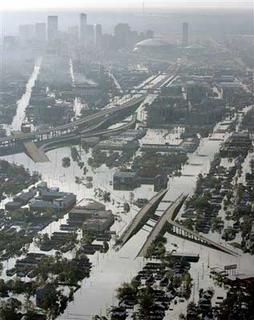
    Surviving Calamity

    Image © 2005 AP via DrudgeReport, 'fair use'

    Who among us isn't looking at the cataclysm that New Orleans has become, and hasn't wondered what things would be like in their neck of the woods should a similar catastrophe strike? Sure... not everyone lives in areas prone to hurricanes, but Nature has a veritable smorgasborg of disasters on an epic scale from earthquakes to tsunamis, volcanic eruptions to massive meteor strikes. Science fiction writers have made millions writing about the death and destruction that would ensue from such calamities and the ensuing chaotic aftermath. And then there's disasters of the man-made variety: epidemic, war and its aftermath, or terrorist attack.

    The aftermath of Hurricane Katrina has been like a disaster novel come alive. Fierce winds pummeled the Gulf Coast and left widepread destruction. A tremendous storm surge washed away buildings and roadways, altering the topology perhaps permanently. Most of us thought that, on the day after Katrina passed northward, God or fate or call it what you will had once again spared New Orleans, and that the worst case had not happened. We were wrong: New Orleans dodged one bullet but she relaxed too soon, only to run smack into the followup shot when the levees failed and the city slowly yet inexorably flooded.

    Is your community ready for a similar disaster? Are you ready for a similar disaster? What does "being ready" mean? It means that your household is ready to survive for a minimum of seven days in complete isolation from society, without the availability of utilities such as electricity, phone, and natural gas, without access to grocery stores or pharmacies, as if your household were transported to a deserted island.

    • Being ready means stockpiling sufficient food and water for your household to last seven days

    At a bare minimum, you should have one-half gallon of drinking water per person per day (that means 3.5 gallons per person for seven days of sufficiency). This water will be used for drinking only, not washing or cleaning. An easy way to obtain a water supply is to thoroughly clean your used one-gallon plastic milk containers as your family normally consumes the milk inside, and fill them with tap water. Do this for a few weeks until you have enough water stockpiled. Once you have sufficient water stockpiled, empty and refill one gallon every week as you rotate through the stockpiled water, ensuring that the water remains fresh. Additionally, keep pure chlorine bleach on hand as an expedient way of purifying water (16 drops of chlorine bleach per gallon should be sufficient to purify filtered water) as well as a water purification system although remember that these are adjuncts to, and not substitutes for, stockpiled water. Note that one-half gallon a day will lead to eventual dehydration under severe conditions, so you might want to stockpile even more water.

    Military MREs make good survival food; they come in environmentally-resistant packaging, they contain balanced, nutritious meals that have enough calories to sustain moderate to intense physical activity, and they can be eaten as-is and are provided with a means of heating them. No, they are not gourmet meals and yes, under normal conditions you will tire of them... but in an emergency you will devour them with gusto. MREs are bulky, but are fairly inexpensive and excellent for a limited duration stockpile that will be used to get your household past a short-term crisis of a week or two. I recommend that you stock a minimum of two MREs (2400-2600 calories total) per person per day for seven days (you can always eat less to prolong your food supply if necessary). Google the Web to find vendors.

    Don't forget necessary prescription meds. A good, stocked first-aid kit is also a necessity.

    • Being ready means stockpiling sufficient simple utilitarian tools and equipment to facilitate your survival

    Anyone who camps should have items such as tents, sleeping bags, backpacks, sturdy boots, and portable stoves that greatly facilitate surviving under extreme conditions. If you don't camp, you should consider buying such items and trying them out by camping out (in your backyard, at least). I guarantee that those folks who are still in New Orleans and who have tents and camp stoves and fuel are a lot better off than those who don't.

    If you live in a flood-prone area, then common sense indicates that you may be trapped in, or on, your house. Having some common tools, like a hatchet, a crowbar, and a hammer, could mean the difference between drowning in your attic or escaping. A folding shovel is an exceptionally useful item to keep in your vehicle (here's my favorite). It can save your life.

    You also need flashlights with sufficient batteries to last for at least a week of several hours-per-day usage. Consider obtaining rechargeable batteries and a source of power (such as a generator), and perhaps contacting an electrician to install a cut-out circuit that will allow you to power several circuits in your house from that generator while isolating your residence from the power grid (so your generator doesn't waste fuel attempting to power the neighborhood or endanger utility crews). Consider also alternate means of power generation (such as a solar cell) or getting a recharger that can utilize a car's 12-volt electrical system that can be used to recharge batteries.

    Dry storage for supplies is also important. I have many large Rubbermaid containers that I store camping gear in, that I grab for my camping and hunting trips. Each container is labeled so I know what is where, and I keep them stocked. In an emergency, I can grab a couple of these containers, bungee the lids closed, and toss them in the back of my pickup truck knowing that I have everything I need to survive living outdoors. I keep a couple of extras around that we store blankets in, to be used to store clothing (heavy jackets, extra trousers, shirts, socks, footware, etc.) and MREs in case we have to quickly leave our house. You know what? These float, too, meaning you can tow them behind you with little effort if you have to traverse a flooded area.

    • Being ready means acquiring sufficient weapons and training to defend yourself from those who would steal your stockpile or otherwise do you harm

    If you don't own firearms, then make the decision today to learn how to handle and use them safely and effectively... and buy a gun. If you truly believe that the government will always be able to protect you, and that ownership of weapons is a sign of sexual inadequacy, please save my bandwidth for more intelligent readers and skip reading the rest of this because your stupidity has condemned you to be one of the first victims of post-disaster anarchy.

    If you're still reading, then there's hope for you. All responsible law-abiding adults in your household should have at least one handgun, in a caliber and configuration suitable for self-defense (4" .38 Special revolver or 9mm pistol minimum), and should have had the minimum training necessary to be able to pass your local police qualification course. Additionally, your family should have at least one defensive rifle (16" AR-15 or Mini-14 or lever-action rifle in .357 Magnum, minimum) for every two adults (better to have one for each adult, and they should be identical) with a 'basic load' of magazines and ammo (210-300 rounds loaded in magazines if appropriate) and every adult should know how to load, fire, and maintain these rifles, and be able to hit a basketball-sized target at 50 yards at a minimum.

    Firearms are useless without ammunition. Obtain at least 300 rounds of ammunition for each firearm and at least four spare magazines per firearm (for those firearms that take detachable magazines). Obtain cleaning kits for each firearm as well and keep them stocked. A gun that won't fire due to inadequate maintenance is useless.

    Chances are, you'll never need these weapons. Good. If disaster strikes, and looters see that you can defend yourselves, chances are they'll bypass your household and look for those readers who skipped this section. If worse comes to worse, you'll most likely prevail... and if you don't then you are no worse off than if you never owned a gun in the first place.

    • Being ready means possessing sufficient means of communication to enable your household to stay in contact if neighborhood separation becomes necessary, and to communicate to areas outside the disaster area, without having to rely on the public communications infrastructure

    Cell phones are modern miracles of technology... that invariably fail when disasters hit. You can't rely on them in an emergency. Get a Technician-class amateur radio license ASAP and upgrade from Tech to General-class as soon as possible. The Technician license lets you own and operate two-way radios that transmit on frequencies above 30 Mhz which are excellent for local and regional communication. The General license lets you operate in the HF bands (1.8 to 30 Mhz) where you can communicate around the world on as little as 5 watts of transmitted power. Contact the ARRL for more information on amateur radio in the US.

    Once you get your Tech license, get a 5-watt handi-talkie (HT) that can be opened to operate outside the amateur radio bands, and open it. Do not operate outside the ham radio bands unless and until you are in a true emergency where you need to communicate in order to save lives or property from damage and have no other means of communication. Your HT should also have scanning and monitoring capabilities so you can listen to AM or FM radio, emergency Public Service frequencies, and National Weather Service broadcasts.

    Get enough FRS walkie-talkies for everyone in your household. Get everyone in your household familiar with using the FRS radios, and their shortcomings. In an emergency, your 'opened' amateur radio HT will be able to communicate with your (and others') FRS walkie-talkies, you will be able to stay in touch with everyone via FRS radios and frequencies, and you can use your HTs to obtain news and valuable information and to contact the authorities to arrange for rescue.

    Make auxiliary battery packs for your HTs that can utilize common, inexpensive 12-volt gel cell batteries. Unlike a $40+ factory battery pack, which only lasts a couple of hours, your homemade pack will cost under $20 and last for a couple of days.

    After you obtain your General license, get a portable HF transceiver and make your own antenna out of wire. This small setup will allow you to communicate outside the region, if necessary, to arrange for help or to share information. If Tom Hanks had packed one of these in his briefcase he never would have spent four years on a desert island and lost Helen Hunt to an ex-"Law and Order" detective cum dentist.

    • Being ready means possessing a viable means of transporting your household out of the disaster area if, and when, you determine that leaving your current location is necessary to ensure your survival

    Everyone mocks SUVs, but the best vehicle for emergency travel is a big honkin' SUV with four-wheel drive. You can tow a trailer behind it... or rescue someone else's car. You can haul all of your stockpiled food, water, supplies, and weapons, as well as your entire household. You can cross damaged roadways, traverse minor flooded areas, ram your way through looter roadblocks, and withstand gunfire better than with just about any other vehicle. If you live in a city like New Orleans and you know a flood is coming (say, the news alerts you to a levee breach), then load up the SUV and head to a highway overpass. Set up your tent outside, establish watches, and be ready to flee the area when the waters subside.

    If you live in flood-prone areas, such as river flood planes or, say, cities that are below mean sea level, perhaps a small johnboat or canoe might be a good idea... but only if you can store it at your house and where it won't be destroyed or rushed away by strong winds or flash floods.

    Whatever vehicle you have, keep at least a half-tank of gas in it at all times. Most natural disasters strike without warning, and you will not be able to pump gas from underground tanks when the power is out.

    • Being ready means not waiting until the last minute

    Don't wait until a couple days before a major hurricane is predicted to wipe out your city before starting to prepare. If the National Hurricane Center starts issuing press releases with words like "horrible" and "devastating" don't wait for your mayor to give the word. The majority of Orleaneans didn't wait for Mayor Nagin and his belated call for a mandatory evacuation; they listened to the urgent warnings from the National Hurricane Center and got out of Dodge before Katrina struck. Some might have felt a little silly on Tuesday morning, when the aftereffects of Katrina didn't seem too bad... just a little wind damage. I'm sure they feel a lot better now about their decision. They're alive.

    ---------------------

    Watching Katrina approach, and then overwhelm New Orleans and south Louisiana, where I went to high school and college and lived for more than a decade, has been particularly disturbing. As of today I still cannot contact many friends who live in the affected area, and my thoughts and prayers are with them. I am saddened and disgusted by the dregs of society who are taking advantage of the situation to wreak havoc on the city and its innocents, and I am heartened and encouraged by the numerous acts of courage and compassion by those in the maelstrom that is New Orleans, and by those outside who are expending considerable time and energy (and money) to help save the people of Louisiana, Mississippi, and Alabama who have been so devastated by this storm and its aftermath. Please, donate to the organizations that are rushing to help. My suggestions: The Salvation Army, The American Red Cross, and Mercy Corps.

    You can learn more about the Blog for Relief Day at Instapundit. Michelle Malkin also has information about how more than just New Orleans has been affected. And, Brendan Loy has done an outstanding job of Katrina-blogging; his sentiments on the performance of the city's leadership echo mine exactly.

    Update: Ed at Captain's Quarters has a post on how the primary responsibility for disaster planning lies with local governments. I would (and have) extended that line of thinking: the primary responsibility for disaster planning lies with each of us (as described above).

    Technorati tags:

    Monday, July 25, 2005

    What Not To Do When Challenged By The Police

    Last week, a man was shot and killed in London after he he fled when approached by several police officers, ran into an Underground station while being pursued by the police, and jumped onto a subway train.

    Mark Whitby said he was sitting on the Tube at Stockwell Station (search) on Friday when the man ran in to the train car. “As he ran, he was hotly pursued by what I knew to be three plain-clothes police officers,” Whitby told BBC News 24.

    "As the man got on the train I looked at his face. He looked from left to right, but he basically looked like a cornered rabbit, like a cornered fox,” Whitby said. "He looked absolutely petrified.”

    "He half-tripped, was half-pushed to the floor,” Whitby said. "One of the police officers was holding a black automatic pistol in his left hand. They held it down to him and unloaded five shots into him. I saw it. He's dead, five shots, he's dead."
    The man, who was wearing a thick, padded jacket and who had recently been spotted leaving a suspected terrorist safe house that was under police surveillance, was initially believed to be a homicide bomber due to his dress, his Arab-looking features, and his reactions after being confronted by police. It turns out, however, that the individual, Jean Charles de Menezes, a Brazilian national, was not a terrorist but instead was living and working in London illegally after the expiration of his work visa, and he evidently fled from the police so he wouldn't be deported back to Brazil.

    Predictably, some are outraged by what they see as an overreaction by the Metropolitan Police who, in their view, illegally gunned down an innocent man. My response: after two terrorist attacks in as many weeks that resulted in the deaths of scores of innocents on London subways and buses, what did Menezes expect? Yes, it is regrettable that an man who was guilty only of illegal immigration is dead. However, the only party to blame for this tragedy is Menezes himself.

    He knew what had been happening in London. He knew that police would be especially suspicious and cautious, and especially quick in any attempt to stop another terrorist attack. He knew his visa was expired and he alone made the decision to run.

    To those who think the police overreacted, put yourself in their place. Your city has been attacked by terrorists, and you probably have personally seen the bloody results of their carnage. Your department has made every effort to ensure the security of the citizenry while also planning for worst-case scenarios... and a pursued bomb-laden terrorist getting on the subway and detonating himself is about as worst-case as it gets. So... you receive orders to confront a man wearing a thick jacket, in the heat of the summer, who has been seen by police exiting a suspected terrorist nest. Several of you approach the suspect, and some of you are openly armed (which is extremely rare in London). Instead of stopping and showing identification when asked, the suspect instead immediately flees towards the nearest Tube stop and you, of course, pursue.

    Now we have a situation where an Arab-looking young man in a thick, padded jacket is fleeing the police and heading towards the subway. This meets every criteria of the terrorist bomber profile. Heavy, padded jacket in warm weather? Check! Looks Arabic? Check! Flees from police? Check! Heads for the subway, dear God? Check!

    At this point, Menezes' fate is just about sealed. The only thing he could have done to even possibly keep himself from being shot would have been to immediately take off his jacket and fling it away from himself, throw himself spread-eagled on the ground, and scream "I surrender!!" repeatedly... thus breaking the profile. We know, of course, that Menezes did not do this.

    Instead, he vaulted over the subway turnstiles, headed towards the nearest train, and jumped aboard with numerous police carrying shotguns, submachine guns, and handguns openly running after him, clearly convinced that Menezes was indeed a homicide bomber, realizing that perhaps they had only moments to live unless they absolutely and unfailingly prevented the suspect from detonating his bomb, and screaming to other passengers "Get out! Get out!" in an attempt to save as many innocent lives as possible in the probably case they failed.

    You see, if Menezes had been a homicide bomber, he would have blown himself up as soon as he got on the train, because even though the police were only seconds behind him, seconds are all that he would have needed. And, standard procedures when apprehending a homicide bomber suspect is, if you are lucky enough to get close enough to shoot him before he detonates himself, then shoot him repeatedly until you are convinced he can no longer act to blow himself up.

    Hey, if you don't want the greyhounds to chase you, don't act like the rabbit. It is obvious that the pursuing officers were convinced they would most likely be killed, yet rather than get the heck out of the subway they continued the pursuit and caught the suspect because it offered the only chance to save innocent lives. Knowingly risking violent death to save others is the classic definition of heroism.

    So, don't blame the heroes. Blame the person responsible. Blame Menezes, a man who died from terminal stupidity, who did everything wrong. It is a tragedy that an innocent man was killed. But the tragedy is the sole responsibility of the victim, Menezes, and not the London Metropolitan Police.

    For more on this subject, follow the link to Captain's Quarters.

    Update: Michelle Malkin is reporting that others have picked up on this theme.

    Monday, March 28, 2005

    Q & A: Whither ball for the .32 ACP?

    Q: What do you consider the best defensive ammo for the .32 ACP? I have a Beretta Tomcat and was wondering if I should carry ball or hollow-points? Which one will have better stopping power?

    A: Do not carry ball ammo for self-defense!

    The .32 ACP belongs to the class of what I call the "eye, ear, nose, and throat" guns... because those are your preferred aiming points. Seriously, the .32 ACP earned its anemic reputation as a poor self-defense round because shooting someone with ball ammo is akin to stabbing them with a .32" diameter Phillips head screwdriver. It hurts, it very well may kill them... eventually, from sepsis... but it isn't going to stop them unless you stab them in the right place. Carrying ball ammo in your Tomcat is an attempt to turn a sow's ear into a silk purse... and it ain't gonna work. Use Winchester Silvertips instead; they do expand because the lighter bullet goes fast enough, and they penetrate enough to let the expansion actually do some good.

    If you're bound and determined to carry ball in this caliber because you want penetration, you're fooling yourself and you're probably going to end up dead if you are forced to resort to using your gun and ammo in a defensive situation. If you really need penetration, because of winter and people are wearing thick clothes, etc., then choose another caliber--like the 9mm.

    There are two components to "stopping power", the physical and the psychological. Physical stopping power (absolute stopping power) is caused by turning the brain off by destroying enough vital tissue that the attacker can no longer function. Hit someone in the brain, the aorta, the carotid artery or jugular vein, the spinal column, or some other area where even a relatively minor injury will cause an immediately life-threatening or -ending injury, and they're going to be stopped.

    Psychological stopping power is the more uncertain of the two, and it occurs when the person who's attacking you becomes more worried about their own survival than in continuing the attack against you... whether or not your hit was life-threatening or whether or not you even have to shoot (that's why pointing a gun at the bad guy discourages many of them). For instance, hit someone in the shin with a bullet and it's going to hurt. Shoot them in the jaw and shoot out a few teeth on the way in, and it's going to hurt. Of course, for pyschological stopping power to have an effect, the person you have shot must have the mental wherewithal to realize that he has indeed been shot and to consider the potentially deleterious ramifications thereof.

    I have talked to police officers who are dealing with people on crystal meth, or PCP, on a regular basis. People under the influence of these drugs can become fairly numb to pain, and can also be in a psychotic state where reality won't intrude. My LE friends have told me of being attacked by a naked PCP freak (seems a recurrent theme is for PCP addicts to end up naked because the drug makes them think they're really hot... even in the winter), and breaking this person's arm with a restraining hold yet the attacker still kept trying to attack because he felt no pain and didn't realize his arm was broken. That's when you see a bunch of cops clubbing an attacker with their batons, pepper-spraying them (they don't feel pain, but swollen membranes make it hard for them to breathe), etc. Shades of Rodney King (who I believe was "dusted").

    If you are attacked by someone on PCP, or crystal meth, or some other substance that deadens pain and reduces the user to an animal, raging state once the adrenaline starts flowing, then chances are you are going to have to physically destroy enough of their body to eliminate their capability to continue the attack because they aren't going to respond to psychological stopping power. These criminals are the reason we have .223s and 12ga shotguns loaded with double-ought buck. Like the Moro juramentados in the Phillipine Insurrection who withstood multiple hits from the .38 Special and kept on coming (some of those guys were shot repeatedly with .30-40 Krags and kept on coming), and like a charging grizzly, you're going to have to shoot for bone and break them down.

    The .32 ACP is really too anemic to be a primary self-defense handgun. I know, they're nice to carry (I have a Seecamp), but they're really the gun you carry when you can't carry anything bigger... and you need to realize you are basically shooting a .32" drill. My strategy when I'm carrying the .32 has always been to load it with Silvertips, act like a complete wuss if someone confronts me with a deadly weapon, sucker them into complacency, and then ambush them as I go to draw my 'wallet' and empty the gun into their upper chest and neck... and then running like hell.

    Quite frankly, a S&W Airlight weighs less than a Seecamp or Guardian (and not much more than a P32), hits a lot harder, penetrates a lot better, is more reliable than any semiautomatic, isn't that much harder to conceal... can you see why I seldom carry my Seecamp anymore? Also, despite the rudimentary sights, I have no problem keeping them all on a B27 or IPSC target at 25 yards, and head shots within 10 yards rapid fire are also easy (all it takes is proper instruction and practice).

    So, in summation my advice is:
    • carry Silvertips
    • practice shooting at close range until you can empty the gun quickly into your target without missing
    • be prepared to run
    • carry a larger caliber if at all possible

    That answer your questions?


    NB: Other gun-related articles, in my 'Lessons Learned' series that describes gun fights and what we can learn from them, can be found here and here.

    Tuesday, March 01, 2005

    Lessons Learned

    A man was killed in Tyler, Texas on February 24, 2005, as he attempted to stop a murderer who had already killed his ex-wife and wounded his son at the Tyler Courthouse during a bitter child-support dispute. Mark Allen Wilson, 52, was in his apartment overlooking the courthouse square when he heard gunshots, grabbed his Glock 9mm handgun, and went out to confront the shooter, David Hernandez Arroyo Sr.
    "They traded shots, missing each other, and then the gunman hit Wilson and Wilson went down," said Nelson Clyde III, publisher of the Tyler Morning Telegraph, recalling the shooting as he watched from Don Juan's.

    "The gunman walked up to Wilson and shot him while he was on the ground," Clyde said. "I couldn't believe what I was seeing ... it was sickening."

    "He was either wounded or dead, but the guy (Arroyo) shot him again to make sure he wouldn't get up," said witness Brandon Malone, a Tyler builder who was lunching inside Don Juan's.
    According to another eyewitness account (see the comments), Wilson actually shot the gunman several times, but his rounds had no effect because the gunman was wearing a military flack jacket over a bullet-proof vest. Wilson then took cover behind a pickup truck (that coincidentally happened to be the gunman's). The gunman closed the distance and then maneuvered around the truck, shooting Wilson several times at close range with an AK-47 rifle, and finishing him off with a shot to the head. The gunman then drove off, followed by another witness to the events, and was shortly cornered and killed by responding police in the ensuing shootout.

    I salute Mark Wilson for his courage in running to the sound of the guns. How many of us would do the same? Police credit his intervention with saving the life of Arroyo's son. Mark Wilson was a very brave man, who paid the ultimate price for helping others. What can we learn from this?

    Being that he was at his house, why didn't Wilson grab a rifle or a shotgun instead of his handgun? Think how this story would have ended if he had grabbed, say, an AR-15 (every patriotic American should own an AR-15 as their 'Stuff Hits The Fan' gun).


    A view of the Courthouse square, steps in foreground.
    The flowers on the steps are where Arroyo killed his wife,
    flowers across the street in front of yellow building where
    Wilson was killed, Wilson's apartment in
    building at right with arched windows.
    (Image courtesy of 'Blackfork6' via Geek with a .45)


    The Bad Guy's vest wouldn't have stopped the rounds... and if it did a headshot would have been far easier. From the pictures of the courthouse I've seen (see above), I believe Wilson could have engaged the Bad Guy from his front door, or even his apartment window, very effectively with a rifle and with relative safety. Or, think how several rounds of 00 buck would have made shredding the Bad Guy's legs, arms, and/or head a lot easier at the relatively short range that this gunfight occurred, or how a slug would have made hash of the Bad Guy's vest, or at least broken some ribs beneath it.

    Above all, all of us who carry guns for self-defense need to remember that when the chips are down and Plan A isn't working, then go to Plan B... or Plan C... or Plan D. And we need to have alternatives already thought out, because once the bullets start flying there isn't a lot of time to think. If you shoot a Bad Guy in the body and he doesn't react, shoot him somewhere else! Head shots are a lot easier if the Bad Guy is lying on the ground (and still posing a threat) than if he up on his feet and running back and forth. If you are forced to go to cover behind a vehicle, look for other parts of his body to engage (feet, legs, etc.). This was the successful strategy used by LAPD SWAT during the North Hollywood bank robbery shootout; the good guys went down to avoid the bad guy's shooting, saw his legs and feet, and started pouring in rounds. Plan B (or C, or D) might be to run away, and although you can't outrun a rifle bullet you can outrun someone you just shot in the foot or ankle or shin or thigh, who might then be more concerned about his mangled leg, blood loss, and the massive pain caused by multiple broken bones than someone disappearing between cars a block away.

    Again, this isn't to criticize Mark who was a very brave man. It is for the rest of us to think realistically about what it means to use a gun in defense of ourselves and others, to remember that guns (especially handguns) aren't the Hammer of Thor and that we need to consider what we do next when we put a few in the ten-ring and our opponent's only reaction is anger, and to have a plan, and a second plan to use when the first plan fails. Guns don't win gunfights, tactics win gunfights.

    Rules To Live By (a distillation of numerous classes and conversations with those far more qualified than I):

    • Never take a handgun to a gunfight if a long gun is available. A handgun is what we use to fight to get to our long gun.

    • Never take your eyes off of your opponents; if you duck behind a car, get down to ground level so you can see his feet, see where he's heading, scoot around to keep the car between you and him, and shoot him in the feet if possible to eliminate his mobility.

    • Never do at close range what you can do at long range, and remember that you don't have to get close enough to the bad guy to hit him with the gun, just close enough to hit him with the bullets. A gun (even a handgun) isn't a contact weapon and if you're reduced to using it as such you're screwed.

    • The ideal tactical situation in a gunfight is to be where you can effectively bring fire on your opponent and he cannot return the favor. Let your opponent stand out in the open while you're behind cover. Don't leave cover unless it's for a good reason. Don't ever stand toe-to-toe; distance is the ally of the good marksman. Don't give your opponent a chance.

    • Never forget that running away is a viable tactic; "those who fight and run away fight again another day."

    • If you choose to get involved in a gunfight (rather than being dragged into one kicking and screaming), you had better figure a way out if things aren't working if you are at all interested in surviving.

    • The only way you win a gunfight is by not being shot. If you and your opponent are both shot, you both lose.

    I hesitate to use the word "hero" because it is so often used to describe people who really aren't heroic. Sports figures who play children's games for millions of dollars aren't heroes. Neither are sleazy politicians who commit perjury, hide behind semantics, and claim glory for earning a comtempt citation and the loss of their law license. Every once in a while, however, we see an example of real heroism, where someone among us shows tremendous physical and moral courage and risks his life to help others. The firefighters and police of New York City on September 11 who ran to the burning towers come to mind, as do people like the passengers of Flight 93, football player-turned-Army Ranger Pat Tillman and others who have given their all to help make us safer. Mark Wilson is another real hero, and we are diminished by his passing.

    Here's to you, Mark Wilson. You had the courage to try. Rest in Peace.

    NB: Other gun-related articles, in my 'Lessons Learned' series that describes gun fights and what we can learn from them, can be found here. I also write on .32 ACP defense ammo that is perhaps the most-read article on this blog, here.

    Notes: More on Mark Wilson in the links above, and from the blogs of Greek with a .45, The Smallest Minority, and The Carnival of Cordite at Resistance is futile! who clued me into this story (hat tip to Instapundit). In fact, this will be my entry into next week's carnival.

    Update:Other blogs are discussing this as well, from several different points of view. Here's a link to a good summary, and here's another.

    Tuesday, January 25, 2005

    The Case For Violence

    I'm a big fan of violence. Not in the movies, mind you, but in real life and only when called for. I don't understand those who decry every use of violence with the tired old cliche of "Violence never solves anything." Do these people read history books? When it comes to deciding disagreements, violence solves everything.

    Don't believe me? Ask the Carthagenians, the Moors, the Mongols, Native Americans, Imperial Japan, Nazi Germany, etc. Violence may not solve things in the way the losers prefer (or the winners prefer, for that matter) but things definitely are solved. I think history argues that the problem with using violence to solve disagreements is not violence per se, but that too often half-measures are used. The losers aren't convinced they lost, problems crop back up, and the winners have to go and kill lots more people and break lots more things... which wouldn't have to be done if they'd only gone in right the first time.

    I ran across this website while perusing information on PalmOS programming (don't ask me how I got there). The author seems to be a good fellow and he's a good writer, yet he gets it all wrong here... not just on why we went to war in Iraq but on the usefuless of war in general. He writes:

    But all those excuses, boiled down, equal only this: Oil from the Middle East powers our free market economy, and Iraq sits on the world’s second-largest known supply. Saddam Hussein’s resistance of the western world threatened our financial security. His rumored weapons programs and ties to terrorist groups gave us all the evidence we needed to justify a pre-emptive strike.
    Uhhh... that's fine except it all doesn't come down to this. We didn't invade Iraq because of oil. We invaded Iraq because after 9/11 (and before, really, but as a nation we were unwilling to face facts) we could not afford to let an amoral dictator with billions of petro-dollars, the resources of a nation-state, and the willingness to develop WMDs and pass them to terrorists have the freedom and ability to do just that.

    If it was all about the oil, we'd have our troops securing the oilfields and pipelines while the rest of Iraq stewed in its juices. Or, we would have just reached an accomodation with Saddam: kill as many Iraqis, Kuwaitis, and Iranians as you want as long as the price of oil stays below $15 a barrel.

    But violence can never defeat violence. And Christians who support the idea of a "just war" may not be serving the same God that Jesus called his Father.
    Fortunately, violence can, and has, defeated violence. In fact, violence in and of itself is not necessarily a bad thing. Violence is a tool, and like any other tool the morality of violence is determined by the purpose of its use. Was it immoral to use violence to defeat Adolf Hitler and the Nazis? Even the Bible states that there is a purpose for violence. In Ecclesiastes 3:1-8, the Bible notes that "To everything there is a season... a time to kill and a time to heal...." The Iraq War was a time to kill, just as our efforts to rebuild Iraq and establish a democracy despite attacks by terrorists are done during a time to heal.

    The problem with condemning all violence is that you end up throwing out the baby with the bathwater. Yes, it is obviously right to condemn the violence of, say, a rapist, just as it is obviously wrong to condemn the violence of the police officer... or victim... who uses violence to defeat the rapist. To believe otherwise is to morally equate the status of rapist with that of victim, or policeman... the sinner is no worse than the one protecting from sin. In other words, equating the acts of a sinner with the acts of a non-sinner. And that obviously flies in the face of everything that Christians believe.

    Bismark said that war is diplomacy by other means. It's obvious to any thinking person that when two nation-states disagree about something strongly enough to fight over it, the goal is not war, the goal is to force the enemy to submit to your will. In such a case, if war is warranted by the seriousness of the disagreement (it must be serious enough to represent an existential threat in order for war to be justified), then it well behooves the combatants to use force strongly and swiftly and sufficiently to quickly decide the issue. Further, it is both strategically unsound and immoral to use insufficient force when force is called for. Think of the Vietnam War here; 57,000 American dead, one million South Vietnamese dead, two million North Vietnamese dead, millions more wounded, the US failed to accomplish its strategic goal of keeping Southeast Asia out of totalitarian control resulting in several million more deaths in Vietnam and Cambodia after the war... and it all could have been prevented if LBJ had possessed the courage to invade North Vietnam and capture Hanoi. Or better yet, if Truman had had the courage to support Ho Chi Minh and tell the French Non! when they insisted on keeping Vietnam as a colony after WWII in an attempt to salvage French pride.

    I'll end this with a question: what caused pacifism to become more important than confronting evil in mainstream European and American Christian belief? In my opinion, the short answer is the carnage of World War I. I'll elaborate on this in a future post.