The whole PlameGate thing is much ado about nothing. Yet I understand why the press is in a frenzy, as are the Democrats. Since Watergate, using the legal system against political opponents has become an art form, and no one is better at it than the Democrats and their fellow travelers in the mainstream media.
Yes, lying under oath is a big deal. Libby should have resigned... and he did. Too bad the Democrats and Bill Clinton didn't think that resigning was the appropriate thing for someone who has committed perjury to do. But, the Dems only hold Republicans up to a high standard. I guess that is a complement.
Note also that the reason Libby was caught in a lie is because every single other White House staffer who was questioned, including Rove, contradicted Libby's testimony. There was no stonewalling here, no Rose Garden press conferences defending the person under indictment. Instead, the president let it be known that an indictment would need to be followed by a resignation. Contrast that with William Jefferson Clinton's statement to Dick Morris after the latter warned him against the political and legal firestorm that would ensue if Clinton lied about Monica Lewinsky: "Well, I guess we'll just have to win, then."
And, speaking of lies, it should be obvious to anyone who can read the bipartisan 911 Commission Report that the biggest liar in the Plamegate scandal is none other than Joe Wilson, Ms. Plame's husband. His leak to Nicholas Kristol that started the furor over Iraqi attempts to buy yellowcake in Africa, his op-ed in the New York Times, and his testimony to the 911 Commission have all been proven to be riddled with lies. How about a little mainstream media focus on Mr. Wilson and his lies? How about indicting him for perjury in his testimony?
Re Libby being the first White House official to be charged with a crime since the days of Grant, how about Watergate? And, is the Clinton White House staff exempt because Monica plea-bargained, Bill committed perjury, and everyone else who faced indictment was either elected (Al Gore, for campaign law violations) or a Cabinet-level official, or resigned before they were indicted?
Libby was foolish to lie when it seems evident that he broke no law. The law in question describes outing an agent as a crime when that agent is undercover, the people who out that agent know the agent is undercover and that blowing the cover will endanger the agent's life, and they do it anyway. Valerie Plame Wilson's neighbors knew she worked for the CIA. The woman posed with her husband in 'Vanity Fair' magazine, for criminy's sake. Her cover had been blown years earlier; that's why she worked in-house as a WMD analyst.
What does this so-called 'scandal' prove about Democrats and Republicans? About honesty?
It proves is that the Democrats are more accomplished liars who, unlike the Republicans, rally around their fellow liars and mischaracterize and then deny the lie rather than forcing them to face the music. If only Libby had uttered "Valerie Plame!" during a moment of passion with Judy Miller. Then, he could use the Clinton defense: it's all about sex!
It proves that the Democrats and their fellow travelers in the mainstream media are intent on fighting the issue of whether we were justified in going to war in Iraq years after its relevancy has passed.
It proves that the Democrats would rather defeat George Bush than Al Quaeda and the Iraqi insurgents, and if it takes losing the War on Terror to win the White House, then that is the price they're willing to pay.
The scary thing it proves is that the CIA is effectively able to oppose the elected head of the executive branch, enough to at least politically damage the president and reduce his effectiveness at governing, and at worst to give his political opponents enough ammunition to hound the president or vice-president from office. This isn't Allende's Chile in 1973. This is America, at war, in 2005, and elements in the CIA have actively worked to cripple the president's ability to govern.
The anti-war Left blames Bush, calling him a liar because he supposedly went to war based on false intelligence. Funny, (not so funny, really) how that intelligence came from the CIA... the same source of the current scandal.
Saturday, October 29, 2005
Wednesday, September 14, 2005
They Mean To Govern Well...
It is hardly too strong to say that the Constitution was made to guard the people against the dangers of good intentions, real or pretended.... There are men in all ages who mean to exercise power usefully—but who mean to exercise it. They mean to govern well; but they mean to govern; they promise to be kind masters, but they mean to be masters. – Daniel Webster (ht: Jim Leth)There was considerable outrage last week when Mayor Nagin directed the remnants of the New Orleans Police Department to confiscate legally-owned firearms from law-abiding residents of New Orleans. Nagin justified the move as a means of re-establishing control over the city and avoiding resistance to his policy of forcibly evacuating city residents. In order to carry out the Mayor's policy, the NOPD, assisted by federal marshals and military police, have forcibly entered private households without probable cause or a warrant and seized lawfully-owned private property.
The uproar over this policy was immediate and widespread. DavidKopel, a noted constitutional attorney, quickly pointed out that the Mayor's order was illegal on both procedurally and constitutionally. The NRA got into the act a few days later:
"The NRA will not stand idly by while guns are confiscated from law-abiding people who’re trying to defend themselves," he [Chris Cox, NRA-ILA director] said.
"We’re exploring every legal option available to protect the rights of lawful people in New Orleans," Cox said, "and we’re taking steps to overturn such laws in every state where they exist."
Here we are, a week later, and after considerable furor, it seems that the confiscation policy has been effectively, if not explicitly, rescinded. No more confiscations are occurring, and the federal government announced that it would not allow its military or civilian personnel to assist the city forcibly evacuate non-willing residents. Hopefully, they have also been told to refrain from any other type of constitutionally dubious actions. Of course, under Louisiana state law the Mayor would have to repeatedly re-issue his order (there is considerable doubt whether he legally issued the order in the first place) every five days. Thank God the state legislature realized that one way to reign in out-of-control officials who enacted idiotic policies during emergencies was to give those policies a very short lifetime.
What's next?
This is America! Time for a lawsuit! A massive lawsuit against the Mayor, the City of New Orleans, and any federal agency that was involved in this clearly unconstitutional policy is the proper, legitimate means of discouraging future acts of stupidity by panicked, incompetent officials. Contact everyone who suffered under this odious policy and make it a class-action suit.
Oh, and something else needs to happen: gun owners in New Orleans should organize a petition drive to recall the Mayor and call for new mayoral elections. Set up a website to contact evacuees, and get this ball rolling ASAP.
What's that, you say? The mayor was trying to do what he thought was best for the city? Doesn't cut it; the mayor has legal advisors that should have been consulted and that should have strongly advised him against such a policy. Incompetence, ignorance, or capriciousness... none are a valid excuse.
Here in America the ends don't justify the means. New Orleans is a beautiful city with a unique and vibrant culture that has been woefully mismanaged for decades. Many areas are effectively lawless, and the police literally will not go into certain neighborhoods unless they move in with overwhelming force to handle a specific complaint. These neighborhoods are effectively ceded to the control of the thugs who terrorize innocent residents, and the city's murder rate makes it the Homicide Capital of America for two years in a row. Yet we don't solve the problem by cordoning these areas off and napalming them. To any reasonably-informed and thinking American (which, it seems, excludes Mayor Nagin), kicking people's doors in, lining them up against the wall at gunpoint, searching the household for guns, and taking the guns without probable cause is obviously unconstititutional and equally repugnant. Mayor Nagin's approach seems to be "So much for the rule of law if it gets in the way of what I think is a good idea."
America is what it is because it was the first nation-state in the history of the world to govern itself by the rule of law, and to declare individual rights as inviolable: all men are created equal under the law and are guaranteed certain rights, among them the right of freedom of speech and thought, the right to be free from unreasonable searches and seizures, the right against self-incrimination, the right to due process, and lastly the right to keep and bear arms. The anarchy following the complete disintegration of civil authority in New Orleans after Katrina is a prime example of why, in order to protect their right to life and property, law-abiding residents needed to exercise their right to keep and bear arms.
The stories coming out of the city about how people were able to protect themselves and drive off looters speaks volumes for the relevance of the Second Amendment and the wisdom of our country's founders. Sadly, the story of police-state tactics and the trampling of fundamental rights speaks volumes, too... and it's all bad.
I grew up in small-town south Louisiana and spent several years living in New Orleans and Baton Rouge during and after college, so I think it's fair to say I have a reasonably good idea of what's wrong with the state, and how to fix it. To my friends in New Orleans and throughout Louisiana, I say this: you deserve better! Fix the problem. Get rid of the idiots and quit electing them! And hold the current idiots responsible for all of their lapses, constitutional and otherwise!
Update (19 Sept 05): Michelle Malkin has some comments on the subject that are worth reading (read the referenced articles, also). And, it looks like the idea of holding leaders responsible is gaining popularity. But don't forget about Nagin! (ht: Instapundit)
Monday, September 12, 2005
Lies, Damned Lies, and Polls... er, Statistics
John Zogby has this to say about the results of his latest poll:
Also, concerning Kerry, you have to consider the comparison. Kerry's political career ended back in August 2004; the November presidential election was merely the sound of dirt hitting the coffin. What does it say about a political party when John Kerry, an arrogant, immature, self-aggrandizing bullshitter, is the best candidate they can come up with? What does it say about a candidate when he still can't beat Bush at Bush's lowest point?
And then, on to the Instapundit: Bush's weakness as a candidate is more a reflection of perception than reality. Need I point out that Bush's numbers were a lot higher in the late summer and fall of 2004 than they are now? Every Republican president either knows going in, or comes to understand, that the press really isn't impartial. Not when 90% of the press simultaneously declare their objectivity and their identification as, and agreement with, Democrats. How else do you explain the resounding silence on Kerry's war record (he has yet to fully disclose his military records to the press as he promised repeatedly, as recently as last January)? How else do you explain the rush to bring forth the Texas National Guard "memos" supplied by Bill Burkett, that were so obviously false that casual observers on a blog could spot the forger's mistakes?
Glenn doesn't think much of Bush as president either:
I also think it's fair to point out that Bush has also made mistakes. A big mistake was not housecleaning the Executive Branch in the manner of the Clintons; much of his agenda has been attacked, and sabotaged, by administration opponents who work in the administration. Appointing Colin Powell as SecState was, in hindsight, another mistake, albeit one that was quickly rectified after the '04 election. However, the biggest mistake (and it is an ongoing one) is the absolute failure of the Bush Administration to use the power of the bully pulpit to push their agenda and to respond to critics' attacks. A major strength of Bush's character is the fact that he really doesn't care what people think of him as long as he is doing what he believes is right; that is admirable in a person but potentially fatal in a politician.
Bush is the type of person that everyone always claims to want in the office: reflective, principled, and more concerned about doing the right thing than being popular. He is virtually the anti-Bill Clinton, and historians will undoubtedly find it interesting that the electorate turned from one to the other. However, he is also a skilled politician who has benefitted from the combined arrogance and ignorance of his opponents who tend to continually "misunderestimate" Bush to their detriment. I think that history, and hindsight, will be far kinder to him than Glenn Reynolds is today.
Glenn Reynolds adds:In our new poll, every president since Carter defeats Bush. But Kerry still loses to Bush by one point. What am I missing here?
It says a lot about what a weak candidate Kerry was, doesn't it? It also underscores Bush's weakness. I said from the beginning that he was a weak candidate, and vulnerable in 2004, but the Democrats managed to put up a guy that he could beat. (I was prophetic in 2003: "I'm always hesitant to disagree with Barone -- but I think that Bush is far more vulnerable than most commentators suggest. The real question, I guess, is whether he'll be vulnerable to whoever the Democrats nominate." Survey says -- nope!)I'll answer Zogby first: the reason your poll numbers are where they are right now is because of the non-stop lambasting that Bush has taken in the press over the past six weeks (really, over the past five years). Much of the lambasting has been unsubstantiated by the facts, and most of it has been unfair. What your poll is really reporting is the effectiveness of the MSM attack machine at its peak.
Also, concerning Kerry, you have to consider the comparison. Kerry's political career ended back in August 2004; the November presidential election was merely the sound of dirt hitting the coffin. What does it say about a political party when John Kerry, an arrogant, immature, self-aggrandizing bullshitter, is the best candidate they can come up with? What does it say about a candidate when he still can't beat Bush at Bush's lowest point?
And then, on to the Instapundit: Bush's weakness as a candidate is more a reflection of perception than reality. Need I point out that Bush's numbers were a lot higher in the late summer and fall of 2004 than they are now? Every Republican president either knows going in, or comes to understand, that the press really isn't impartial. Not when 90% of the press simultaneously declare their objectivity and their identification as, and agreement with, Democrats. How else do you explain the resounding silence on Kerry's war record (he has yet to fully disclose his military records to the press as he promised repeatedly, as recently as last January)? How else do you explain the rush to bring forth the Texas National Guard "memos" supplied by Bill Burkett, that were so obviously false that casual observers on a blog could spot the forger's mistakes?
Glenn doesn't think much of Bush as president either:
Bush is, in my estimation, adequate as President, but not much more. I've thought that all along -- which is why you've never seen the kind of lyrical praise of Bush here that once appeared at Andrew Sullivan's place, or the kind of disappointment with Bush you see at Sullivan's place now. But in a world of goofy-looking yet pompous empty suits, the adequate man is . . . President. And the Democrats made sure that this was the choice we had in 2004.Everyone's entitled to their opinion, especially someone who self-identifies as the InstaPundit. However, I think it's fair to ask Professor Reynolds about his grading criteria. After all, Bush is the first president since his father (back in 1988) to win a majority of the popular vote. Bush is the first president since FDR to see his party's lead in Congress increase during a mid-term election. Facing a bitterly divided Congress and a hostile Senate for his first term, Bush still managed to get his major legislation passed. Contrast this to the Clinton Administration, their reneging on all of their major campaign promises before the first inauguration, and the stunning losses among the Democrats in Congress that reversed control of that branch of government for the first time in 40 years. All of Bush's successes should go into the 'plus' column.
I also think it's fair to point out that Bush has also made mistakes. A big mistake was not housecleaning the Executive Branch in the manner of the Clintons; much of his agenda has been attacked, and sabotaged, by administration opponents who work in the administration. Appointing Colin Powell as SecState was, in hindsight, another mistake, albeit one that was quickly rectified after the '04 election. However, the biggest mistake (and it is an ongoing one) is the absolute failure of the Bush Administration to use the power of the bully pulpit to push their agenda and to respond to critics' attacks. A major strength of Bush's character is the fact that he really doesn't care what people think of him as long as he is doing what he believes is right; that is admirable in a person but potentially fatal in a politician.
Bush is the type of person that everyone always claims to want in the office: reflective, principled, and more concerned about doing the right thing than being popular. He is virtually the anti-Bill Clinton, and historians will undoubtedly find it interesting that the electorate turned from one to the other. However, he is also a skilled politician who has benefitted from the combined arrogance and ignorance of his opponents who tend to continually "misunderestimate" Bush to their detriment. I think that history, and hindsight, will be far kinder to him than Glenn Reynolds is today.
Thursday, September 01, 2005
Surviving Calamity
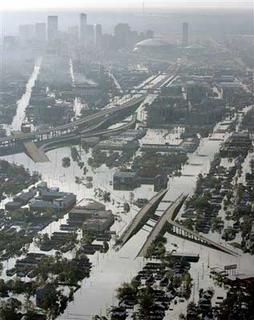
Who among us isn't looking at the cataclysm that New Orleans has become, and hasn't wondered what things would be like in their neck of the woods should a similar catastrophe strike? Sure... not everyone lives in areas prone to hurricanes, but Nature has a veritable smorgasborg of disasters on an epic scale from earthquakes to tsunamis, volcanic eruptions to massive meteor strikes. Science fiction writers have made millions writing about the death and destruction that would ensue from such calamities and the ensuing chaotic aftermath. And then there's disasters of the man-made variety: epidemic, war and its aftermath, or terrorist attack.
The aftermath of Hurricane Katrina has been like a disaster novel come alive. Fierce winds pummeled the Gulf Coast and left widepread destruction. A tremendous storm surge washed away buildings and roadways, altering the topology perhaps permanently. Most of us thought that, on the day after Katrina passed northward, God or fate or call it what you will had once again spared New Orleans, and that the worst case had not happened. We were wrong: New Orleans dodged one bullet but she relaxed too soon, only to run smack into the followup shot when the levees failed and the city slowly yet inexorably flooded.
Is your community ready for a similar disaster? Are you ready for a similar disaster? What does "being ready" mean? It means that your household is ready to survive for a minimum of seven days in complete isolation from society, without the availability of utilities such as electricity, phone, and natural gas, without access to grocery stores or pharmacies, as if your household were transported to a deserted island.
• Being ready means stockpiling sufficient food and water for your household to last seven days
At a bare minimum, you should have one-half gallon of drinking water per person per day (that means 3.5 gallons per person for seven days of sufficiency). This water will be used for drinking only, not washing or cleaning. An easy way to obtain a water supply is to thoroughly clean your used one-gallon plastic milk containers as your family normally consumes the milk inside, and fill them with tap water. Do this for a few weeks until you have enough water stockpiled. Once you have sufficient water stockpiled, empty and refill one gallon every week as you rotate through the stockpiled water, ensuring that the water remains fresh. Additionally, keep pure chlorine bleach on hand as an expedient way of purifying water (16 drops of chlorine bleach per gallon should be sufficient to purify filtered water) as well as a water purification system although remember that these are adjuncts to, and not substitutes for, stockpiled water. Note that one-half gallon a day will lead to eventual dehydration under severe conditions, so you might want to stockpile even more water.
Military MREs make good survival food; they come in environmentally-resistant packaging, they contain balanced, nutritious meals that have enough calories to sustain moderate to intense physical activity, and they can be eaten as-is and are provided with a means of heating them. No, they are not gourmet meals and yes, under normal conditions you will tire of them... but in an emergency you will devour them with gusto. MREs are bulky, but are fairly inexpensive and excellent for a limited duration stockpile that will be used to get your household past a short-term crisis of a week or two. I recommend that you stock a minimum of two MREs (2400-2600 calories total) per person per day for seven days (you can always eat less to prolong your food supply if necessary). Google the Web to find vendors.
Don't forget necessary prescription meds. A good, stocked first-aid kit is also a necessity.
• Being ready means stockpiling sufficient simple utilitarian tools and equipment to facilitate your survival
Anyone who camps should have items such as tents, sleeping bags, backpacks, sturdy boots, and portable stoves that greatly facilitate surviving under extreme conditions. If you don't camp, you should consider buying such items and trying them out by camping out (in your backyard, at least). I guarantee that those folks who are still in New Orleans and who have tents and camp stoves and fuel are a lot better off than those who don't.
If you live in a flood-prone area, then common sense indicates that you may be trapped in, or on, your house. Having some common tools, like a hatchet, a crowbar, and a hammer, could mean the difference between drowning in your attic or escaping. A folding shovel is an exceptionally useful item to keep in your vehicle (here's my favorite). It can save your life.
You also need flashlights with sufficient batteries to last for at least a week of several hours-per-day usage. Consider obtaining rechargeable batteries and a source of power (such as a generator), and perhaps contacting an electrician to install a cut-out circuit that will allow you to power several circuits in your house from that generator while isolating your residence from the power grid (so your generator doesn't waste fuel attempting to power the neighborhood or endanger utility crews). Consider also alternate means of power generation (such as a solar cell) or getting a recharger that can utilize a car's 12-volt electrical system that can be used to recharge batteries.
Dry storage for supplies is also important. I have many large Rubbermaid containers that I store camping gear in, that I grab for my camping and hunting trips. Each container is labeled so I know what is where, and I keep them stocked. In an emergency, I can grab a couple of these containers, bungee the lids closed, and toss them in the back of my pickup truck knowing that I have everything I need to survive living outdoors. I keep a couple of extras around that we store blankets in, to be used to store clothing (heavy jackets, extra trousers, shirts, socks, footware, etc.) and MREs in case we have to quickly leave our house. You know what? These float, too, meaning you can tow them behind you with little effort if you have to traverse a flooded area.
• Being ready means acquiring sufficient weapons and training to defend yourself from those who would steal your stockpile or otherwise do you harm
If you don't own firearms, then make the decision today to learn how to handle and use them safely and effectively... and buy a gun. If you truly believe that the government will always be able to protect you, and that ownership of weapons is a sign of sexual inadequacy, please save my bandwidth for more intelligent readers and skip reading the rest of this because your stupidity has condemned you to be one of the first victims of post-disaster anarchy.
If you're still reading, then there's hope for you. All responsible law-abiding adults in your household should have at least one handgun, in a caliber and configuration suitable for self-defense (4" .38 Special revolver or 9mm pistol minimum), and should have had the minimum training necessary to be able to pass your local police qualification course. Additionally, your family should have at least one defensive rifle (16" AR-15 or Mini-14 or lever-action rifle in .357 Magnum, minimum) for every two adults (better to have one for each adult, and they should be identical) with a 'basic load' of magazines and ammo (210-300 rounds loaded in magazines if appropriate) and every adult should know how to load, fire, and maintain these rifles, and be able to hit a basketball-sized target at 50 yards at a minimum.
Firearms are useless without ammunition. Obtain at least 300 rounds of ammunition for each firearm and at least four spare magazines per firearm (for those firearms that take detachable magazines). Obtain cleaning kits for each firearm as well and keep them stocked. A gun that won't fire due to inadequate maintenance is useless.
Chances are, you'll never need these weapons. Good. If disaster strikes, and looters see that you can defend yourselves, chances are they'll bypass your household and look for those readers who skipped this section. If worse comes to worse, you'll most likely prevail... and if you don't then you are no worse off than if you never owned a gun in the first place.
• Being ready means possessing sufficient means of communication to enable your household to stay in contact if neighborhood separation becomes necessary, and to communicate to areas outside the disaster area, without having to rely on the public communications infrastructure
Cell phones are modern miracles of technology... that invariably fail when disasters hit. You can't rely on them in an emergency. Get a Technician-class amateur radio license ASAP and upgrade from Tech to General-class as soon as possible. The Technician license lets you own and operate two-way radios that transmit on frequencies above 30 Mhz which are excellent for local and regional communication. The General license lets you operate in the HF bands (1.8 to 30 Mhz) where you can communicate around the world on as little as 5 watts of transmitted power. Contact the ARRL for more information on amateur radio in the US.
Once you get your Tech license, get a 5-watt handi-talkie (HT) that can be opened to operate outside the amateur radio bands, and open it. Do not operate outside the ham radio bands unless and until you are in a true emergency where you need to communicate in order to save lives or property from damage and have no other means of communication. Your HT should also have scanning and monitoring capabilities so you can listen to AM or FM radio, emergency Public Service frequencies, and National Weather Service broadcasts.
Get enough FRS walkie-talkies for everyone in your household. Get everyone in your household familiar with using the FRS radios, and their shortcomings. In an emergency, your 'opened' amateur radio HT will be able to communicate with your (and others') FRS walkie-talkies, you will be able to stay in touch with everyone via FRS radios and frequencies, and you can use your HTs to obtain news and valuable information and to contact the authorities to arrange for rescue.
Make auxiliary battery packs for your HTs that can utilize common, inexpensive 12-volt gel cell batteries. Unlike a $40+ factory battery pack, which only lasts a couple of hours, your homemade pack will cost under $20 and last for a couple of days.
After you obtain your General license, get a portable HF transceiver and make your own antenna out of wire. This small setup will allow you to communicate outside the region, if necessary, to arrange for help or to share information. If Tom Hanks had packed one of these in his briefcase he never would have spent four years on a desert island and lost Helen Hunt to an ex-"Law and Order" detective cum dentist.
• Being ready means possessing a viable means of transporting your household out of the disaster area if, and when, you determine that leaving your current location is necessary to ensure your survival
Everyone mocks SUVs, but the best vehicle for emergency travel is a big honkin' SUV with four-wheel drive. You can tow a trailer behind it... or rescue someone else's car. You can haul all of your stockpiled food, water, supplies, and weapons, as well as your entire household. You can cross damaged roadways, traverse minor flooded areas, ram your way through looter roadblocks, and withstand gunfire better than with just about any other vehicle. If you live in a city like New Orleans and you know a flood is coming (say, the news alerts you to a levee breach), then load up the SUV and head to a highway overpass. Set up your tent outside, establish watches, and be ready to flee the area when the waters subside.
If you live in flood-prone areas, such as river flood planes or, say, cities that are below mean sea level, perhaps a small johnboat or canoe might be a good idea... but only if you can store it at your house and where it won't be destroyed or rushed away by strong winds or flash floods.
Whatever vehicle you have, keep at least a half-tank of gas in it at all times. Most natural disasters strike without warning, and you will not be able to pump gas from underground tanks when the power is out.
• Being ready means not waiting until the last minute
Don't wait until a couple days before a major hurricane is predicted to wipe out your city before starting to prepare. If the National Hurricane Center starts issuing press releases with words like "horrible" and "devastating" don't wait for your mayor to give the word. The majority of Orleaneans didn't wait for Mayor Nagin and his belated call for a mandatory evacuation; they listened to the urgent warnings from the National Hurricane Center and got out of Dodge before Katrina struck. Some might have felt a little silly on Tuesday morning, when the aftereffects of Katrina didn't seem too bad... just a little wind damage. I'm sure they feel a lot better now about their decision. They're alive.
---------------------
Watching Katrina approach, and then overwhelm New Orleans and south Louisiana, where I went to high school and college and lived for more than a decade, has been particularly disturbing. As of today I still cannot contact many friends who live in the affected area, and my thoughts and prayers are with them. I am saddened and disgusted by the dregs of society who are taking advantage of the situation to wreak havoc on the city and its innocents, and I am heartened and encouraged by the numerous acts of courage and compassion by those in the maelstrom that is New Orleans, and by those outside who are expending considerable time and energy (and money) to help save the people of Louisiana, Mississippi, and Alabama who have been so devastated by this storm and its aftermath. Please, donate to the organizations that are rushing to help. My suggestions: The Salvation Army, The American Red Cross, and Mercy Corps.
You can learn more about the Blog for Relief Day at Instapundit. Michelle Malkin also has information about how more than just New Orleans has been affected. And, Brendan Loy has done an outstanding job of Katrina-blogging; his sentiments on the performance of the city's leadership echo mine exactly.
Update: Ed at Captain's Quarters has a post on how the primary responsibility for disaster planning lies with local governments. I would (and have) extended that line of thinking: the primary responsibility for disaster planning lies with each of us (as described above).
Thursday, August 25, 2005
Solving The Energy Crisis... Really!
I see that the Bush Administration has finally decided to modify the way CAFE (corporate average fuel economy--the way car manufacturers' average gas mileage for their fleets is computed) standards are measured. The major change is to move SUVs and light trucks (pickup trucks) from the exempt 'truck' category into the 'passenger cars' category. The goal is to try and force car manufacturers to make lighter, more efficient SUVs and trucks with better fuel economy.
What the NHTSA seems to have forgotten is why the popularity of SUVs rose in the first place. In the late '70s, SUVs were available (the IH Scout II, Jeep Grand Cherokee, Chevy Suburban, full-size Ford Bronco) but were generally sold to special purpose users, i.e., large families, rural residents who lived in communities with bad roads or bad weather, trailer pullers. The station wagon was the vehicle of choice for the average American family with children. The Carter Administration changed that, when they enacted CAFE regulations, and these regulations largely doomed the station wagon. Corresponding with these regulations were the increasing requirements for child safety seats, which require more 'hip room' than the average adult occupies. The American car-buying public is inherently rational, and the disappearance of the station wagon forced many of them into buying SUVs. This trend was noticed by the Big 3 and, with the introduction of the Dodge Caravan mini-van and the Jeep Cherokee SUV the market was born. It didn't hurt (the car manufacturers) that SUV and light truck sales weren't counted against the CAFE averages.
Here we are, twenty years after the introduction of the mini-van. What will happen if American auto manufacturers are restricted from making enough SUVs to satisfy customer demand? Well, car buyers will buy SUVs from foreign manufacturers. Used SUVs will rise in price. And people will keep their SUVs longer, and keep them running longer. Altogether, not what the rule-changers have in mind, and a course of action that will actually result in a decrease in average fuel economy (older vehicles invariably are less efficient as their drivetrain ages and deteriorates).
Instead of all of this useless symbolism, why not do something that will make a difference? That will result in a decrease of at least 10% of the petroleum used by this country? That will make the environment cleaner? And, that will require absolutely no reduction in energy consumption by American businesses and consumers? I know... you're sold already... or if not, you should be.
First, some facts about US energy consumption:
• Approximately 2% of the electricity consumed in this country is generated using petroleum not including natural gas
• Because of inherent generation inefficiencies, it takes three times the amount of energy as measured in BTUs to be consumed as is generated, e.g., one BTU of electricity requires the expenditure of three BTUs of petroleum with two BTUs wasted in heat and friction losses
• Approximately 45% of the total petroleum consumed in this country is used for gasoline production and use in automobile transportation
These facts indicate that if we can generate an extra 2% of our electricity via other means we can eliminate the use of petroleum for electrical generation, and any extra generation will reduce the usage of natural gas. They also indicate that using another energy source for automotive transportation besides petroleum (electricity, hydrogen) that is itself not a byproduct of petroleum will, again, reduce our oil consumption.
The secret to petroleum independence is alternate means of generating electricity. After all, hydrogen is created using electricity. And, solar-generated electricity (by the use of solar panels) is among the cheapest forms of electricity; the entire cost consists of the cost of the panels and ancillary hardware, and there is no operating cost. So, what we have to do is to increase the amount of solar electrical generation.
Here's how:
• Change building codes to require each new residential and commercial construction to include enough solar or wind generation capability to provide 10% of the anticipated daily building consumption
• Give corporate and individual taxpayers a tax credit for US-manufacturered solar or wind generation equipment used to provide up to 10% of their daily energy consumption (US-manufactured means the solar panel must be made entirely in the US, ancillary gear must be manufacturered here in the US and use US-made components if available)
• Require utilities to provide net metering so consumers can sell their generated electricity back to the utilities, thus reducing the amount of electricity utilities have to generate especially during peak times (daytime) while lowering consumers' electricity costs
• Give corporate and individual taxpayers a tax credit for purchasing vehicles that use renewable energy sources (electric vehicles) or for using non-petroleum fuel sources (electricity, biodiesel, ethanol)
• Require public transport to use either electricity, biodiesel, ethanol, or LPG as fuel, and prohibit the use of any other fuel (gas, diesel)
• Let drivers of electrical vehicle get free public parking and use of HOV lanes regardless of the number of passengers in the vehicle
• Allow the sale of biodiesel to consumers and exempt it from any fuel-related tax (sales tax only)
• Open up ANWR for drilling and exploration because any oil we get domestically reduces our trade deficit and keeps US dollars in the US instead of sending them to the Middle East
These changes would result in automakers building SUVs with small, powerful, yet efficient turbodiesels, as well as producing more electric and hybrid vehicles. They would also stimulate the public to buy these vehicles. The onsite generation requirement would result in more efficient structures that also generated part of the electricity they consume.
All of these changes would be much less disruptive to the American economy (the tax credit for US-manufactured energy equipment would greatly stimulate production and lower costs due to increased economies of scale), and would knock back our usage of petroleum. If only the business/residential energy generation requirement were passed in California, their electricity crisis would be over (max consumption is during the day, when the sun shines). Giving people incentives to purchase new, more energy-efficient and eco-friendly vehicles that still met their needs will also help, and it will help stimulate the economy. If all of these changes were adopted nationwide, in a decade or so our petroleum energy consumption would probably drop by 25% per capita, which would make a big difference.
Well, there's my plan for energy independence. What do you think?
What the NHTSA seems to have forgotten is why the popularity of SUVs rose in the first place. In the late '70s, SUVs were available (the IH Scout II, Jeep Grand Cherokee, Chevy Suburban, full-size Ford Bronco) but were generally sold to special purpose users, i.e., large families, rural residents who lived in communities with bad roads or bad weather, trailer pullers. The station wagon was the vehicle of choice for the average American family with children. The Carter Administration changed that, when they enacted CAFE regulations, and these regulations largely doomed the station wagon. Corresponding with these regulations were the increasing requirements for child safety seats, which require more 'hip room' than the average adult occupies. The American car-buying public is inherently rational, and the disappearance of the station wagon forced many of them into buying SUVs. This trend was noticed by the Big 3 and, with the introduction of the Dodge Caravan mini-van and the Jeep Cherokee SUV the market was born. It didn't hurt (the car manufacturers) that SUV and light truck sales weren't counted against the CAFE averages.
Here we are, twenty years after the introduction of the mini-van. What will happen if American auto manufacturers are restricted from making enough SUVs to satisfy customer demand? Well, car buyers will buy SUVs from foreign manufacturers. Used SUVs will rise in price. And people will keep their SUVs longer, and keep them running longer. Altogether, not what the rule-changers have in mind, and a course of action that will actually result in a decrease in average fuel economy (older vehicles invariably are less efficient as their drivetrain ages and deteriorates).
Instead of all of this useless symbolism, why not do something that will make a difference? That will result in a decrease of at least 10% of the petroleum used by this country? That will make the environment cleaner? And, that will require absolutely no reduction in energy consumption by American businesses and consumers? I know... you're sold already... or if not, you should be.
First, some facts about US energy consumption:
• Approximately 2% of the electricity consumed in this country is generated using petroleum not including natural gas
• Because of inherent generation inefficiencies, it takes three times the amount of energy as measured in BTUs to be consumed as is generated, e.g., one BTU of electricity requires the expenditure of three BTUs of petroleum with two BTUs wasted in heat and friction losses
• Approximately 45% of the total petroleum consumed in this country is used for gasoline production and use in automobile transportation
These facts indicate that if we can generate an extra 2% of our electricity via other means we can eliminate the use of petroleum for electrical generation, and any extra generation will reduce the usage of natural gas. They also indicate that using another energy source for automotive transportation besides petroleum (electricity, hydrogen) that is itself not a byproduct of petroleum will, again, reduce our oil consumption.
The secret to petroleum independence is alternate means of generating electricity. After all, hydrogen is created using electricity. And, solar-generated electricity (by the use of solar panels) is among the cheapest forms of electricity; the entire cost consists of the cost of the panels and ancillary hardware, and there is no operating cost. So, what we have to do is to increase the amount of solar electrical generation.
Here's how:
• Change building codes to require each new residential and commercial construction to include enough solar or wind generation capability to provide 10% of the anticipated daily building consumption
• Give corporate and individual taxpayers a tax credit for US-manufacturered solar or wind generation equipment used to provide up to 10% of their daily energy consumption (US-manufactured means the solar panel must be made entirely in the US, ancillary gear must be manufacturered here in the US and use US-made components if available)
• Require utilities to provide net metering so consumers can sell their generated electricity back to the utilities, thus reducing the amount of electricity utilities have to generate especially during peak times (daytime) while lowering consumers' electricity costs
• Give corporate and individual taxpayers a tax credit for purchasing vehicles that use renewable energy sources (electric vehicles) or for using non-petroleum fuel sources (electricity, biodiesel, ethanol)
• Require public transport to use either electricity, biodiesel, ethanol, or LPG as fuel, and prohibit the use of any other fuel (gas, diesel)
• Let drivers of electrical vehicle get free public parking and use of HOV lanes regardless of the number of passengers in the vehicle
• Allow the sale of biodiesel to consumers and exempt it from any fuel-related tax (sales tax only)
• Open up ANWR for drilling and exploration because any oil we get domestically reduces our trade deficit and keeps US dollars in the US instead of sending them to the Middle East
These changes would result in automakers building SUVs with small, powerful, yet efficient turbodiesels, as well as producing more electric and hybrid vehicles. They would also stimulate the public to buy these vehicles. The onsite generation requirement would result in more efficient structures that also generated part of the electricity they consume.
All of these changes would be much less disruptive to the American economy (the tax credit for US-manufactured energy equipment would greatly stimulate production and lower costs due to increased economies of scale), and would knock back our usage of petroleum. If only the business/residential energy generation requirement were passed in California, their electricity crisis would be over (max consumption is during the day, when the sun shines). Giving people incentives to purchase new, more energy-efficient and eco-friendly vehicles that still met their needs will also help, and it will help stimulate the economy. If all of these changes were adopted nationwide, in a decade or so our petroleum energy consumption would probably drop by 25% per capita, which would make a big difference.
Well, there's my plan for energy independence. What do you think?
Monday, August 22, 2005
What Democracy Really Means

courtesy of Zombietime.com
For too many Americans, "democracy" is a nebulous concept that seems to mean "our government when my candidate wins." Refusing to abide by the results of elections, many (including Hillary Clinton) claimed George Bush was "selected, not elected" and decried his first term as illegitimate. Congressional Democrats, with the help of former Republican Jim Jeffords, stalemated the Senate for two years while claiming that Bush's "selection" rendered his presidency subject to bipartisan control and influence. Of course, Bush ignored his political opponents and governed as if he had won by a landslide (as any successful president must), enraging his adversaries even more and spurring them on to increasingly extreme attempts to thwart the president's agenda. How these actions were viewed by the general public was shown in the stunning setbacks suffered by Congressional Democrats in the 2002 mid-term elections.
The 2004 presidential election was "deja vu all over again." Many Democrats claimed that, once again, the election was "stolen" by GOP voter fraud in places like Florida and Ohio, despite a complete lack of evidence for their position (and, in fact, considerable evidence that what voter fraud existed was done by Democratic operatives). Again, many Democrats refuse to accept the outcome of the elections. The last time this happened, the last time Democrats refused to accept the legitimacy of a Republican president and the rule of law, was in 1860 and the result was the Civil War. Is that what Leftists really want—another Civil War? In many cases, yes it is.
I look at what many on the Left are calling for... actively urging our troops to disobey orders and desert, urging troops to kill their commanding officers, and other sorts of anarchic violence. All because they disagree with the policy of the current administration. Yet they have the gall to defend these, and other odious acts, as legitimate acts of "dissent" that demonstrate their love of country. I see it differently. I see these acts as treasonous, as giving aid and comfort to our enemies in time of war.
These people need to understand that legitimate dissent is not the same thing as denying the outcome of elections, nor does it include urging unlawful acts. Our system of government relies on everyone agreeing to abide by the rule of law and the outcome of elections, whether or not their candidate wins. Fight the good fight, and accept the outcome. (Heck, in the first days of our country, the loser of the presidential election became the vice-president. How hard would that be today, to have Al Gore and then John Kerry willingly agree to support George Bush and work for his agenda?) In our constitutional republic everyone's rights are protected and each individual has the right to have their say, but at the end of the day the winners of elections get to run things (while following the Constitution, of course). If we don't understand this and abide by it, then our elections mean nothing and our country is a banana republic instead of a constitutional republic.
I view many of these "dissenters" as spoiled children... except that their acts only encourage our enemies and hurt America, just as the US peace movement encouraged the North Vietnamese to continue to fight after the Tet debacle and that victory only required killing sufficient numbers of American troops to turn public opinion against the war. The Sunni Baathist diehards and the al Quaeda extremists will continue to target US servicemen and innocent Iraqi civilians as long as they believe there is a magic number of casualties that will force the US to disengage and abandon Iraq to them. After all, it worked for the North Vietnamese and the "dissenters" are telling our enemies that it will work for them, too. Many on the Left want the US to lose in Iraq because losing would be a setback for the Bush Administration. Never mind the cost in American lives and the harm to our country and the West if the terrorists prevail; it's more important to exercise the right to "dissent."
If you don't like the outcome of an election, then work to win the next election. If you don't like the policies of the current administration, say your piece... but realize that losers are in no position to demand anything. If you want your agenda to be enacted, convince the majority of voters that your agenda is preferable to their agenda. Hint: understanding why you lost and working to rectify that is probably a better tactic than insulting everyone who voted against you.
These "dissenters" like to claim that dissent is patriotic. I agree: dissenting legitimately is patriotic. However, advocating murder, military insurrection, and encouraging our enemies is not legitimate dissent, despite any claims to the contrary. I am reminded of Samuel Johnson's words whenever I hear "dissenters" arguing that any action is legitimate and that "dissenters" love their country: "[to claim] patriotism is the last refuge of a scoundrel."
Note: It seems there is a large battle brewing among Democrats as to whose view (the "dissenters" or the moderates) should be represented by the Party, and as to whether or not the far-Left fringe groups should be ignored or courted (ht: Wizbang). Protein Wisdom also weighs in on patriotism being used to justify extremism.
Saturday, August 20, 2005
A Letter To Cindy Sheehan
Dear Cindy,
I have a friend who was killed in Iraq, and I also have a small son and I can imagine the devastation you must feel after losing your son.
However, like your son I am also a person who has stood up to take the oath and enlisted into our nation's military, and like your son I did it of my own free will.
From reading some of your interviews, it is clear that your son made a choice, albeit a choice you disagreed with. The choice was your son's to make, not yours. Your son made another brave choice when he volunteered to go help his brothers in arms who were in need of rescue. His death was noble, because he truly gave his life for his fellow soldiers.
Please don't denigrate his sacrifice, or the sacrifice of my friend. Both of these men were among the best our country has, and their lives were taken not by George Bush but by the bastards who have raped Iraq for decades but for brave men like my friend and your son.
Can't you see that the course you champion, cutting and running, only renders the sacrifices made by our troops a waste? Can't you not also see that, by finishing what has been started... and we are winning this brutal war... these men will have bought something worthwhile with their sacrifice? They will have brought democracy to the birthplace of human civilization for the first time in history. They will have dealt a crushing blow to al Quaida and its minions. They will have made our country and our world safer. They will have shown ordinary Arabs that peace and freedom are possible, and that despair that leads to terrorism is not the path to follow. They are the ones who have risked it all in an attempt to make the world a better place, and they paid the price.
You've met with George Bush once. Do you really think you're going to change his mind, or my mind, or anyone's mind? Of course not... so what's the point? Do you think that your son, if he were still alive, would be embarassed or proud of your actions? Do you not see the harm your actions have done to your family?
You've said your piece. We've heard you. Now, please go home, for your family's sake, and for the sake of your son's memory.
Casey Sheehan deserves to be remembered for his bravery, not your protests.
I have a friend who was killed in Iraq, and I also have a small son and I can imagine the devastation you must feel after losing your son.
However, like your son I am also a person who has stood up to take the oath and enlisted into our nation's military, and like your son I did it of my own free will.
From reading some of your interviews, it is clear that your son made a choice, albeit a choice you disagreed with. The choice was your son's to make, not yours. Your son made another brave choice when he volunteered to go help his brothers in arms who were in need of rescue. His death was noble, because he truly gave his life for his fellow soldiers.
Please don't denigrate his sacrifice, or the sacrifice of my friend. Both of these men were among the best our country has, and their lives were taken not by George Bush but by the bastards who have raped Iraq for decades but for brave men like my friend and your son.
Can't you see that the course you champion, cutting and running, only renders the sacrifices made by our troops a waste? Can't you not also see that, by finishing what has been started... and we are winning this brutal war... these men will have bought something worthwhile with their sacrifice? They will have brought democracy to the birthplace of human civilization for the first time in history. They will have dealt a crushing blow to al Quaida and its minions. They will have made our country and our world safer. They will have shown ordinary Arabs that peace and freedom are possible, and that despair that leads to terrorism is not the path to follow. They are the ones who have risked it all in an attempt to make the world a better place, and they paid the price.
You've met with George Bush once. Do you really think you're going to change his mind, or my mind, or anyone's mind? Of course not... so what's the point? Do you think that your son, if he were still alive, would be embarassed or proud of your actions? Do you not see the harm your actions have done to your family?
You've said your piece. We've heard you. Now, please go home, for your family's sake, and for the sake of your son's memory.
Casey Sheehan deserves to be remembered for his bravery, not your protests.
Saturday, August 06, 2005
Was Hiroshima Necessary? Making the Case For Dropping the Bomb
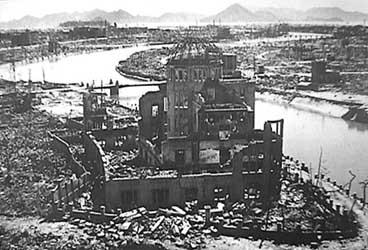
Today, August 6, is the sixtieth anniversary of the first use of atomic weapons in warfare at Hiroshima, Japan.
The atomic bombings of Hiroshima and Nagasaki brought about the unconditional surrender of Japan and the end of World War II. The bombings also started the Atomic Era and kicked off the greatest arms race the world has ever known (and will probably ever know). With the development of thermonuclear weapons (hydrogen bombs) what was once inconceivable—the capability to destroy all life on the planet—now became possible.
Human technology has changed more since Hiroshima than in all of recorded history. For much of the last half of the Twentieth Century Americans, Europeans, and Russians went to bed every night knowing that, just possibly, they might not wake up tomorrow. Computer-controlled machine tools and open access to higher education education has empowered those who would do harm to us and our way of life; what was once the work of geniuses in government labs is now the province of technocrats using equipment available on eBay. The knowledge and skill needed to create atomic weapons is widespread, and the reason terrorists haven't detonated a nuclear bomb in an unsuspecting metropolis is more a matter of lacking the raw materials than the know-how. Many experts believe that within the next two decades we are almost certain to see terrorists use a nuclear weapon to destroy a large city in Europe or America.
This chain of events—the Atomic Era, the Cold War, nuclear proliferation—started sixty years ago today. Was it necessary? Did the US need to develop and deploy nuclear weapons? Did we need to bomb Hiroshima and Nagasaki? I believe an examination of history shows that we did.
How many of us know what was going on back in the 1940s just prior to and during World War II? Genocide was rampant in both theatres of war (Pacific and European); the Nazis were busy pitchforking millions of the undermenschen into crematoria and slit trenches, while in Asia the Japanese engaged in pleasurable activities like baby-bayonetting contests and rape-fests. Early in the War, Japanese maltreatment and brutality towards captured soldiers and innocent civilians became widely known thru events such as the Bataan Death March and the surrender of Wake Island.
The war in the Pacific was unbelievable in the viciousness and cruelty encountered by both sides. Early on, the average fighting American realized that their Japanese opponents would neither give nor accept quarter (mercy). Examples such as the Goettke patrol, where 19 men led by LtCol Goettke went to accept a purported surrender of starving and disease-ridden Japanese troops arranged by a Japanese prisoner only to be ambushed and annihlated—only three men escaped and the remains of the rest of the patrol were never located—hardened the Marines' and GIs' hearts. Once the Japanese tactic of faking surrender, death, or serious injury in order to kill responding Americans became widely known, our Marines and soldiers became understandably reluctant to risk their lives by taking prisoners. Eventually, the American forces developed a deep hatred of their opponents because of this lack of adherence to Western norms of civilized behavior.
As the war progressed and Japan suffered more defeats, its ability to defend itself shrunk accordingly. However, the deeply-ingrained warrior code that was widespread among the professional core of the Japanese military refused to consider surrender and instead resorted to more and more extreme methods and tactics. Despite Japan's military weakness in the face of growing US strength, each island campaign became more and more bloody as the Japanese improved their defensive tactics; no longer would they uselessly sacrifice themselves in repeated banzai charges in an attempt to drive the invading Americans off the beach. Instead, they would carefully prepare extensive defensive fortifications, carefully camouflaged and connected by underground tunnels, and seek to kill as many Americans as they could before they were destroyed by superior American numbers and firepower. The kamikaze was the result of the effective destruction of Japanese Naval air power and the deaths of experienced and trained Japanese aviators, yet despite the tremendous casualties inflicted on the American fleet surrounding Okinawa there was no chance that kamikaze attacks could influence the outcome of the war.
So, here we are, the Allied commanders in the Pacific in the summer of 1945. In the past year our troops have just experienced the carnage of Pelelieu, the Phillipines, Saipan, Guam, Iwo Jima, and Okinawa. We've witnessed the tragedy of Japanese troops forcing civilians to jump off cliffs rather than surrender to Americans. We've seen spectacular counterattacks that were as bloody and tragic as they were useless. We've seen young Japanese men who could barely control their rickety aircraft gladly dive into troop transports and aircraft carriers, killing thousands of our men and sinking dozens of ships. Our intelligence shows us the depths and the desperation of the Japanese preparations to counter an invasion of the Japanese home islands.
We also had evidence of a more sinister type. Japanese biological and germ warfare research was well-known; what was not so well-known was the Japanese atomic bomb project. Yes, they were trying to build a Bomb, too. And there is a report that the Japanese were on the way to attack America with a dirty bomb when the war ended; a German U-boat with U-235 aboard surrendered to US forces in the Pacific at the time the Japanese government capitulated; two Japanese on board the submarine committed suicide in order to avoid capture and interrogation.
By late July 1945 the Japanese government had rebuffed several surrender demands by the Allies. American military planners estimated that, based on previous experiences against Japanese forces, the invasion of the Japanese Home Islands would result in hundreds of thousands of American deaths and millions of Japanese military and civilian deaths—and that was something that a war-weary America that had suffered 300,000 deaths and millions of injuries on the battlefields of World War II didn't want to have to endure. So, facing an enemy who had fought fanatically, who neither accepted or offered surrender, whose words and deeds demonstrated the willingness to fight on and die rather than capitulate, who was not discouraged by the firebombing of Tokyo, the total embargo of the Home Islands, or the virtual destruction of the Japanese Air Force and Navy, who had no hope of victory yet no fear of death... what would you do?
Truman made the hard call when he gave the orders to proceed with the first attack against Hiroshima. Yet, even after the incredible devastation that literally left the Japanese government reeling in disbelief and astonishment, the Japanese government refused to surrender. America waited 5 more days, and then dropped a second bomb on Nagasaki that was even more devastating. There is evidence that this second bombing precipitated a military coup by officers who were adamant about not surrendering (the coup was fortunately aborted due to an American bombing raid that killed the coup's leaders). Upon delivering a second surrender ultimatum, the Allies also announced that cities would continue to be destroyed until the Japanese surrendered (a stone cold bluff on our part as there were no more atomic bombs available). The Soviets, seeing that the end was near and wanting to expand their Far Eastern territories, invaded Japanese-controlled Japan and China. Finally, the Japanese realized that the war was over; the only thing they could control was how many more Japanese died. Upon this realization the government admitted defeat and accepted the offered terms of surrender. The war was over.
Could we have won without dropping the Bomb? Almost certainly... but at what cost? For those who claim the Bombings were immoral, I would point out that a government owes one duty to its citizens; to protect their lives and to value them above those of an enemy nation-state. When there is no other alternative, it is far better for enemy civilians to die than for our troops to die. And, how many Japanese civilians would have died if we had invaded the Home Islands? The civilian casualties that occurred on Saipan and Okinawa—casualties that were largely the responsibility of the Japanese—equal those of Hiroshima and Nagasaki. A powerful and compelling argument can be made that dropping the Bombs actually saved lives.
The complications of the Atomic Era mentioned earlier... the Cold War, living under the fear of Mutually Assured Destruction, the rise of nuclear proliferation and the threat of nuclear terrorism... are historical events that would have happened in one manner or another regardless of our use of the Bomb. Time only flows in one direction; the nuclear genie was out of the bottle and it will never go back in.
Responding to a question about Woodrow Wilson's claim that World War I was the "war to end all wars" philosopher George Santayana replied "Only the dead have seen the end of war." What can we learn from Hiroshima and Nagasaki? War is hell. Innocent people die horribly in war. Therefore it behooves all nations to avoid war whenever possible, to only wage just war, and to wage war relentlessly so that the conflict is decided sooner rather than later.
The lessons have all been learned, and forgotten, before. Again, quoting Santayana, "Those who do not learn from history are doomed to repeat it." We dropped the Bomb because our enemy refused to face reality, to learn from history. Unfortunately, I think we will need to one day drop it again.
Monday, August 01, 2005
Principle Over Politics or Vice Versa?
As you may know, a few years ago President Bush authorized, for the first time in the country's history, federal funding for embryonic stem cell research. However, the research funding bill limited funding limiting that funding to be used on a fixed number of stem cell lines (stem cells descended from specific embryos); I believe it was seventy-two. In other words, researchers couldn't go out and get new stem cells, by harvesting new embryos, if they wanted to remain eligible for federal research money.
This seemed, to me anyway, to be a Solomon-like approach to the issue of embryonic stem cell funding. The law recognized the reality that research was being done on these seventy-two lines anyway, so the moral dilemna of whether or not harvesting embryos was tantamount to murder was avoided because they were already being used. The only decision to be made was, are the benefits of experimentation on these already-sacrificed embryos worth the expenditure of federal funds?
In the past couple of years, researchers have been disappointed with the initial results on embryonic stem cells, and the most promising research has been done using adult stem cells (generic cells that all of us have, and that are readily available to researchers without the moral issues that invariably accompany embryonic stem cells).
On Friday, Senator Bill Frist (R-TN) announced he would support the easing of the current federal funding ban on embryonic stem cell research by loosening the restrictions and allowing for the harvesting/collecting/acquiring of new embryos from the pool of surplus embryos that were created by parents for in vitro fertilization but never used.
Those in favor of relaxed restrictions argue that the embryos are most likely going to be destroyed (or will die in storage) anyway, so why not use them for research? Also, researchers have discovered that embryonic stem cells (all stem cells, actually) become useless after a certain number of replications/divisions, and lose the nondifferentiated attributes that researchers depend upon to try and convert them into specific-purpose cells, i.e., heart muscle cells, liver cells, etc. In short, the view seems to be that since the stem cell lines we're currently working with are becoming useless, and we have all of these embryos sitting there in liquid nitrogen, why don't we make federal funding available to buy and use these embryos for further experimentation?
To me, this reasoning ignores the principle behind the funding limitations; human life is sacrosanct and should not be arbitrarily ended to further medical research. Let me explain further.
There is no doubt that thousands of lives could be saved each year if only we had a sufficient number of organ donors in good health whose deaths could be predicted or controlled to coincide with efficient organ harvesting. The Chinese solution is to typematch their prisoners and coordinate executions with organ harvests... or to harvest certain organs like kidneys involuntarily from prisoners who aren't facing execution. We could do the same thing here. We could easily establish a DNA database of all death row inmates and execute them by simply letting them die once a suitable recipient needed their organs and the harvest was complete. After all, why should an innocent little girl die, and a kidney or liver or heart be wasted? Of course, not very many people want to slide down the slippery slope resulting from the support of the harvesting of organs from prison inmates, or from the poor who might wish to sell an extra kidney to a stranger for the money. After all, in many places in the world people have been kidnapped and their organs have been stolen.
Now, some will argue that embryos aren't human and are not entitled to the protections we afford human life. Where do we draw the line? Can aborted fetuses be kept alive, and a new abortion procedure developed, so that stem cells and organs can be harvested? Since elective late-term partial-birth abortion is legal, do we allow a woman in her eighth month to terminate her pregnancy and provide the fetus' organs for harvest? Certainly there are billions of stem cells in the expelled umbilical cord; let's sell those to the researchers and give the money (derived from federal taxes) either to the mother or the abortion clinic. What about people like Terri Schiavo? Certainly she must have had a bunch of good stuff that might have saved several lives. Why didn't we harvest her organs, because she wasn't going to be needing them. Where do we draw the line?
The time is coming, and soon, when we're going to have to stop ducking the question: when does human life begin, and when does it end? In the near future we will develop the technology to "grow" a human from embryo to full-term infant without it ever having to be inside a woman's body. Maybe we'll develop a way to use another animal, like a cow or a sheep or a chimpanzee... or a brain-dead woman. Maybe we'll develop an artificial womb. Whatever... but then we won't be able to avoid the question of what a human life really is anymore, or when it begins. Not unless we want to see companies growing humans by the boatloads... maybe genetically engineered with full manual dexterity and the ability to learn simple repetitive tasks but with no higher brain capability. Will these be the new slaves, able and willing to do the most menial of tasks for nothing more than mere substenance? Or will humans make something more sinister, like the Clone Army from Star Wars but infinitely more menacing?
I'm not Catholic, and I have some problems with established dogma (and more problems with the way the hierarchy of the Church functions, as exemplified by the pederast priest problems that were knowingly covered up). I don't agree that preventative contraception, such as condoms, that blocks fertilization is immoral. However, I do agree with Catholic thought on this issue: human life begins at conception and we must treat that life with the same reverence, respect, and protection that we offer newborn infants. This position is the only principled way that prevents the horrors that will inevitably occur as our technology increases to the point where we can intimately control the most minor aspects of our biology.
So, is Frist's change of heart a matter of principle over politics? Or, is he trying to stake out a political position that differentiates him from other potential presidential candidates at the expense of principles? I can't claim to see inside someone else's heart, or head. But I don't understand how someone could be against such research on principle and then, a few years later, switch sides.
It's either a human life, or it isn't. If it is, and I believe it is, then no human life has the right to arbitrarily end another human life whether or not one benefits. After all, isn't arbitrarily ending another human's life the very definition of murder?
This seemed, to me anyway, to be a Solomon-like approach to the issue of embryonic stem cell funding. The law recognized the reality that research was being done on these seventy-two lines anyway, so the moral dilemna of whether or not harvesting embryos was tantamount to murder was avoided because they were already being used. The only decision to be made was, are the benefits of experimentation on these already-sacrificed embryos worth the expenditure of federal funds?
In the past couple of years, researchers have been disappointed with the initial results on embryonic stem cells, and the most promising research has been done using adult stem cells (generic cells that all of us have, and that are readily available to researchers without the moral issues that invariably accompany embryonic stem cells).
On Friday, Senator Bill Frist (R-TN) announced he would support the easing of the current federal funding ban on embryonic stem cell research by loosening the restrictions and allowing for the harvesting/collecting/acquiring of new embryos from the pool of surplus embryos that were created by parents for in vitro fertilization but never used.
Those in favor of relaxed restrictions argue that the embryos are most likely going to be destroyed (or will die in storage) anyway, so why not use them for research? Also, researchers have discovered that embryonic stem cells (all stem cells, actually) become useless after a certain number of replications/divisions, and lose the nondifferentiated attributes that researchers depend upon to try and convert them into specific-purpose cells, i.e., heart muscle cells, liver cells, etc. In short, the view seems to be that since the stem cell lines we're currently working with are becoming useless, and we have all of these embryos sitting there in liquid nitrogen, why don't we make federal funding available to buy and use these embryos for further experimentation?
To me, this reasoning ignores the principle behind the funding limitations; human life is sacrosanct and should not be arbitrarily ended to further medical research. Let me explain further.
There is no doubt that thousands of lives could be saved each year if only we had a sufficient number of organ donors in good health whose deaths could be predicted or controlled to coincide with efficient organ harvesting. The Chinese solution is to typematch their prisoners and coordinate executions with organ harvests... or to harvest certain organs like kidneys involuntarily from prisoners who aren't facing execution. We could do the same thing here. We could easily establish a DNA database of all death row inmates and execute them by simply letting them die once a suitable recipient needed their organs and the harvest was complete. After all, why should an innocent little girl die, and a kidney or liver or heart be wasted? Of course, not very many people want to slide down the slippery slope resulting from the support of the harvesting of organs from prison inmates, or from the poor who might wish to sell an extra kidney to a stranger for the money. After all, in many places in the world people have been kidnapped and their organs have been stolen.
Now, some will argue that embryos aren't human and are not entitled to the protections we afford human life. Where do we draw the line? Can aborted fetuses be kept alive, and a new abortion procedure developed, so that stem cells and organs can be harvested? Since elective late-term partial-birth abortion is legal, do we allow a woman in her eighth month to terminate her pregnancy and provide the fetus' organs for harvest? Certainly there are billions of stem cells in the expelled umbilical cord; let's sell those to the researchers and give the money (derived from federal taxes) either to the mother or the abortion clinic. What about people like Terri Schiavo? Certainly she must have had a bunch of good stuff that might have saved several lives. Why didn't we harvest her organs, because she wasn't going to be needing them. Where do we draw the line?
The time is coming, and soon, when we're going to have to stop ducking the question: when does human life begin, and when does it end? In the near future we will develop the technology to "grow" a human from embryo to full-term infant without it ever having to be inside a woman's body. Maybe we'll develop a way to use another animal, like a cow or a sheep or a chimpanzee... or a brain-dead woman. Maybe we'll develop an artificial womb. Whatever... but then we won't be able to avoid the question of what a human life really is anymore, or when it begins. Not unless we want to see companies growing humans by the boatloads... maybe genetically engineered with full manual dexterity and the ability to learn simple repetitive tasks but with no higher brain capability. Will these be the new slaves, able and willing to do the most menial of tasks for nothing more than mere substenance? Or will humans make something more sinister, like the Clone Army from Star Wars but infinitely more menacing?
I'm not Catholic, and I have some problems with established dogma (and more problems with the way the hierarchy of the Church functions, as exemplified by the pederast priest problems that were knowingly covered up). I don't agree that preventative contraception, such as condoms, that blocks fertilization is immoral. However, I do agree with Catholic thought on this issue: human life begins at conception and we must treat that life with the same reverence, respect, and protection that we offer newborn infants. This position is the only principled way that prevents the horrors that will inevitably occur as our technology increases to the point where we can intimately control the most minor aspects of our biology.
So, is Frist's change of heart a matter of principle over politics? Or, is he trying to stake out a political position that differentiates him from other potential presidential candidates at the expense of principles? I can't claim to see inside someone else's heart, or head. But I don't understand how someone could be against such research on principle and then, a few years later, switch sides.
It's either a human life, or it isn't. If it is, and I believe it is, then no human life has the right to arbitrarily end another human life whether or not one benefits. After all, isn't arbitrarily ending another human's life the very definition of murder?
Sunday, July 31, 2005
Pano Plane... or Playing With Panoramas

4 SD10 photos stitched with PanoTools
No, this isn't a post about playing the piano. Instead, I want to talk a little about panoramic photographs, aka 'panoramas' or photos that are much larger in one dimension than the other.
 Panoramas can be vertical (portrait) or horizontal (landscape) in orientation. The earliest panoramas that I'm familiar with were landscapes and were usually sections of conventional photographs that were cropped to give the panoramic format. However, panoramic cameras have existed since the late 1800s; I have one early panorama that was taken in 1917 with a Circut camera (a marriage of a complicated clockworks to a camera that produced some very fine panoramas) at a US Army training camp showing a company of men getting ready to head for France; I'm sure that such photos were popular with the Army itself which commissioned the photos as well as the men in the photos.
 The earliest panoramas were created by manually 'stitching' several individual photographs together at the seams. This required dexterity in the darkrooms of the day, and while the results weren't perfect (seams, or differences in exposures, were often visible in the finished panoramas) the pictures were often fascinating. Panoramas were initially created to overcome the lens limitations of early photography; often only one focal length with a correspondingly narrow field of view was available to the photographer. However, panoramas have a beauty and appeal all their own and soon a few photographers started specializing in this form.

from Lawrence Captive Airship, 2000 feet above San Francisco Bay
1906 Geo. R. Lawrence Co. (from the Library of Congress)
Special cameras dedicated to panoramic photos have been designed and sold for decades, but have not sold well to the general public. Even though these cameras use standard-sized film, the negative format was different and unsuitable for commercial processing; the processor often inadvertantly sliced the panoramic negative assuming the film was separated into standard-sized negatives. During the 1970s, and again in the 1990s, Kodak designed and built consumer cameras with panoramic features in both 110 and APS formats, but these cameras were not generally adopted due to their small negative size and fixed lens design. The expense and complexity of taking panoramas with high-end specialized cameras, and the difficulty of splicing pictures from regular cameras, have kept panoramas out of the province of all but the most dedicated amateur and professional photographers, until now.

two Nikon 885 photos stitched via Arcsoft Panorama Maker 2000
Digital cameras have revolutionized panoramic photography (along with everything else in the photographic world). Most digital cameras today come with a plethora of accessory software and often panoramic software is included at no charge. These programs let you assemble panoramas from several overlapping photographs and do a remarkably fine job with little or no user input. The picture above, "Mount Si", was made from two separate photos that overlapped by about 20% on the adjacent sides, using Arcsoft's Panorama Maker 2000 software supplied with my Nikon Coolpix 885 camera. Using the panoramic format allowed me to capture a scene that otherwise could not be photographed with my camera; even on it's widest 8mm focal length (equivalent to a 35mm lens on a 35mm camera) I could only include about half of the mountain.
Capturing scenes like that, or like the shot of Cannon Beach that I posted a week ago, would be impossible with normal cameras. Yes, you might be able to get the same effective field of view with a super-wide-angle lens, but you would lose the detail that exists in the original (the photo that you see above is about 1/8th actual size, the enlarged version you get upon clicking on it is 1/2 actual size). And that leads me to another reason for taking panoramas; I can capture much more detail that I could if I used the appropriate wide-angle lens and just took one photograph. The photo "C5 #2" below is a reduced example of a photo that, at full size, has the horizontal resolution of a 25 megapixel camera. It will look impressive hanging on the wall.

all rights reserved
4 SD10 photos stitched with PanoTools
Max Lyons was the first non-governmental photographer to create a one-gigapixel digital image (yes, one billion pixels!) (The US government has gigapixel-equivalent camera capabilities for photoreconnaissance.) The race is on: a group of scientists from the Netherlands has created a 2.5 gigapixel image on a bet inspired by discussion of Lyons' photograph. What Lyons and other photographers are doing is stretching the limits of resolution to places where film cannot compete. It is generally accepted that 6- to 8-megapixel APS-sensor digital cameras (not smaller 1/1.8" sensor digicams) have image quality equal to 35mm 100 ASA color film, and medium format imagery is roughly equivalent to a 24 megapixel image.
Imagine then, a film camera that could take a 1-gigapixel image... and you would see the Gigapixl camera, a very large-format negative film camera that digitizes the negative and prints the resultant image on high resolution inkjet printers. At this moment, large format film has one advantage over digital: it is currently impossible to make a 1-gigapixel digital sensor. However, as digital technology advances, expect to see the average consumer digicam producing prints better than the best 35mm cameras of a generation ago... and expect to see digital SLRs produce prints as good or better than the best of today's medium format equipment.
Those who decried digital photography as the end of photography were wrong. It is only the beginning.
Note: You can view a larger version of any photo on my website by clicking on the image. All images, unless otherwise noted, are copyright 2005 John Clifford and all rights are reserved. Please do not copy them without permission.
Subscribe to:
Comments (Atom)