Sunday, January 22, 2012

Why Newt Won… and What It Means

(c) Reuters 2012, Fair Use Exemption

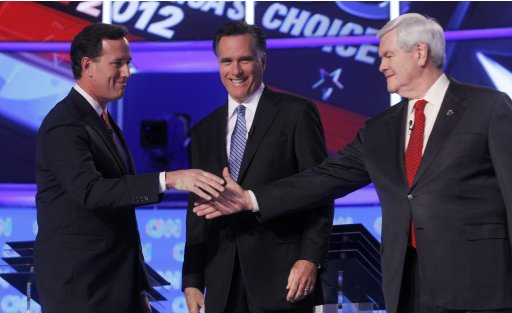
Newt Gingrich handily won the GOP South Carolina primary earlier today, with 41% of the vote to Romney’s 27%, followed by Santorum at 17% and Ron Paul at 13%. Gingrich’s late surge to victory was unthinkable even a week ago. How did he do it? How did he come from being a distant third to dominate the election, winning almost every county in the state? And what does this foretell for the rest of the primary campaign?

The reason for Newt’s victory is simply this: he has convinced the TEA Party faction of the GOP, those voters who are deeply concerned about the steep trajectory of our national debt and deficit spending, who are frustrated with the ever-increasing intrusion of government in terms of laws and regulation and their effect on every facet of American life from what we eat and drink to the type of light bulb, automobile, or health insurance we can (or must) buy, that he is the candidate who understands and respects their concerns. More important, he will do something to alleviate those concerns.

Newt has always been a policy wonk; someone who understands the intricacies of the interactions between government, industry, and the economy, and while voters respect him for his acumen that is not what has swung them over. After all, Mitt Romney and Rick Santorum are also smart fellows with considerable depth and breadth of knowledge about government and business. However, Newt does stand apart from the other candidates in his ability to marshall all of the facts and data to support his positions. That command of the facts gives Gingrich a confidence in the correctness of his answers that really comes across. Newt believes because he demonstrably knows.

That confidence is the reason why Newt won; not only can he unabashedly state his positions, but he can do so in a logical and straightforward way that is as instructive to his audience as it is persuasive. Newt’s decades of teaching experience is a key part of his ability to effectively communicate his positions, ideas, and vision… and that is something no other GOP candidate has. In uncertain times leaders who are intelligent, persuasive, informed, and confident are compelling to voters.

What happens next? I believed (and still do believe) that the SC primary outcome was a decisive inflection point for the GOP nomination battle. Here are my predictions:

  • Rick Santorum’s crushing defeats in New Hampshire and South Carolina effectively ended any chance he has for the nomination; barring a blow-up by Newt Gingrich before the Florida primary that allows Santorum to step up and assume the mantle of the anti-Rommey, he will go down to another resounding defeat in the Sunshine State and end his campaign shortly thereafter… and he will endorse Newt (you read it here first!).
  • Ron Paul, the irascible grandfather figure in the race, has been, is, and will be a non-entity, fading away before the convention even if he doesn’t drop out. Paul is right about many things, and especially right on the goals, but he is way off on the ways to accomplish his goal. Ron will not endorse any other candidate, before, during, or after the convention, but he also won’t run as a third-party candidate because doing so would end his son’s political career.
  • Mitt Romney, the all-but-inevitable candidate as late as last weekend has suddenly morphed into the candidate who has lost two out of the last three primaries. All of the air has gone out of his sails at exactly the moment Newt’s sails have been filled; the shift of momentum couldn’t have come at a worse time. Romney will never get the momentum back because he is lacking confidence in his positions -- the fundamental quality that voters are looking for -- and he no longer has the lock on electability. I expect Romney’s campaign and his Super PACs to go relentlessly after Gingrich, and I expect those efforts to look increasingly desperate and irrelevant. Romney will fight on until Super Tuesday, but it will all be over by the end of February, because the only candidate who will benefit from any Gingrich stumbles will be Santorum… and Gingrich isn’t going to stumble.
  • Newt Gingrich has gotten up from the second standing eight-count of his campaign, and he will not get knocked down again. He has taken everything his opponents and the media have thrown at him and has bounced back. The collapse of the ABC News efforts to use his wife’s allegations to torpedo him just before the South Carolina primary have insulated him from further attacks against his character based upon events in his marriages, and the Romney campaign’s attempts to use the politically-motivated Ethics Committee report against him will hurt Romney more than Gingrich. Newt will win in Florida and will end up getting the majority of delegates well before the convention. He will be the 2012 GOP Republican presidential candidate… and he will win convincingly against Barack Obama much as Reagan thrashed Jimmy Carter.

So, in short Gingrich won because most GOP voters love what he says, how he says it, and believe he could beat Barack Obama in the presidential election… and there’s nothing that any other GOP candidate can do to change this.

Friday, January 20, 2012

The Decisive Point

Tonight’s GOP debate in South Carolina was a clear win for Newt Gingrich, from the cringe-worthy opening question to the final statement. Considered all but dead a few weeks ago, Newt has reached the decisive point in the race to be the Republican nominee: if he wins this weekend’s Palmetto State primary he will most likely win the the nomination, if he loses his campaign is over and the Romney freight train will roll on to the convention.

So, will he or won’t he? My bet is yes, Gingrich will win. Why? Because Romney showed again tonight the weakness that will keep him off the presidential ballot. He cannot withstand the Left’s attacks on his positions because he does not have an ideological foundation for his positions. His head knows he is right but he doesn’t feel it in his heart; he lacks the courage of his convictions. Romney knows there’s nothing wrong with being very successful, but he really doesn’t have the heart to not just defend his success but to throw it in his attackers’ faces and taunt them with it. I believe this also goes hand-in-hand with his unsuccessful and tepid defense of Romneycare. Mitt isn’t stupid; he realizes that Romneycare was a mistake, but he’s put himself in a position where making that admission means he has to admit he was wrong, and he doesn’t have the courage to do it.

Republican voters aren’t looking for a go-along-to-get-along candidate. They’re angry, fed up with the president and his incompetence, and genuinely frightened about the future of the country. They want a candidate who truly believes what he says, who can clearly defend positions to a hostile media, who will not apologize for holding conservative views. Rick Perry wasn’t articulate enough, Backmann and Santorum aren’t polished enough, Cain wasn’t knowledgeable enough, and Ron Paul comes across as impractical. So, that leaves Newt Gingrich and Mitt Romney, two men who represent the two conflicting spheres of Republicanism.

Romney represents the pragmatic, moderate sphere… Republicans who have lots of conservative Democrat friends, who generally agree with the Democrat perspective on social mores, who aren’t ideological. In short, the pragmatist sphere, who believe that the problem with government is that it lacks effective management and rational decision-making. Gingrich represents the ideological sphere… Republicans who generally aren’t willing to compromise on principle, who vehemently disagree with their Democrat associates, who reject Democrat social mores. In short, the people who believe the problem with government is that the fundamental direction is wrong, that a radical course of action is needed and now, that half-measures or tweaks aren’t going to fix it, that the proper tool is a chainsaw rather than a scalpel, and that going back to first principles instead of gentle course correction is what is needed.

I believe the massive support for the Tea Party movement among conservatives in general demonstrates the strong desire for a truly transformative president. Just as the disaster of Jimmy Carter led to Ronald Reagan, the debacle that is Obama drives the need for the antithesis… and Romney for all of his virtues and strengths is more like Reagan’s vice-president George H.W. Bush than Reagan. Republican voters have realized this; Mitt Romney has had them looking for another candidate from day 1 to coalesce around… to believe in.

We’ll know on Sunday whether or not they believe in Newt.

Wednesday, October 05, 2011

Thoughts on the 2012 GOP Candidates…

This afternoon, Sarah Palin announced she would not run for president in 2012. Her ostensible reason given was that she could have more influence as an outsider. Here are my thoughts….

First, Sarah Palin will never be president of the United States. This year was her best chance, but her power and influence came from the fact that she was seen as a central figure in GOP presidential politics having been the ‘08 VP nominee, and since the GOP of today doesn’t give second chances she took McCain’s place as one of inner circle of presumptive nominees. Four years later, she bows out of consideration, and the GOP is no more forgiving. Sarah will continue to have influence on the GOP field, and on the election, but from this moment it will be waning. She will probably spend another year or so in the public light, and then retire to Arizona with her family to enjoy the tens of millions she has made from her ‘fifteen minutes of fame,’ and I don’t begrudge her that reward; she has certainly paid the price for becoming a public figure and a lightning rod.

The interesting question is, why? I have to think that there were just enough to the revelations from the McGinnis book to make a presidential run a disaster for Sarah and the GOP. Certainly the Democrats are the champions when it comes to the politics of personal destruction, and in an environment where the incumbent Democrat president cannot reasonably run on his record, I fully expect Obama and the Democrats to go thermonuclear on their scorched earth progrom. The Democrats have no other alternative than to trash their GOP opponent, to persuade the electorate that no matter how bad they think Obama is, the GOP alternative is worse… and they will relish in making it personal. Maybe Sarah and Glenn Rice had a one-night stand, and maybe they didn’t, and maybe this is a he-said/she-said, and maybe like Monica it’s really no one’s business and has no relevance as to her suitability for the presidency… but it won’t play that way. I can’t say that I blame Sarah for not wanting to go through another year of what will make what has already occurred seem like nothing. I will say, however, that she had a good chance of winning as she was definitely the anti-Obama.

Chris Christie has also definitively announced that he won’t run in 2012, so we are left with the current slate of candidates. On the right we have Herman Cain and Michelle Bachmann, a little further towards the center we have Rick Perry, with Mitt Romney by his lonesome in the center, Jon Huntsman to his left, and then on the fringe we have Ron Paul. I’ve deliberately left out Rick Santorum and Newt Gingrich; both are extremely well-qualified and both are bonafide conservatives, but in this political climate neither is electable… and that is a real pity.

Mitt Romney is the polished, consummate professional in the race. His years of experience in closely-fought campaigns, winning and losing, plus his innate qualities as a businessman, have made him the best-performing of the candidates. He’s always ready with the perfect counter, he knows how to attack his opponents in a likable manner, and he has the appearance and demeanor of a leader. Of course, Romneycare, the Massachusetts universal healthcare approach that has proven to be suboptimal in Massachusetts and that served as partial inspiration for Obamacare, is the millstone around Romney’s neck; extremely unpopular with the constituencies Romney will need to win the nomination and the presidency. That issue combined with his occasional pandering and flip-flopping is why the GOP faithful want someone else to run that they can get behind. I believe he’d make a competent president in the way that George H.W. Bush made a competent president, but I don’t think he is the leader we need at this time.

Michelle Bachmann showed real promise earlier this year at the debates but her recent statements on Perry’s HPV vaccination program have, I believe, knocked her out of serious consideration for the nomination. In my opinion Bachmann wasn’t ready to run this time, but she will be a powerful force in Republican politics for the future.

Similarly, Jon Huntsman has a very good track record but he is seen as too liberal and a little too weird for the average GOP voter. Another person who would make a good president, but not an inspiring one.

I don’t want to waste time on Ron Paul, the Libertarian-leaning candidate. He’s very right on many things, and very wrong on many other things… certainly a good advisor but in my opinion he would make a poor president because the world doesn’t work the way he believes it should… and won’t any time in the near future.

Rick Perry came into the race as the Savior, the One who would save us from Romney. It hasn’t happened. No one gets to be a successful three-term governor by being stupid, but Perry often comes across that way just because he hasn’t taken the time to refine his messaging on his positions. While he has many good qualities that Republican voters are looking for, I think his positions on immigration, in-state tuition for illegals, vaccinations, etc., come across in the mold of a Nelson-Rockefeller-knows-what’s-good-for-you, and his declaration that people who disagreed with him on these subjects “didn’t have a heart” definitely hurt him with his target electorate. Perry is too authoritarian for my tastes; if I want to be lectured to I’ll vote for Obama.

That leaves Herman Cain. A mathematician by training, a businessman, an accomplished turnaround specialist, unassuming, with a bias for action and a willingness to put it out there. Cain’s rise among the other candidates is almost a fortuitous accident. Cain would make a good president, and might turn out to be a great candidate, and he will be able to come right at Obama like no other GOP candidate possibly can.

So, I think Cain will probably get the nomination as Romney and Perry tear each other up and take each other out and disgust the voters while doing so, and there is no other reasonable alternative. I’m looking forward to seeing him debate the One, because I think the American public is fed up with posturing and show over substance after four years of Obama.

Saturday, June 18, 2011

My Addictions…

I often get into new hobbies and activities after reading about them. My problem is, I never seem to be able to get into anything half-heartedly. It’s all or nothing.

A decade ago I happened to be browsing magazines in the local Barnes and Nobles, and ran across the ARRL’s QST with an article about building your own high-performance amateur radio transceiver.k2100d To make a long story short, I bought the magazine, read the article, and then thought How cool would it be to build a radio and then be able to talk around the world on it? Within six months I had obtained my Amateur General license with operating privileges on the worldwide HF bands, and bought and built the Elecraft K2 kit featured in that magazine. A year later I had several ham radios for HF and VHF/UHF, and had talked from Seattle to Tanzania, Kamchatka, Argentina, and the South Pole on 5 watts of radio power. Think about that for a moment… with less electrical energy than a powerful flashlight and without any infrastructure (read: Internet) I was able to communicate around the world. That is pretty amazing, isn’t it?

I won’t even go into my addiction for firearms that led me into opening what was, at the time, the state’s largest indoor shooting range and gun shop. Suffice it to say that I learned a very powerful lesson: never turn your avocation into your vocation. Why not? Because you spend all of your time working at what should be fun, and then when you have some leisure time you don’t want to spend it doing what you do all of the time.

My latest addiction is motorcycles. It started innocently enough, after watching a fly fishing video:

Western Alpine Fly Fishing for Bass

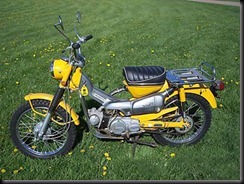
In the video, the fisherman gets into the remote lake by loading his gear onto a ‘80s-era Honda CT-110 motorcycle. While fly-fishing has also been a less intense addiction than most others for me, the motorcycle piqued my interest as a better way to get into remote areas than loading up a pack frame on my back and hiking a couple of miles from my truck (for those of you who don’t live out West, this is BIG country). So, I kept my eye open for a CT-90 (the original ‘70s-era version) or CT-110 at a reasonable price, and picked up a ‘70 CT-90 a few months later.
1970YellowLeftSide

The CT-90 was an excellent motorcycle for a new rider. My previous experience had been as a teenager swapping out the use of my air rifle for an afternoon to a neighbor who had a CT-70; his parents were totally against guns, and mine didn’t want me to have anything to do with motorcycles, so we’d trade and each get to enjoy a little forbidden fruit. Later on, I rode a motorcycle just TWO times as a adult; once on a friend’s Suzuki 400 and another time on a co-worker’s Kawasaki 750 (the 750 was too big for me, and I almost put it down trying to get started… once I had sufficient speed up, it was easy to ride and turn, and I was able to successfully ride down to the end of the parking lot, turn it around and ride back to a stop). At any rate, the automatic clutch and bicycle-like brakes (a lever on each handlebar, plus a rear brake pedal on the right side) made it enough like a bicycle to make the CT-90 a good beginner’s bike. However, it’s low power and lack of a clutch, the attributes which made it good for beginners, became weaknesses as my interests progressed. (BTW, it’s for sale… a 1970 K2 with less than 1500 original miles in great condition.)

My next bike was a Honda CRF230L, a dual-sport (street-legal but capable of off-road riding) that I picked because it was a Honda dual-sport.2009_CRF230L_145x90_Red_trans Here in Washington state, you cannot operate an unlicensed (not-street-legal) motorcycle on the unpaved forest roads in the state and national forests, and that is a large amount of the unpaved roads and trails in the state and throughout the West, so a street-legal bike is a necessity unless you want to be restricted to your own land or the few crowded designated ‘off-highway vehicle’ (OHV) areas. I chose the Honda because of Honda’s well-deserved bullet-proof mechanical reputation, and I chose this particular bike instead of something larger like Suzuki’s DRZ400 or the Honda, Suzuki, and Kawasaki 650 dual-sports because of it’s light weight and low saddle height. I’ve owned the bike since February and it’s been an enjoyable way to work on my riding skills. It’s also a good tool for spending time with my son; he has a Honda XR70 that I bought him for his 10th birthday which allows us to go trail riding together.
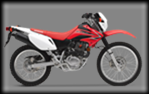
Even though the CRF230L is a great motorcycle for what it is, my addiction made me want something more suitable for longer distances on paved roads. The 230L gets a little squirrelly at highway speeds with its knobbies, and the 223cc engine is not meant to be run at high RPMs for hours on end. I don’t mind throwing it in the back of my pickup and driving to trail heads, but what about riding around Mount Rainier, or around the Yakima River canyon for a day? Nope… I needed a road bike.

After test-riding various Harley Sportster-based bikes, plus a few Yamahas, Kawasakis and Suzukis, I decided what I didn’t want: anything super-high performance, anything that made me lean forward, anything that made it easy to lift the front wheel off the ground with some injudicious use of the throttle and/or clutch, anything with a high saddle height, anything that made its horsepower well up in the RPM range. That pretty much ruled out most of the sport bikes, and a lot of the ‘adventure’ bikes like the V-Strom, the KLR650, and the big Beemers. I found that I liked everything about the Harleys except for the fact they were Harleys: a fine motorcycle but I definitely do not fit the demographic of the typical Harley rider. That was when I stumbled across an article about Honda’s DN-01, a concept bike that was Honda’s modern interpretation of a sports/cruiser combination that had been brought into production. Honda calls it a ‘crossover.’

The DN-01 is a different beast. Unlike sport bikes it has a fairly long wheelbase (62” versus the mid-50” range), is heavy (595 lbs versus mid-400 lb range), and has a low saddle (28” versus 31” or thereabouts for most street bikes). 2009_Honda_DN-01_IMG_0216It also has a 680cc V-twin engine, a great design for a cruiser that pulls well at low revs, unlike the typical high-revving inline-4 crotch rocket engines. Perhaps the biggest difference: there’s no clutch. The DN-01 uses Honda’s HFT (Human-Friendly Transmission) hydraulic automatic transmission that is much more like a car’s transmission than the typical CVT found in motor scooters. However like a CVT the gear ranges are infinite. The combination of electronics and mechanical wizardry in the HFT allows for 100% lockup for maximum efficiency yet the transmission ratios can be continually adjusted to provide the best combination of engine RPM for a given speed and power demand. The result is an incredibly smooth riding experience… just twist it and go.

I test-rode a DN-01 down in Oregon a month ago while on business, and decided to buy it after the dealer made me an offer I couldn’t refuse (about half the original MSRP). The DN-01 has sold well in Europe, but not so well here in the US, probably due to the fact that it was introduced during the middle of our Great Recession and at a fairly high factory MSRP. At any rate, the few that are left at dealerships are often priced very aggressively. A week ago I returned to Oregon on business, planning ahead by arranging a one-way car rental and bringing only soft luggage and a Giant Loop Coyote bag to cart everything home in.

While I was at the dealership I also picked up a new Shoei Hornet dual-sport helmet, as I knew my offroad helmet and goggles would be insufficient to multi-hour interstate trips. The Hornet is touted as a true dual-sport helmet, as it can be used on the street with a clear shield, or the shield can be easily removed and the rider can used goggles. However, the one drawback of the Hornet is that you must remove the visor before riding at high speeds, otherwise the wind resistance is so great that your head is pulled back. Don’t ask me how I know this! IMG045At any rate, I returned to the dealership before heading off to Seattle, removed the visor and stowed it in my computer backpack, bought a new Joe Rocket Ballistic 7.0 jacket as well to augment my inexpensive nylon mesh jacket, and after cramming the old jacket into the coyote bag, lashing the bag to the back of the DN-01, and then lashing my backpack on top of it, hit the road. Of course, by then it was almost 8 pm. No way to get home before dark, so I figured I’d head north and stop for the night when the twilight faded.

After a quick discussion with a few folks who were hanging out at the shop, I decided against heading northwest on Oregon Hwy 30 to Rainier Oregon and then hopping over the Columbia River on the Longview Bridge. I’ve driven this route several times, and ridden it on a bicycle several times also as it is the last 50 miles of the Seattle-to-Portland double century ride, but riding west into the sun on a two-lane road didn’t seem like all that good of an idea. Instead, I hopped on Hwy 26 back east 10 miles to Portland, and then got on I-5 and headed north.

At first I was very nervous, not having any experience riding on a controlled-access highway at high speed and on a new motorcycle, but that soon faded. Wind blast was an issue also; I was not used to the tremendous air resistance encountered at highway speeds,IMG006 and the occasional gusts caused by semis. And, as I crossed the I-5 bridge across Columbia River north of Portland, the 20 mph wind coming through the Gorge from the Pacific to the eastern Oregon deserts had me leaning to the left just to keep the bike going straight. The temperature dropped as the sun set and by the time I hit Woodland, about 25 miles north of Portland, I was starting to shiver, so I pulled into a McDonald’s for dinner, a Quarter Pounder with Cheese and a medium hot chocolate. It took me a while to warm up, even sitting inside a warm restaurant and drinking hot chocolate, so I decided to ride for another 10 or so miles, and then spend the night in Kelso.IMG043 I made it to the Red Lion before it got completely dark, and only realized after I had taken my helmet off to check in how many small bugs were stuck to my visor!
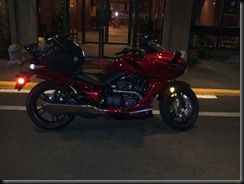
After a good night’s sleep, and a little sleeping in, I was a little worried about the remaining trip. Riding a motorcycle at highway speeds requires one’s full concentration, and is very fatiguing. Certainly this is something that can’t be done for several hundred miles without taking stops every hour or two… and I wanted to be in Seattle by 2:30 to make a phone call to the East Coast. IMG044I got everything packed up and headed north around 11 am, stopping to get gas and then deciding to eat just after noon in Centralia, about 100 miles and 2 hours from Seattle. Getting some food inside made me feel a lot more energetic and optimistic, so after taking a picture of myself in the window, and a picture of my loaded motorcycle, it was time to move on.

The last part of my trip went without incident. By now I was used to how the bike handled, and the wind blast. Running at 75 mph, the bike really ate up the miles, and the warmer daytime temperature was very comfortable. I made it back to Bellevue and up to my office with a minute to spare.  As I rode the couple of miles to home on surface streets after the call, I already missed the exhilaration of leaning into the wind, and into the turns, of looking over my shoulder, signaling, and then accelerating into a lane change. Of being alone with my thoughts while being completely in the moment, of  not consciously thinking anymore about maneuvering and countersteering but just doing, of being one with the motorcycle. That is my latest addiction, and I think I’ll need another fix very soon.
Wednesday, January 20, 2010

Dear Nervous & Frustrated Liberal Pundit…*


Dear Nervous & Frustrated Liberal Pundit,

It’s up to you.

Yesterday, after a year of angering the American people, the voters in perhaps the most Democrat-friendly state elected a conservative Republican to the Senate seat held by one Kennedy or another for more than a half-century.

You’re depressed: Massachusetts was supposed to be a shoe-in, a rubber stamp, a mere formality with Paul Kirk keeping the chair warm until a more permanent Democrat could be installed.

You’re angry. You’re wondering in disbelief how can the American people vote for a Republican after the 8 years of George W Bush? Have they forgotten already? In Massachusetts?

And let’s face it, you’re scared. Jonathan Cohn is right. If Obama, Bill Clinton, and Vicki Kennedy can’t get a Democrat elected to Ted Kennedy’s seat, in Massachusetts for God’s sake! then no Democrat Senator or Representative is safe from defeat.

Now you have a choice.

You can continue the denial, the self-deception. You can blame Brown’s victory on the process, the stomach-turning sausage-making that has resulted in what was once called health care reform, is now spun as health insurance reform, but what we all know as Obamacare. After all, what’s in a name? That which we call Obamacare by any other name would still smell most foul.

What about shelving the bill. The bickering and dickering, the horse-trading, backroom dealings, and outright bribery would stop… and these are among the things that have destroyed the Democrat brand in the eyes of the public. These are the things that Obama promised us he would end, and yet you, Liberal Pundit, are oblivious to the anger that has risen from Obama’s embracing of the corruption that he swore he would stop. Even CSPAN has had enough.

Giving up on this health care bill will not damage Democrats in the polls. Honestly, what could damage them any more than they are already? Liberal Pundit, are you really listening to what the American people are saying? It won’t fix the problem. It costs too much. How are we going to pay for it? When are Obama and the Democrats in Congress going to actually do something about the economy, and that doesn’t mean passing Stimulus II, Son of Stimulus, “Targeted Investment” or whatever the nom du jour of the warmed-over bucket of spit that Democrats are bandying around.

Liberal Pundit, the American people are willing to forgive incompetence in their leaders, to Move On if you will, as long as they think the leader won’t screw up like that again. After all, Bill Clinton won a second term after the ‘93 tax hikes, the ‘94 assault weapon ban, and the Brady Bill. Why not advise the Democrats to start over, to invite Republicans including Scott Brown to the table, to create a list of solutions that both Democrats and Republicans can agree on. Maybe it is only 80%, or 60%, or even 30%… but isn’t 30% of a loaf better than nothing? Especially when bipartisan support also means bipartisan ownership? I think it is, if you care for your country more than you care for your political party, if you’d rather do the right thing than be right, if you’re more interested in accomplishing something than stomping on your political opponents.

So, Liberal Pundit, do you have those qualities? Can you urge the Democrats to be good Americans instead of just good Democrats? To walk the walk and work in a true spirit of bipartisanship to solve the country’s problems? I guess we’ll find out soon enough.

______

*A response to Jonathan Cohn’s letter earlier today

Sunday, January 17, 2010

The End of The Beginning, or The Beginning of The End?

Andrew Sullivan posted recently on how health care seems to be slipping away from the Democrats despite their unassailable supermajority control of Congress and the White House… a supermajority that possibly ends next week if the come-from-behind candidacy of Republican Scott Brown prevails over Mass AG Martha Coakley in the Massachusetts Senate special election.

He had health insurance reform in his grasp and yet it may now be swiped away because they simply took too long to get it done.

The real story of the Massachusetts election, however, is what the outcome will mean in terms of the absolute ability of the Democrats to control Congress. If Coakley wins, it’s another year of one-party rule; the Republicans will continue to play the role of street urchins who can throw rocks at the passing train from behind the fence as it rumbles by but that’s it. If Brown triumphs, however, then the train comes to a screeching halt unless the boys are given some say as to where it’s going, and when. The Democrats will have to work with at least one Republican to get controversial legislation through.

Sullivan argues:

[A vote for Brown is a vote to] embolden every enemy Obama has, from Netanyahu to Ailes.

That’s the only reason to vote for Coakley on Tuesday.

She’s a dreadful candidate, but this race is now a critical battle in the war to rescue the possibility of effective governance.

Give me a break! If Martha Coakley is the one thing that will keep us from descending into chaos, then the battle is lost already and we’re doomed. Actually, the opposite is true. Removing the Democrat supermajority in the Senate is the only chance we have of stopping the bus from driving off of the cliff, of restoring effective governance in the form of ruling according to the wishes of the people.

A Brown victory means that Democrats will no longer be able to damn the torpedoes of public opinion and go full speed ahead on their unpopular radical agenda. They’re going to have to play ball. If healthcare reform is important (and I think that it is, just not in the way the Democrats are proposing), then perhaps adopting a Democrat idea (government as insurer of last resort) along with a Republican idea (allow insurance companies to compete across state lines so that insurance pools can be much larger, spreading the risk around, or tort reform, or both) might actually lead to a better bill, not for the Democrats or Republicans but for the American people. If getting the economy going again is important (and everyone knows that it is), then perhaps we can forego another $800 billion mistake by passing a ‘targeted spending’ bill that is Stimulus II in all but name only. Perhaps we can try making the Bush tax cuts permanent and reducing the corporate and capital gains taxes while also freezing federal spending to 2007 levels. Was government spending really deficient back in 2007?

Of course, if you’re fully invested in the Democrat agenda and believe the country’s finally headed in the right direction, but just not going fast enough, then Martha Coakley is probably your candidate and Andrew Sullivan probably reflects your thinking. Just recognize that most Americans disagree… and that the election of Scott Brown is the beginning of the end for Democrat control of the federal government as it likely presages a GOP landslide in the mid-term elections. The People are mad as hell and they’re not going to take it anymore.

Wednesday, January 13, 2010

Plan B

In the past few days, there’s been a couple of stories floating an idea by the Treasury Department to encourage people with 401(k) accounts to switch their investing out of securities (stocks, bonds, etc.) and into annuities:

The U.S. Treasury and Labor Departments will ask for public comment as soon as next week on ways to promote the conversion of 401(k) savings and Individual Retirement Accounts into annuities or other steady payment streams, according to Assistant Labor Secretary Phyllis C. Borzi and Deputy Assistant Treasury Secretary Mark Iwry, who are spearheading the effort.

The purported reason for this is to ensure that those who plan to depend on their 401(k)s for the bulk of their retirement income will have a sufficient income stream, with the excuse given that investors lost an average of 31% of the value of their 401(k) accounts between January 2008 and March 2009. What is hidden in the story is the fact that these accounts recovered half of that loss in the past nine months, and at the current rate of growth in the stock market the average 401(k) will be back at January 2008 levels in another nine months. So, where is the crisis? What is the real reason?

I think the real reason is clear; the Obama Administration has an eye on all of that money and wants to grab it. Obviously, outright confiscation would result in an armed uprising by outraged Americans. However, what if the Congress pulled an Argentina and changed the 401(k) laws to force conversions of all of the funds in 401(k)s to government-backed annuities… T-bills… or face a confiscatory tax rate? Yes, there’d be a court battle that would drag on for years, and that might or might not be won by taxpayers, but in the meantime the government has all of that money. And what would they do with it?

Today, our budget deficits are funded by taking the surplus funds out of Social Security, and selling T-bills. The Social Security surplus is drying up as the number of retired recipients is approaching the number of working contributors. Buyers of our T-bills are similarly drying up; it’s a lot easier to sell a couple hundred billion dollars worth of T-bills each year than to sell more than a trillion dollars worth of T-bills each year… and as the economy falters and we buy less imported oil and Asian-manufactured goods the Arabs, Japanese, and Chinese have less dollars to buy our T-bills. More important, the Chinese, who are the largest purchasers of T-bills, have us over a barrel. They can use the threat of not buying our debt as a strategic lever against us. Certainly our economy would collapse if we were forced to either stop all deficit spending or print more than a trillion dollars to buy next year’s debt. As China’s domestic consumption grows, they need our markets less and less… and we’ve already funded much of their economic development. What if they decide to annex Taiwan, and they use the threat of cutting off purchasing our debt if we interfere? Will the Obama Administration risk economic collapse over Taiwan? I don’t know if the Chinese are willing to push us that far, but certainly we’re fools if we expect them to continue to buy our debt when our ability to repay that debt is becoming increasingly doubtful. So the Obama Administration and the Congressional Democrats have come up with an alternative, a Plan B, to take all of the money in our 401(k) accounts.

A prudent nation would forego more government spending than it collects in taxes. Prudent and Congress are two words that are seldom if ever found in the same sentence, however. The current Congress seems hell-bent on spending every dime they can get their hands on, and borrowing even more money to spend once that is gone. The current Administration will not stop them. Changing the law to put another $3.6 trillion in the hands of the Congressional spendthrifts and postponing the hard decisions about government spending for another couple of elections is the easy way out, especially if enough people buy the spin about how this is somehow looking after their best interests.

This is how a once-great country sinks into economic purgatory. This is how America, the strongest nation the world has ever known, with the largest economy and the highest standard of living, turns into a banana republic. Be afraid. Be very afraid. (HT: Instapundit)

Tuesday, January 05, 2010

Buddy, Can You Spare a Dime?

A letter from the RNC was in the mail tonight. Michael Steele is shaking the tree to help fund the RNC for the ‘10 campaign cycle. So what else is new?

Well, for one thing the RNC’s historical fundraising advantage is missing this year. The Washington Times reports that the RNCC has barely enough money to fund a single Congressional race, having raised $18 million less than the DNCC and with less than $2 million of available funds today versus over $15 million for the Democrats. Politico reports that Congressional GOP incumbents have been reluctant to turn over campaign funds to the RNCC; Democrat GOP incumbents have given $2 million more out of their campaign war chests to the DNCC. But this is really a smokescreen; the real reason that the RNCC is running on fumes has to do with GOP voter disaffection. (HT: Newsweek) Yet Republican Party leaders don’t seem to get it… or they don’t want to get it.

For too long, each party has treated much of its base like bastard step-children. But evidence abounds that the conservative voters are fed up with politics as usual, with party bosses who cavalierly dismiss supporters’ concerns and frustrations with a wave of the hand while snickering “Where are they going to go?” Well, guess what? They went and started their own political organization: the TEA Party. They’ve decided to take back their country and take on both Democrats and Republicans. TEA Party supporters played a major role in the Republican off-year election victories, but perhaps their biggest statement was made in the NY-23 Congressional election that was won by a Democrat after the GOP establishment insisted on supporting Dede Scozzafava, a liberal ‘RINO’, over a conservative candidate (Doug Hoffman) for pragmatic reasons (GOP elites didn’t think a conservative Republican could win in that district and wanted a liberal Republican, assuming that all of the Republicans and many Democrats would vote for her). The RNCC spent over $1 million to support Scozzafava, yet Hoffman’s endorsement by Sarah Palin brought the nation’s attention to his candidacy, a significant amount of donations from out-of-state TEA Party supporters, and overwhelming support in the district. Realizing she had no chance of winning, Scozzafava dropped out of the race… and then endorsed the Democrat candidate who went on to win. The real loser in this election wasn’t Doug Hoffman, who will run again in 2010 and who will most likely win, it was the GOP leadership.

So, “where are they going to go?” Well, as a volunteer who spent his own time and money to leave Washington state and go to Florida to help campaign for McCain last November, and as someone who believes the GOP leadership hasn’t learned its lesson from the past two national election cycles, I can tell you where I’m going to go… and it’s not to a GOP fund-raiser. I gave money to Doug Hoffman, and I’ve given to Joe Wilson, and I’ve given to Scott Brown… and I’ve given to them directly instead of donating to the RNC and letting them pick and choose. Millions of disaffected GOP voters are doing the same thing, bypassing the party and supporting only those candidates who agree with them.

The GOP leadership is in grave danger of losing their conservative base, and more ‘Scozzafavas’ (supporting establishment RINO Republicans) will only hasten the process. I personally have no intention of giving to the RNC for a while; if my campaign contributions are going to be thrown down a rathole then I’d just as soon pick the rathole.

In 1994, Newt Gingrich successfully ended 40 years of Democrat control in the House by understanding why the majority of Americans were angry at the Democrat-controlled Congress, and then getting GOP candidates (incumbents and challengers) to pledge to address those issue if voters supported them. The majority of voters agreed with the agenda and believed in the GOP candidates, and history was made. Sixteen years later, and four years after losing control of the Congress, today’s GOP leadership seemingly has no real clue as to why many of the folks who voted the GOP out are now gathering by the millions… and no clue as to how to obtain TEA Party support. Voter disaffection with the incumbent Democrats is nearly at an all-time high (and it is only going to get higher as the economy fails to recover), yet the Palins and Bachmanns who are inspiring the TEA Party supporters have little influence in the GOP.

Mr. Steele, with all due respect, you and the rest of the GOP leadership need to get a clue. And you need to get it quick. Otherwise, 2010 will be historical only in that future pundits and historians will wonder how the GOP could have blown such a great opportunity. Here’s a hint: listen to the TEA Party protests and come up with objective, measurable solutions for America’s problems and not just less of what the Democrats are promising. And tell us the truth! We can take it.

Thursday, July 09, 2009

The World Leaders' Guide to Dressing One's Children at International Summits... or, what not to wear

Malia - © London Daily Mail, displayed under fair use


The London Daily Mail has an article on Malia's attire at the G-8 Summit, specifically on the political nature of the peace symbol displayed prominently on Obama's eldest daughter's shirt.

Perhaps the Obamas see this differently than I and many others do. In their minds, a peace sign is non-confrontational, and besides no one in their right mind can be against peace. Maybe they do understand the significance of the symbol and this is someone's way (Michelle?) of making a point. Or could it be that this is a cheap way to score points with the disaffected Left, the folks who are angry with Obama for not pulling the plug on Iraq, Gitmo, DOMA, etc. Yes, this is the cynical view.

Look at the bright side. Maybe Obama's daughters can hang out with fellow Democrat presidential offspring Amy Carter, famous for the shoutout she received from Dad during one of the Carter-Reagan debates for her role as one of her fathers's sought-after advisors on nuclear weapons policy. Sure, then Obama can be like Jimmy Carter, following Carter's example, consulting with the Obama girls just like Jimmy. Because we all remember what a smashing job HE did on foreign policy, economic policy, etc.

Oh, wait...

Saturday, June 13, 2009

The Definitive Electronic Reader: Amazon gets it right with the new Kindle DX

The new Kindle DX alongside an original Kindle


Although I was an early adopter of the original Kindle, I've eagerly anticipated Amazon's Kindle DX. The original device was, and is, well-suited for light reading of non-serious material, but its small screen size and lack of PDF support made it mostly a recreational device. I quickly realized that any serious technical book still worked better in physical form. That, combined with the original Kindle's inability to handle PDFs (Adobe Portable Document-format files, a rendering of a document's printed image via Adobe Acrobat and other converters) in a usable form (the conversion left a lot to be desired), made me look at other e-readers, particularly the iLiad iRex Digital Reader 1000-series. Unfortunately, the iRex 1000 ereader, at above $1000, was still a work-in-progress, with serious deficiencies in terms of functionality and reliability, and I didn't want to be an alpha tester of a device that might never be finished. Amazon's announcement of the large-format Kindle DX with native PDF support seemed like the answer... so I plunked down the money for a DX and the Amazon case and got on the waiting list.

Why would you want native PDF support? The small Kindles support PDF files via translation; you send a PDF document to Amazon and they convert it to the Kindle's AZW format and send it back to you, either to your desktop email account (free) or directly to your Kindle ($0.10 per document). However, if your document is anything more than simple text, formatting and imagery are mangled. What you get is readable but not nearly as readable as a Kindle document that was specifically prepared for the device. This is an inherent restriction caused by the difference between a document file structure that is meant to preserve formatting (PDF) and one that is meant to allow for text flow despite screen or font size concerns (AZW). The result was that you couldn't practically use either the original or 2nd gen Kindles for reading even reasonably complex PDF documents. Having an integral native PDF reader on the new Kindle DX (as seen to the left) solves this problem and opens up a HUGE world of documents to the Kindle owner.

I've had the Kindle DX for about a day now, and it's everything I was looking for. PDFs render beautifully, not like they did on the original (the same PDF on the original Kindle, at right) and Kindle AZW documents render even better than they did on the original Kindle due to the larger screen size and 16-tone grey scale capability. The large screen really elevates the new DX into something more than a convenient device for light reading. The Kindle DX shows the true utility of an electronic reader for the first time. It's what the Kindle should have been from the start.

What has improved? Performance is better, particularly the screen refresh rate. The new button design means not turning pages accidentally anymore (although I wish they'd kept buttons on both sides of the device for us left-handers). I don't like not having an SD card slot on the device, nor do I like not being able to change the battery without sending the device back to Amazon. Being able to turn the Whispernet modem on and off via software (menu item) is scads better than having to move a switch. The web browser's 'desktop' mode makes the browser very usable, especially when combined with the rotation feature. Speaking of rotation, the ability to rotate the device and view documents in either landscape or portrait mode is KILLER. Text-to-speech works well, but I have yet to try it for actually 'reading' (listening to) a document while doing something else, e.g., driving, to see if it is really useful or just a checklist feature. The Amazon cover (extra charge) is WAY above the original Kindle's flimsy cover; it actually holds the device securely, protects the screen, yet is easy to open (beware of the magnetic latch around external hard drives or near the bottom of your laptop).

Okay, so now I have two Kindles. My wife asked me why I need two, a good question. My answer is, the small Kindles are great for light reading... the latest fiction novel, public-domain classics, etc., but they're useless for PDFs or more serious reading such as technical books because the screen size is too small and images, formulas, etc., don't display well. The Kindle DX is great for any type of reading and shines with PDFs and more serious books, yet it is considerably heavier than the original Kindle (I'd say twice as heavy, if not more so) and not as convenient to stuff in a carry-on bag. I've already moved all of the technical books I own over to the DX, as well as many PDF documents. I had decided to not buy any serious books for my Kindle, using it only for light reading... but the new Kindle DX has changed my mind. The experience of reading a technical book is as good or better than the physical book, and that is something that could not be said about the smaller Kindles.

If I had to own just one electronic reading device, the choice is obvious: the Kindle DX. Amazon has gotten it right; the Kindle DX finally fulfills the 'book' paradigm in an electronic device.